Fishing Calendar App
Sockeye salmon
Oncorhynchus nerka
- Freshwater & Saltwater
- Least Concern
- Max length
- 84 cm
- Class
- Teleostei
- Order
- Salmoniformes
- Family
- Salmonidae
- Genus
- Oncorhynchus
- North America - Inland waters
- Pacific, Northeast
- Pacific, Northwest
About the sockeye salmon
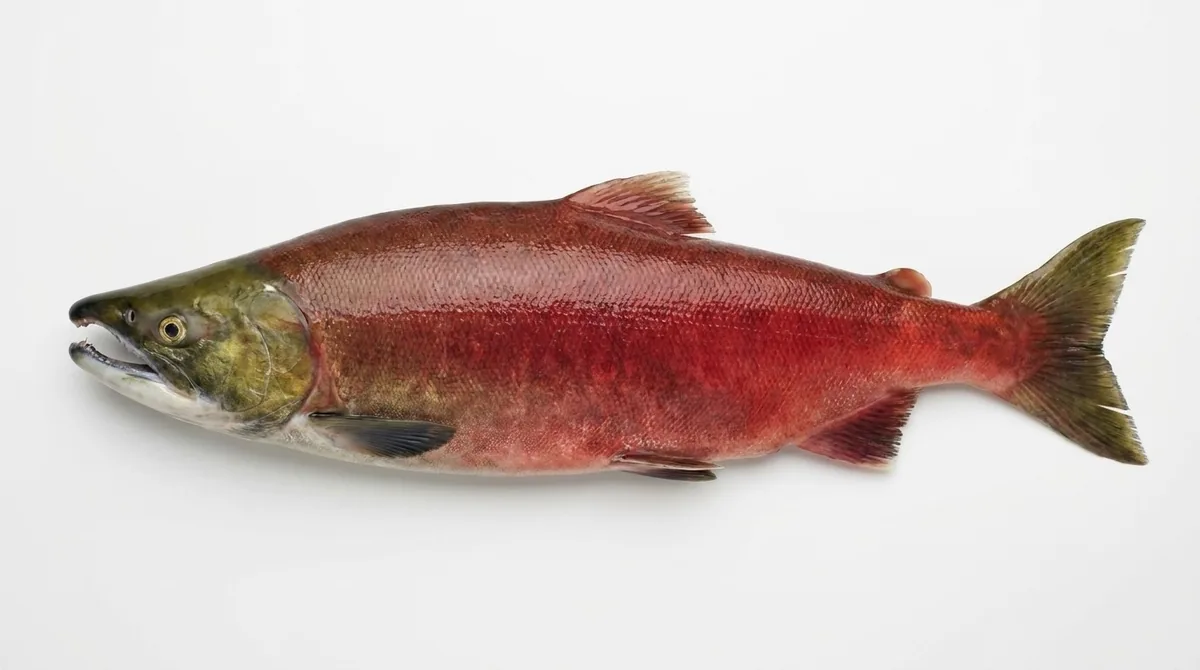
The sockeye salmon (Oncorhynchus nerka), also called red salmon, kokanee salmon, blueback salmon, or simply sockeye, is an anadromous species of salmon found in the Northern Pacific Ocean and rivers discharging into it. This species is a Pacific salmon that is primarily red in hue during spawning. They can grow up to 84 cm (2 ft 9 in) in length and weigh 2.3 to 7 kg (5–15 lb). Juveniles remain in freshwater until they are ready to migrate to the ocean, over distances of up to 1,600 km (1,000 mi). Their diet consists primarily of zooplankton. Sockeye salmon are semelparous, dying after they spawn. Some populations, referred to as kokanee, do not migrate to the ocean and live their entire lives in fresh water.
Distribution
Sockeye salmon range as far south as the Columbia River in the eastern Pacific (although individuals have been spotted as far south as the 10 Mile River on the Mendocino Coast of California) and in northern Hokkaido in Japan in the western Pacific. They range as far north as the Bathurst Inlet in the Canadian Arctic in the east and the Anadyr River in Siberia in the west. The farthest inland sockeye salmon travel is to Redfish Lake, Idaho, over 1,400 km (900 mi) by river from the ocean and 2,000 m (6,500 ft) in elevation. In the United States, populations of sockeye salmon have been extirpated from Idaho and Oregon.
Behaviour
Sockeye salmon use patterns of limnetic feeding behavior, which encompasses vertical movement, schooling, diel feeding chronology, and zooplankton prey selectivity. They can change their position in the water column, timing and length of feeding, school formation, and choice of prey to minimize the likelihood of predation. This also ensures they still get at least the minimum amount of food necessary to survive. All of these behaviors contribute to the survivability, and therefore fitness of the salmon. Depending on location and threat of predation, the levels of aggressive feeding behavior can vary.
Sockeye salmon, unlike other species of Pacific salmon, feed extensively on zooplankton during both freshwater and saltwater life stages. They also tend to feed on small aquatic organisms such as shrimp. Insects and occasionally snails are part of their diets at the juvenile stage.
Description from Wikipedia, available under CC BY-SA.
Where the sockeye salmon lives
Distribution data from GBIF (DOI: 10.15468/dl.8rzs8d).
Also known as
- Kokanee
- Red salmon
- Blueback
- Blueback salmon
- Kokanee salmon
- Salmon rojo
- Kokani
- Saumon rouge
- Saumon sockeye
- Rotlachs
- Indianlax
- Rødlaks
- Rdeči losos
- Nerka (ryba)
- Salmó roig
- Losos nerka
- Nerko
- Punalohi
- Vörös lazac
- Rauðlax
- Raudonoji lašiša
- Rode zalm
- Raudlaks
- Ruopsisluosâ
- Нерка
- Красная
- 홍연어
- ベニザケ
- ベニザケ/ヒメマス
- ヒメマス
- سلمون أحمر
- السلمون الاحمر
- Червена сьомга
- آزادماهی سرخ
- אלתית אדומה
- ნერკა
- لال سالمن
- ปลาแซลมอนซ็อกอาย
- Cá hồi đỏ
- 紅鉤吻鮭
Where to catch sockeye salmon
- Arkansas River at Salida United States River · live river data
- Bristol Bay United States Bay · Alaska
- Cape Fear River United States River · North Carolina
- Columbia River at Astoria United States River · Oregon-Washington
- Green River (Flaming Gorge) United States River · live river data
- Kenai River United States River · Alaska