Fishing Calendar App
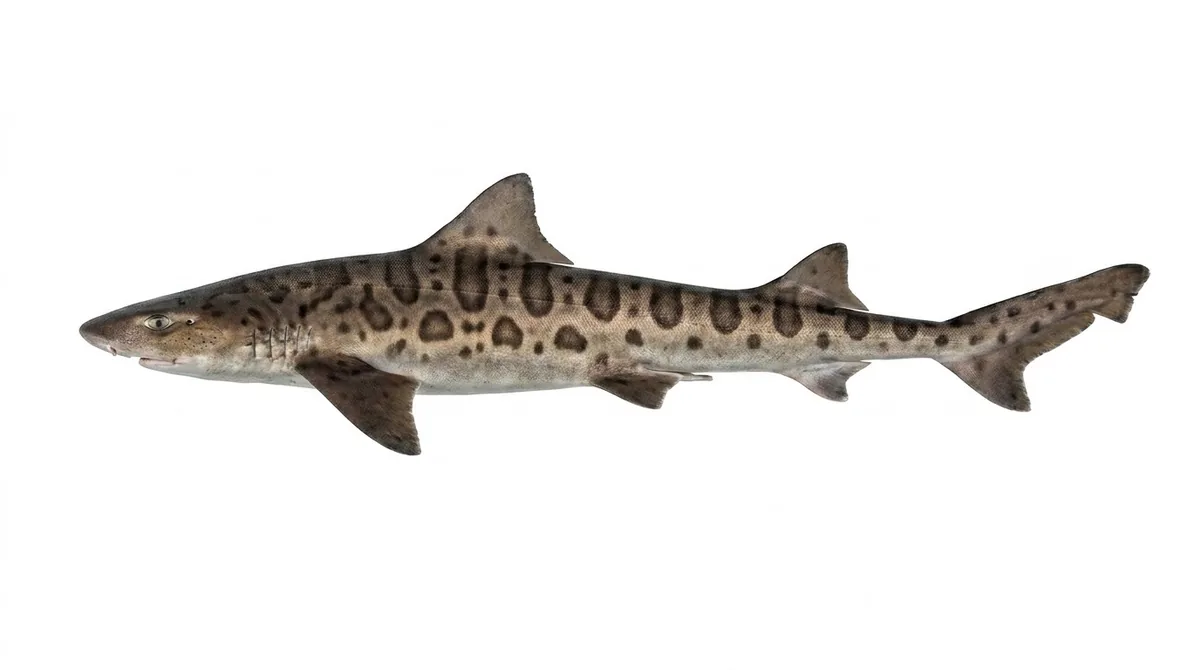
Leopard shark
Triakis semifasciata
- Saltwater
- Least Concern
- Max length
- 210 cm
- Class
- Elasmobranchii
- Order
- Carcharhiniformes
- Family
- Triakidae
- Genus
- Triakis
- Pacific, Eastern Central
- Pacific, Northeast
About the leopard shark
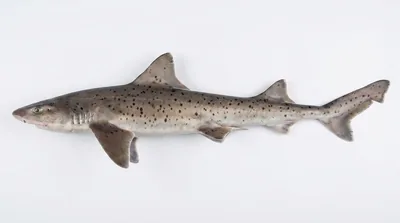
The leopard shark (Triakis semifasciata) is a species of houndshark, in the family Triakidae. It is found along the Pacific coast of North America, from the U.S. state of Oregon to Mazatlán in Mexico. Typically measuring 1.2–1.5 m (3.9–4.9 ft) long, this slender-bodied shark is immediately identifiable by the striking pattern of black saddle-like markings and large spots over its back, from which it derives its common name. Large schools of leopard sharks are a common sight in bays and estuaries, swimming over sandy or muddy flats or rock-strewn areas near kelp beds and reefs. They are most common near the coast, in water less than 4 m (13 ft) deep.
Active-swimming predators, groups of leopard sharks often follow the tide onto intertidal mudflats to forage for food, mainly clams, spoon worms, crabs, shrimp, bony fish, and fish eggs. Most leopard sharks tend to remain within a particular area rather than undertaking long movements elsewhere, which has led to genetic divergence between populations of sharks living in different regions. This species is aplacental viviparous, meaning that the young hatch inside the uterus and are nourished by yolk. From March to June, the female gives birth to as many as 37 young after a gestation period of 10–12 months. It is relatively slow-growing and takes many years to mature.
Harmless to humans, the leopard shark is caught by commercial and recreational fisheries for food and the aquarium trade. This species is mostly fished in the waters off California where, after a period of population decline in the 1980s, new fishing regulations in the early 1990s reduced harvesting to sustainable levels. The International Union for Conservation of Nature has assessed this species as of Least Concern, while noting that local stocks may easily become overfished because of the shark's slow growth and limited migratory habits.
Distribution
The leopard shark occurs in the Northeastern Pacific Ocean, from the temperate continental waters of Coos Bay, Oregon to the tropical waters of Mazatlán, Mexico, including the Gulf of California. It favors muddy or sandy flats within enclosed bays and estuaries, and may also be encountered near kelp beds and rocky reefs, or along the open coast. Numbers have been known to gather near discharges of warm effluent from power plants. Leopard sharks generally swim close to the bottom and are most abundant from the intertidal zone to a depth of 4 m (13 ft), though they may be found as deep as 91 m (299 ft). Many leopard sharks, particularly in the north, leave their coastal habitats in winter and return in early spring. A study in Tomales Bay in northern California determined that they depart when the water temperature drops below 10–12 °C (50–54 °F); one tagged shark was found to have swum some 140 km (87 mi) south.
While a few leopard sharks have been documented traveling hundreds of kilometers, most individuals tend to remain in a localized area for much of their lives. This low level of dispersal has led to genetic divergence across its range. Seven discrete gene pools have been identified along the Californian coast between Humboldt Bay and San Diego. Of these, the Humboldt Bay subpopulation is perhaps the most isolated, with the sharks there maturing at a larger size and producing fewer offspring than those from other areas. By contrast, the area around Los Angeles represents a genetic transitional zone between subpopulations whose boundaries are more diffuse. Off Baja California, the leopard sharks on the Pacific side are probably distinct from those in the northern Gulf of California. Although there is equivocal evidence for natal philopatry (returning to one's birthplace to breed) in this species, proximity to established breeding grounds likely contributes to the structuring of these different subpopulations.
Behaviour
The diet of the leopard shark consists of small benthic and littoral animals, most significantly crabs (Cancridae, Grapsidae, and Hippoidea), shrimp, bony fish (including anchovies, herring, topsmelt, croakers, surfperch, gobies, rockfish, sculpins, flatfish, and midshipmen), fish eggs, clams, and the echiurid fat innkeeper worm (Urechis caupo). This opportunistic hunter has also been known to eat ghost shrimp, polychaete worms, and the young of smoothhounds, shovelnose guitarfish (Rhinobatos productus), and bat rays (Myliobatis californicus). Eelgrass (Zostera) and algae may be swallowed incidentally.
The leopard shark captures prey by expanding its buccal cavity to create a suction force, which is facilitated by its labial cartilages swinging forward to form the mouth into a tube. Simultaneously, the shark protrudes its jaws forward to grip the prey between its teeth. As with other sharks, the teeth of the leopard shark are periodically shed and replaced; it takes 9–12 days for a replacement tooth to move into position. Leopard sharks have been caught with stomachs filled with clam siphons, which the sharks seize before the clams can retract and break off with a levering motion of their bodies. On occasion, the shark tears the entire clam body out of its shell this way. Other sharks examined have had stomachs containing whole innkeeper worms with no bite marks, suggesting that the sharks sucked them out of their burrows. Under a hollow bridge support in San Francisco Bay, a group of leopard sharks and spiny dogfish have been observed feeding on a dense school of anchovies by slowly swimming counterclockwise through the clockwise-swimming school, and swallowing any anchovies that accidentally entered their open mouths. Leopard sharks are also known to use their nose as a shovel in order to reach prey that have burrowed underground.
In some places, this species feeds only on a few prey types and little else (e.g. innkeeper worms and cancrid crabs in Tomales Bay, jack silverside (Atherinopsis californiensis) eggs and the crabs Romaleon antennarium and Metacarcinus magister in Humboldt Bay). The predominant prey taken depends on location, time of year, and age. For example, in the Elkhorn Slough at Monterey Bay, cancrid crabs and innkeeper worms are mostly eaten in winter and spring, fish eggs from winter to early summer, bony fish in summer, and grapsid crabs and clams in fall. Young sharks feed mostly on crabs and transition to clam siphons, fish eggs, and innkeeper worms once they reach 70–80 cm (2.3–2.6 ft) long. The largest sharks are the ones that consume the most fish.
Description from Wikipedia, available under CC BY-SA.
Where the leopard shark lives
Distribution data from GBIF (DOI: 10.15468/dl.8rzs8d).
Also known as
- Leopardenhai
- Leopardhaj
- Leopardhai
- Tiburón leopardo
- Tauró lleopard
- Leopardihai
- Siorc liopaird
- Leopárdcápa
- Hiu macan tutul
- Luipaardhaai
- Pars köpek balığı
- Калифорнийская тройнозубая акула
- カリフォルニアドチザメ
- Леопардова акула
- Καρχαρίας λεοπάρδαλη
- כרישון נמרי
- ლეოპარდისებრი ზვიგენი
- Леопард ајкула
- திருவாளியன் சுறா
- Леопардова акула звичайна
- قرش الفهد
Where to catch leopard shark
- Bristol Bay United States Bay · Alaska
- Columbia River at Astoria United States River · Oregon-Washington
- Monterey Bay United States Bay · California
- Puget Sound at Seattle United States Sound · Washington
- San Diego Bay United States Bay · California
- San Francisco Bay United States Bay · California