Fishing Calendar App
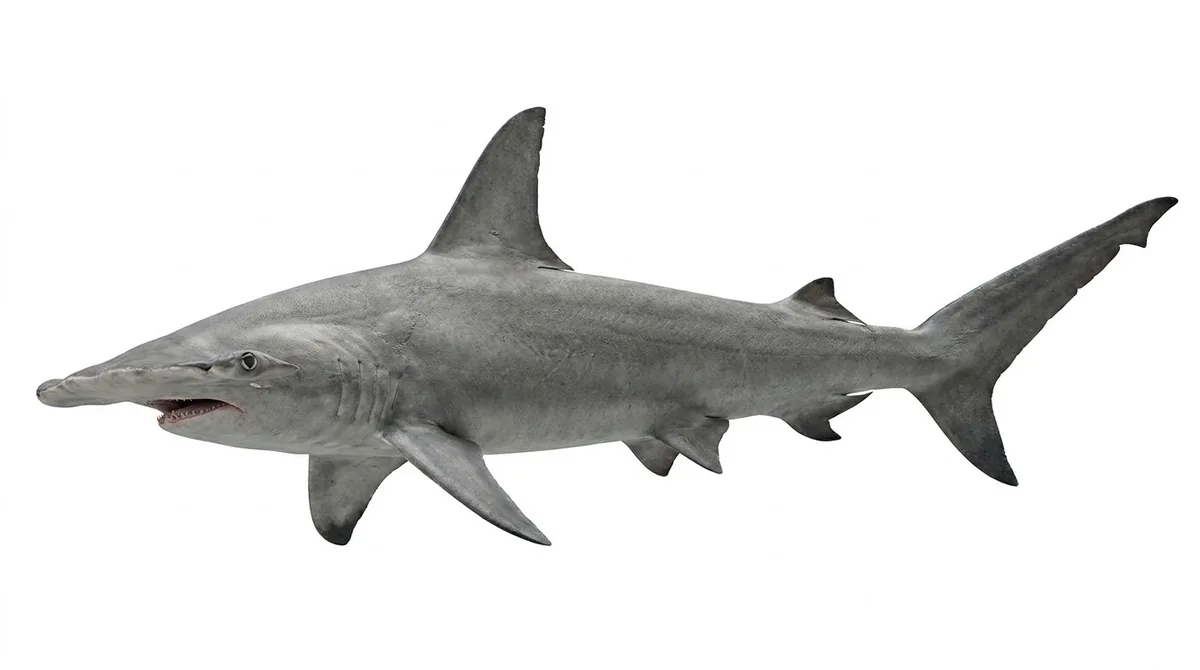
Great hammerhead
Sphyrna mokarran
- Saltwater
- Critically Endangered
- Max length
- 610 cm
- Class
- Elasmobranchii
- Order
- Carcharhiniformes
- Family
- Sphyrnidae
- Genus
- Sphyrna
- Atlantic, Northeast
- Atlantic, Western Central
- Indian Ocean, Western
- Pacific, Western Central
About the great hammerhead
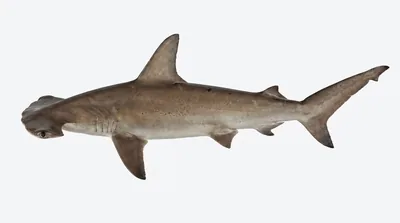
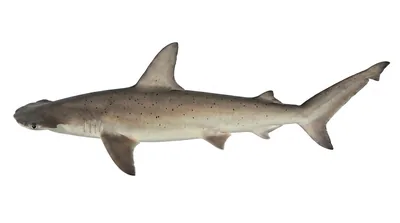
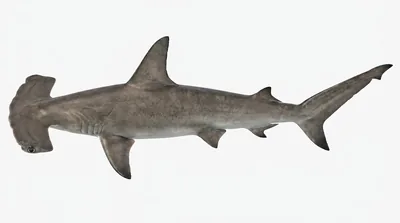
The great hammerhead (Sphyrna mokarran) is the largest species of hammerhead shark, belonging to the family Sphyrnidae, attaining an average length of 4.6 m (15 ft) and reaching a maximum length of 6.2 m (20 ft). It is found in tropical and warm temperate waters worldwide, inhabiting coastal areas and the continental shelf. The great hammerhead can be distinguished from other hammerheads by the shape of its "hammer" (called the "cephalofoil"), which is wide with an almost straight front margin, its tall, sickle-shaped first dorsal fin, and its strongly falcated pelvic fins. A solitary, strong-swimming apex predator, the great hammerhead feeds on a wide variety of prey ranging from crustaceans and cephalopods, to bony fish, to smaller sharks. Observations of this species in the wild suggest that the cephalofoil functions to immobilize stingrays, a favored prey. This species has a viviparous mode of reproduction, bearing litters of up to 50 pups every two years.
Although potentially dangerous, the great hammerhead rarely attacks humans and can sometimes behave inquisitively toward divers. This shark is heavily fished for its large fins, which are valuable on the Chinese market as the main ingredient of shark fin soup. As a result, great hammerhead populations are declining substantially worldwide, and it has been assessed as critically endangered by the International Union for Conservation of Nature (IUCN) as of 2019.
Distribution
The great hammerhead inhabits tropical waters around the world, between the latitudes of 40°N and 37°S. In the Atlantic Ocean, it is found from North Carolina to Uruguay, including the Gulf of Mexico and the Caribbean Sea, and from Morocco to Senegal, and the Mediterranean Sea. It is found all along the rim of the Indian Ocean, and in the Pacific Ocean from the Ryukyu Islands to Australia, New Caledonia, and French Polynesia, and from southern Baja California to Peru. It may occur off Gambia, Guinea, Mauritania, Sierra Leone, Western Sahara, and occasionally seen near Hawaii but this has not been confirmed. Great hammerheads may be found from inshore waters less than 1 m (3.3 ft) deep, to a depth of 80 m (260 ft) offshore. They favor coral reefs, but also inhabit continental shelves, island terraces, lagoons, and deep water near land. They are migratory; populations off Florida and in the South China Sea have been documented moving closer to the poles in the summer.
Behaviour
The great hammerhead shark is an active predator with a varied diet. Known prey of the great hammerhead include invertebrates such as crabs, lobsters, squid, and octopus; bony fishes such as tarpon, sardines, sea catfishes, toadfish, porgies, grunts, jacks, croakers, groupers, flatfishes, boxfishes, and porcupine fishes; and smaller sharks such as smoothhounds. At Rangiroa Atoll, great hammerheads prey opportunistically on grey reef sharks (Carcharhinus amblyrhynchos) that have exhausted themselves pursuing mates. The species is known to be cannibalistic. In the Gatun Formation of Panama, fossil teeth belonging to great hammerheads suggest the shark once preyed on juvenile Otodus megalodon, alongside the extinct snaggletooth shark Hemipristis serra, with which it was once contemporary.
Great hammerheads are apex predators among sharks, and are specialists at feeding on other sharks, rays, and skates, especially stingrays. The venomous spines of stingrays are frequently found lodged inside its mouth and do not seem to bother the shark, as one specimen caught off Florida had 96 spines in and around its mouth. Great hammerheads primarily hunt at dawn or dusk, swinging their heads in broad angles over the sea floor so as to pick up the electrical signatures of stingrays buried in the sand, via numerous electroreceptory organs located on the underside of the cephalofoil. The cephalofoil also serves as a hydrofoil that allows the shark to quickly turn around and strike at a ray once detected. Off Florida, large hammerheads are often the first to reach newly baited sharklines, suggesting a particularly keen sense of smell.
Another function of the cephalofoil is suggested by an observation of a great hammerhead attacking a southern stingray (Dasyatis americana) in the Bahamas; the shark first knocked the ray to the sea bottom with a powerful blow from above, and then pinned it with its head while pivoting to take a large bite from each side of the ray's pectoral fin disc. This effectively crippled the stingray, which was then picked up in the jaws and sawed apart with rapid shakes of the head. A great hammerhead has also been seen attacking a spotted eagle ray (Aetobatus narinari) in open water by taking a massive bite out of one of its pectoral fins. The ray thus incapacitated, the shark once again used its head to pin it to the bottom and pivoted to take the ray in its jaws head-first. These observations suggest that the great hammerhead seeks to disable rays with the first bite, a strategy similar to that of the great white shark (Carcharodon carcharias), and that its cephalofoil is an adaptation for prey handling. Adult great hammerheads have been observed hunting in coral reef flats as shallow as ~0.7 m (2.3 ft).
Description from Wikipedia, available under CC BY-SA.
Where the great hammerhead lives
Distribution data from GBIF (DOI: 10.15468/dl.8rzs8d).
Also known as
- Great hammerhead shark
- Cornuda gigante
- Tiburón martillo gigante
- Grand requin-marteau
- Großer Hammerhai
- Głowomłot olbrzymi
- Stor hammarhaj
- Tubarão-martelo-panã
- Cambeva
- Hammerhai
- Velika kladvenica
- Groothamerkophaai
- Rinkin penn-mailh bras
- Peix martell gegant
- Kladivoun velký
- Isovasarahai
- Nagy pörölycápa
- Hiu martil besar
- Grote hamerhaai
- Tribon cabes di martiu
- Büyük çekiç başlı köpekbalığı
- Гигантская акула-молот
- Акула-молот гигантская
- 큰귀상어
- ヒラシュモクザメ
- قرش أبو مطرقة العظيم
- قرش ابو مطرقة العظيم
- Гигантска акула чук
- Μεγαλοζύγαινα
- פטישן פגום-חרטום
- Հսկա մուրճագլուխ շնաձուկ
- Алып балға акула
- വമ്പൻ ചുറ്റികത്തലയൻ സ്രാവ്
- وڈی تھؤڑاسر شارک
- ปลาฉลามหัวค้อนใหญ่
- Акула-молот велика
- 无沟双髻鲨
Where to catch great hammerhead
- Limfjord Denmark Fjord · North Jutland
- Skagen Coast Denmark Coast · North Jutland
- Helsinki Archipelago Finland Archipelago · Uusimaa
- Rügen (Baltic Coast) Germany Coast · Mecklenburg-Vorpommern
- Sylt (Wadden Sea) Germany Coast · Schleswig-Holstein
- Dingle Bay Ireland Bay · Munster