Fishing Calendar App
Mahi-mahi
Coryphaena hippurus
- Saltwater
- Least Concern
- Max length
- 210 cm
- Class
- Teleostei
- Order
- Carangiformes
- Family
- Coryphaenidae
- Genus
- Coryphaena
- Atlantic, Northwest
- Atlantic, Western Central
- Indian Ocean, Eastern
- Indian Ocean, Western
- Mediterranean and Black Sea
- Pacific, Eastern Central
- Pacific, Northwest
- Pacific, Southeast
- Pacific, Southwest
- Pacific, Western Central
About the mahi-mahi
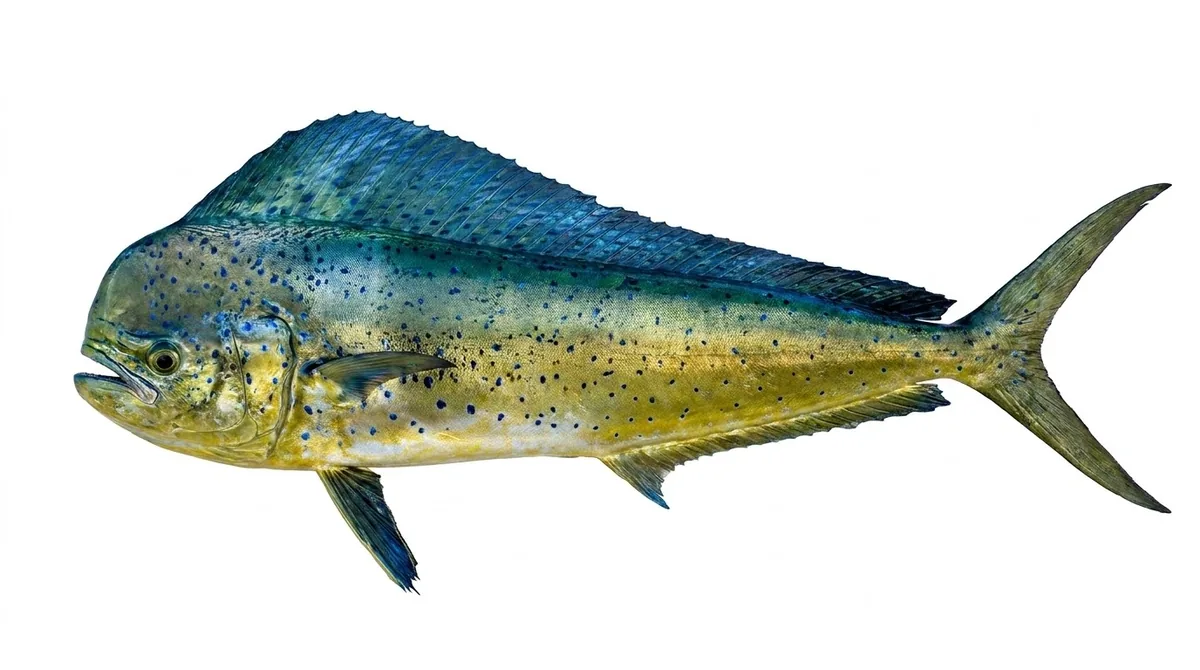
The mahi-mahi ( MAH-hee-MAH-hee), common dolphinfish, dolphin or dorado (Coryphaena hippurus) is a surface-dwelling ray-finned fish found in off-shore temperate, tropical, and subtropical waters worldwide. It is also widely called dorado (not to be confused with Salminus brasiliensis, a freshwater fish) and dolphin (not to be confused with the aquatic mammal dolphin). It is one of two members of the family Coryphaenidae, the other being the pompano dolphinfish. These fish are most commonly found in the waters around the Gulf of Mexico, Costa Rica, Hawaii, and the Indian Ocean. In Italy it is called corifena, lampuga or pesce capone, and has even given its name to the caponata though eggplant has now taken the place of the fish.
Habitat
Depending on how it is caught, mahi-mahi is classed differently by various sustainability rating systems: The Monterey Bay Aquarium classifies mahi-mahi, when caught in the US Atlantic, as a best choice, the top of its three environmental-impact categories. The aquarium advises to avoid imported mahi-mahi harvested by long line, but rates troll and pole-and-line caught as a good alternative.
The Natural Resources Defense Council classifies mahi-mahi as a "moderate mercury" fish (its second-lowest of four categories), and suggests eating six servings or fewer per month.
The mahi-mahi is also a common vector for ciguatera poisoning. Although a very popular food dish in many parts of the world, there have been reports of ciguatera poisoning from human consumption of this fish. Ciguatera poisoning is caused by the accumulation of toxins (ciguatoxins and maitotoxin) in the flesh of the fish over time. These are produced by Gambierdiscus toxicus which grows together with marine algae, which causes fish like the mahi-mahi to consume them by accident.
Mahi-mahi naturally have high levels of histidine, which is converted to histamine when bacterial growth occurs during improper storage or processing. Subsequent cooking, smoking, or freezing does not eliminate the histamine. This leads to a foodborne illness known as scombroid food poisoning, which also affect other fish such as tuna, mackerel, sardine, anchovy, herring, bluefish, amberjack and marlin. Symptoms are those of histamine intolerance and may include flushed skin, headache, itchiness, blurred vision, abdominal cramps, and diarrhea, and the onset of symptoms is typically 10 to 60 minutes after eating and can last for up to two days. Rarely, breathing problems (like that of allergic asthma) or an irregular heartbeat may occur. Diagnosis is typically based on the symptoms and may be supported by a normal blood tryptase.
Behaviour
Mahi-mahi are carnivorous, feeding on flying fish, crabs, squid, mackerel, and other forage fish. They have also been known to eat zooplankton. To pursue such varied pelagic prey, mahi-mahi are fast swimmers, swimming as fast as 50 knots (92.6 km/h; 57.5 mph).
Description from Wikipedia, available under CC BY-SA.
Where the mahi-mahi lives
Distribution data from GBIF (DOI: 10.15468/dl.8rzs8d).
Also known as
- Common dolphinfish
- Dolphin
- Dolphinfish
- Coryphène commune
- Gemeine Goldmakrele
- Grosse Goldmakrele
- Guldmakrill
- Corifena
- Lampuga
- Dorado
- Dorado commún
- Koryfena
- Dourado
- Dalfinho
- Delfim
- Gullmakrell
- Delfinka
- Parang
- Dorade
- Llampuga
- Zlak nachový
- Dolfiini
- Dorád
- Ikan Lemadang
- Belitung lumba
- Goudmakreel
- Lampuca
- pazik
- 만새기
- Большая корифена
- Дорадо
- シイラ
- ماهي ماهي
- ماهى ماهى
- Обикновена делфинова риба
- ފިޔަލަ
- Tɔƒlesi
- Κυνηγός
- گالیت
- רעמתן כחלחל
- माही-माही
- ოქროსფერი მაკრელი
- പുള്ളിമോത
- அயிலை
- ปลาอีโต้มอญ
- امروز
- Cá nục heo cờ
- 鲯鳅
Where to catch mahi-mahi
- Dubrovnik Coast Croatia Coast · Dubrovnik-Neretva
- Istria Coast Croatia Coast · Istria
- Kornati Archipelago Croatia Archipelago · Šibenik-Knin
- Kvarner Gulf Croatia Gulf · Kvarner
- Neretva Delta Croatia Delta · live river data
- Pag Channel Croatia Channel · Zadar