Fishing Calendar App
Blacktip reef shark
Carcharhinus melanopterus
- Saltwater
- Vulnerable
- Max length
- 180 cm
- Class
- Elasmobranchii
- Order
- Carcharhiniformes
- Family
- Carcharhinidae
- Genus
- Carcharhinus
- Atlantic, Northeast
- Indian Ocean, Eastern
- Indian Ocean, Western
- Pacific, Eastern Central
- Pacific, Western Central
About the blacktip reef shark
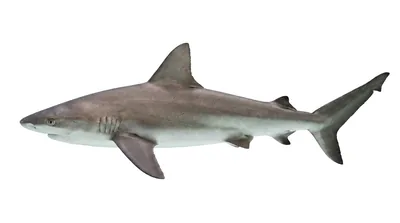
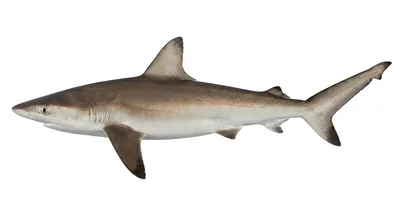
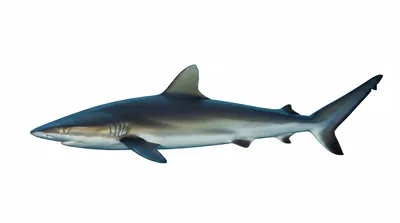
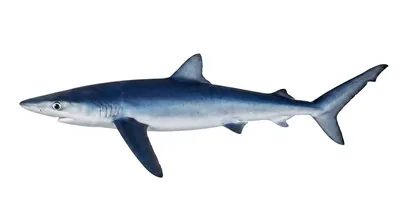
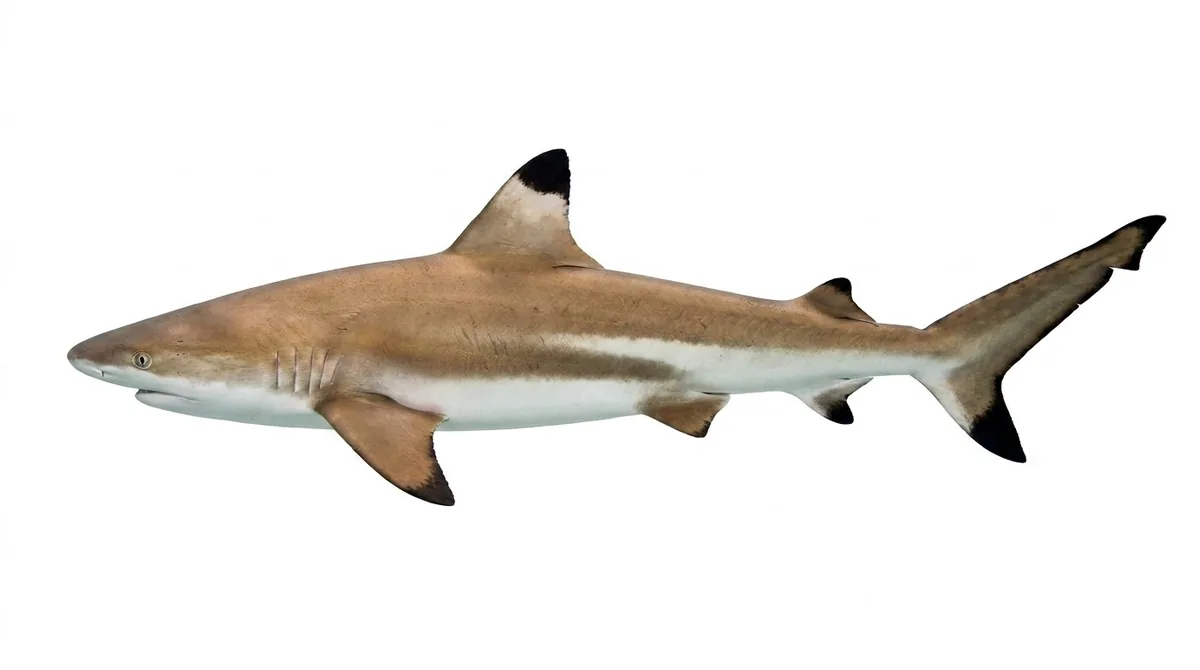
The blacktip reef shark (Carcharhinus melanopterus) is a species of requiem shark, in the family Carcharhinidae, which can be easily identified by the prominent black tips on its fins (especially on the first dorsal fin and its caudal fin). Among the most abundant sharks inhabiting the tropical coral reefs of the Indian and Pacific Oceans, this species prefers shallow, inshore waters. Its exposed first dorsal fin is a common sight in the region. The blacktip reef shark is usually found over reef ledges and sandy flats, though it has also been known to enter brackish and freshwater environments. It typically attains a length of 1.6 m (5.2 ft). Like other sharks, the females are larger than the males.
The blacktip reef shark has extremely small home ranges and exhibits strong site fidelity, remaining within the same local area for up to several years at a time. It is an active predator of small bony fish, cephalopods, and crustaceans, and has also been known to feed on sea snakes and seabirds. Accounts of the blacktip reef shark's life history have been variable and sometimes contradictory, in part reflecting geographical differences within the species. Like other members of its family, this shark is viviparous, with females giving birth to two to five young on a biennial, annual, or possibly biannual cycle. Reports of the gestation period range from 7–9, through 10–11, to possibly 16 months. Mating is preceded by the male following closely behind the female, likely attracted by her chemical signals. Newborn sharks are found further inshore and in shallower water than adults, frequently roaming in large groups over areas flooded by high tide.
Timid and skittish, the blacktip reef shark is difficult to approach and seldom poses a danger to humans unless roused by food. However, people wading through shallow water are at risk of having their legs mistakenly bitten. This shark is used for its meat, fins, and liver oil, but is not considered to be a commercially significant species. The International Union for Conservation of Nature has assessed the blacktip reef shark as Vulnerable. Although the species as a whole remains widespread and relatively common, overfishing of this slow-reproducing shark has led to its decline at a number of locales.
Distribution
The blacktip reef shark is found throughout nearshore waters of the tropical and subtropical Indo-Pacific. In the Indian Ocean, it occurs from South Africa to the Red Sea, including Madagascar, Mauritius, and the Seychelles, and from there eastward along the coast of the Indian subcontinent to Southeast Asia, including Sri Lanka, the Andaman Islands, and the Maldives. In the Pacific Ocean, it is found from southern China and the Philippines to Indonesia, northern Australia and New Caledonia, and also inhabits numerous oceanic islands, including the Marshall, Gilbert, Society, and Hawaiian Islands and Tuamotu. Contrary to what most sources state, there is a report suggesting that the specimens of this species from Japanese waters might be from Taiwan, however a number of sightings and captures of this species have been reported from the inshore waters of Ishigaki Island of Okinawa Prefecture in southern Japan. A Lessepsian migrant, this shark has colonized the eastern Mediterranean Sea by way of the Suez Canal.
Although it has been reported from a depth of 75 m (246 ft), the blacktip reef shark is usually found in water only a few meters deep, and can often be seen swimming close to shore with its dorsal fin exposed. Younger sharks prefer shallow, sandy flats, while older sharks are most common around reef ledges and can also be found near reef drop-offs. This species has also been reported from brackish estuaries and lakes in Madagascar, and freshwater environments in Malaysia, though it is not able to tolerate low salinity to the same degree as the bull shark (C. leucas). At Aldabra in the Indian Ocean, blacktip reef sharks congregate in the channels between reef flats during low tide and travel to the mangroves when the water rises. There is equivocal evidence that sharks from the northern and southern extremes of its distribution are migratory.
Behaviour
As often the most abundant apex predator within its ecosystem, the blacktip reef shark plays a major role in structuring inshore ecological communities. Its diet is composed primarily of small teleost fishes, including mullet, groupers, grunters, jacks, mojarras, wrasses, surgeonfish, and smelt-whitings. Groups of blacktip reef sharks in the Indian Ocean have been observed herding schools of mullet against the shore for easier feeding. Squid, octopus, cuttlefish, shrimp, and mantis shrimp are also taken, as well as carrion and smaller sharks and rays, though this is rare. Off northern Australia, this species is known to consume sea snakes, including Acrochordus granulatus, Hydrelaps darwiniensis, Hydrophis spp. and Lapemis hardwickii. Sharks off Palmyra Atoll have been documented preying on seabird chicks that have fallen out of their nests into the water. Miscellaneous items that have been found inside the stomachs of this species include algae, turtle grass, coral, hydrozoa, bryozoa, rats, and stones.
Researchers working at Enewetak Atoll in the Marshall Islands have found the blacktip reef shark can be readily attracted by splashing or striking metal tools against hard objects underwater, as well as by the scent of both healthy and injured fish. As with most sharks, the blacktip reef shark does not have any cone cells in its retina, limiting its ability to discriminate colors and fine details. Instead, its vision is adapted for sensitivity to movement or contrast under low light conditions, which is further enhanced by the presence of a reflective tapetum lucidum. Experiments have shown that this shark is capable of detecting small objects up to 1.5–3 m (5–10 ft) away, but is unable to clearly discern the shape of the object. Electroreception is another means by which this shark can locate prey; its ampullae of Lorenzini have a sensitivity of approximately 4 nV/cm and an effective range of 25 cm (10 in). Similar to the grey reef shark, this species becomes more excited and "confident" in the presence of other individuals of its species, and in extreme situations can be roused into a feeding frenzy. Feeding activity may be greater at night than during the day.
Description from Wikipedia, available under CC BY-SA.
Where the blacktip reef shark lives
Distribution data from GBIF (DOI: 10.15468/dl.8rzs8d).
Also known as
- Requin à pointes noires
- Schwarzspitzen-Riffhai
- Mindre svartfenad revhaj
- Tubarão-de-pontas-negras-do-recife
- Črnoplavuti morski pes
- Swartvin-rifhaai
- Kakia képés selem
- Tauró de puntes negres dels esculls
- Žralok černoploutvý
- Sorttippet revhaj
- Mustuim-hallhai
- Punta beltzeko arrezife marrazo
- Mustaevähai
- Pilo Nustem
- Crnovrhi grebenski morski pas
- Feketeúszójú szirticápa
- Hiu mada
- Hiu sirip ireng
- Zwartpuntrifhaai
- Žralok čiernohrotý
- Siyah uçlu resif köpek balığı
- Pating
- Мальгашская ночная акула
- 흑기흉상어
- ツマグロ
- قرش الشعاب أسود الطرف
- قرش الشعاب اسود الطرف
- কালোডগা প্রবালপ্রাচীর হাঙর
- އުރަހަކަޅު މިޔަރު
- کوسه باله سیاه آبسنگی
- כריש שחור-סנפירים
- Қара жүзбеқанатты риф акуласы
- കറുത്ത ചിറകൻ സ്രാവ്
- Црноврха гребенска ајкула
- ปลาฉลามครีบดำ
- Рифова акула чорнопера
- Cá mập vây đen
- 烏翅真鯊
Where to catch blacktip reef shark
- Limfjord Denmark Fjord · North Jutland
- Skagen Coast Denmark Coast · North Jutland
- Helsinki Archipelago Finland Archipelago · Uusimaa
- Rügen (Baltic Coast) Germany Coast · Mecklenburg-Vorpommern
- Sylt (Wadden Sea) Germany Coast · Schleswig-Holstein
- Dingle Bay Ireland Bay · Munster