Fishing Calendar App
Sand tiger shark
Carcharias taurus
- Saltwater
- Critically Endangered
- Max length
- 320 cm
- Class
- Elasmobranchii
- Order
- Lamniformes
- Family
- Odontaspididae
- Genus
- Carcharias
- Atlantic, Northwest
- Atlantic, Southeast
- Atlantic, Western Central
- Indian Ocean, Eastern
- Indian Ocean, Western
- Pacific, Southwest
- Pacific, Western Central
About the sand tiger shark
The sand tiger shark (Carcharias taurus), spotted ragged-tooth shark (in South Africa), or blue-nurse sand tiger, is a species of shark that inhabits subtropical and temperate waters worldwide. It inhabits the continental shelf, from sandy shorelines (hence the name sand tiger shark) and submerged reefs to a depth of around 191 m (627 ft). They dwell in the waters of Japan, Australia, South Africa, and the east coasts of North and South America. The sand tiger shark also inhabited the Mediterranean; however, it was last seen there in 2003 and is presumed extirpated. Despite its common names, it is not closely related to either the tiger shark (Galeocerdo cuvier) or the nurse shark (Ginglymostoma cirratum).
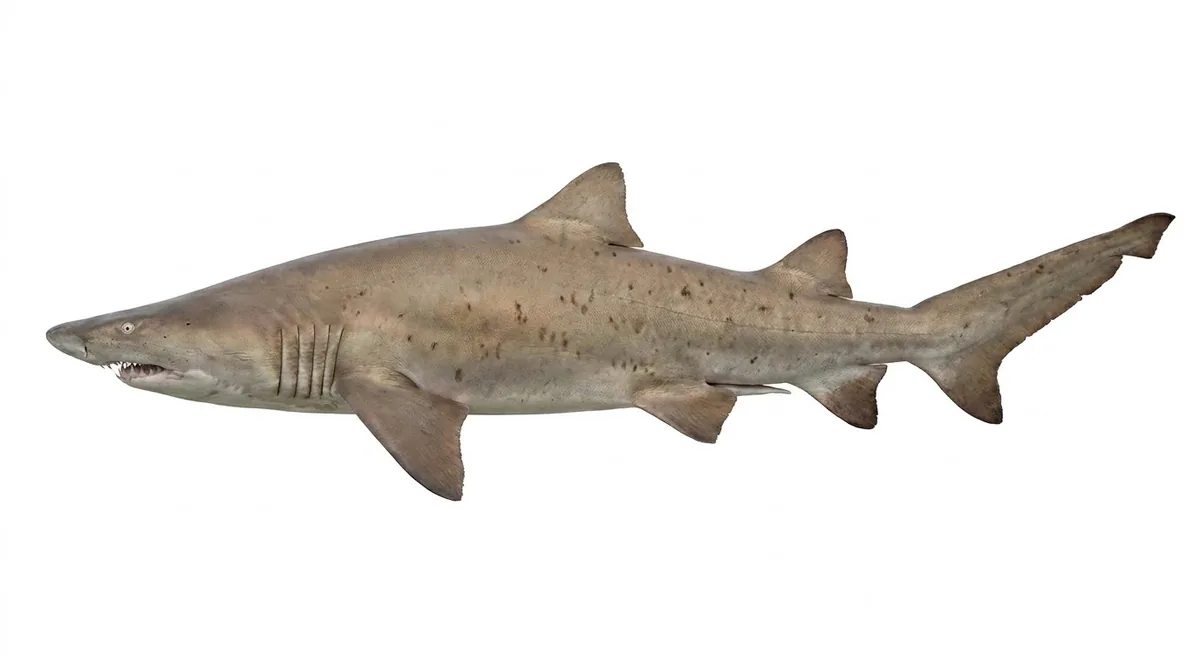
Despite its fearsome appearance and strong swimming ability, it is a relatively placid and slow-moving shark with no confirmed human fatalities. This species has a sharp, pointy head, and a bulky body. The sand tiger's length can reach 3.2 m (10.5 ft) but is normally 2.2–2.5 m in length. They are grey with reddish-brown spots on their backs. Shivers (groups) have been observed to hunt large schools of fish. Their diet consists of bony fish, crustaceans, squid, skates and other sharks. Unlike other sharks, the sand tiger can gulp air from the surface, allowing it to be suspended in the water column with minimal effort. During pregnancy, the most developed embryo will feed on its siblings, a reproductive strategy known as intrauterine cannibalism i.e. "embryophagy" or, more colorfully, adelphophagy—literally "eating one's brother". The sand tiger is categorized as critically endangered on the International Union for Conservation of Nature Red List. It is the most widely kept large shark in public aquariums owing to its tolerance for captivity.
Distribution
Sand tiger sharks roam the epipelagic and mesopelagic regions of the ocean, sandy coastal waters, estuaries, shallow bays, and rocky or tropical reefs, at depths of up to 190 m (623 ft).
The sand tiger shark can be found in the Atlantic, Pacific and Indian Oceans, and in the Adriatic Seas. In the Western Atlantic Ocean, it is found in coastal waters around from the Gulf of Maine to Florida, in the northern Gulf of Mexico, around the Bahamas and Bermuda, and from southern Brazil to northern Argentina. It is also found in the eastern Atlantic Ocean from the Mediterranean Sea to the Canary Islands, at the Cape Verde islands, along the coasts of Senegal and Ghana, and from southern Nigeria to Cameroon. In the western Indian Ocean, the shark ranges from South Africa to southern Mozambique, but excluding Madagascar. The sand tiger shark has also been sighted in the Red Sea and may be found as far east as India. In the western Pacific, it has been sighted in the waters around the coasts of Japan and Australia, but not around New Zealand.
Behaviour
The majority of prey items of sand tigers are demersal (i.e. from the sea bottom), suggesting that they hunt extensively on the sea bottom as far out as the continental shelf. Their diet consists mainly of teleosts and other elasmobranchs. Bony fish (teleosts) form about 60% of sand tigers' food, the remaining prey being sharks, skates, other rays, lobsters, crabs and squid. In Argentina, the prey includes mostly demersal fishes, e.g. the striped weakfish (Cynoscion guatucupa) and whitemouth croaker (Micropogonias furnieri). The most important elasmobranch prey is the bottom-living narrownose smooth-hound shark (Mustelus schmitti.). Benthic (i.e. free-swimming) rays and skates are also taken, including fanskates, eagle rays and the angular angel shark, with larger individuals feeding on a higher number of benthic elasmobranchs than smaller individuals. Stomach content analysis indicates that smaller sand tigers mainly focus on the sea bottom and as they grow larger they start to take more pelagic prey. This perspective of the diet of sand tigers is consistent with similar observations in the north west Atlantic and in South Africa where large sand tigers capture a wider range of shark and skate species as prey, from the surf zone to the continental shelf, indicating the opportunistic nature of sand tiger feeding. Off South Africa, sand tigers less than 2 m (6.6 ft) in length prey on fish about a quarter of their own length; however, large sand tigers capture prey up to about half of their own length. The prey items are usually swallowed as three or four chunks.
Description from Wikipedia, available under CC BY-SA.
Where the sand tiger shark lives
Distribution data from GBIF (DOI: 10.15468/dl.8rzs8d).
Also known as
- Blue nurse shark
- Brown shark
- Grey nurse
- Grey nurse shark
- Grey shark
- Raggedtooth shark
- Carcharia tauro
- Odontaspe tauro
- Pisci cani
- Triglochide tauro
- Pez toro
- Sarda
- Tiburón
- Tiburón arenero tigre
- Tiburón de leznas
- Tiburón toro
- Toro bacota
- Escalandrún
- Tiburón sarda
- Lamio
- Odontaspide taureau
- Requin sable tachete
- Requin taureau
- Verdoun
- Sandtigerhai
- Sandtiger
- Grauer Sandhai
- Sandhai
- Schnauzenhai
- Tawrosz piaskowy
- Sandtigerhaj
- Tubarão-mangona
- Skeurtandhaai
- Kakia macan pasir
- Solraig clapejat
- Žralok písečný
- Zezen-marrazo
- Hietahai
- Homoki tigriscápa
- Hiu harimau pasir
- Zandtijgerhaai
- Žralok býčí
- Kaplan kum köpek balığı
- Owston’s sand shark
- Обыкновенная песчаная акула
- 모래뱀상어
- シロワニ
- قرش الرمل الببري
- قرش الرمل الببرى
- Обикновена сива акула
- Καρχαρίας ταύρος
- כריש-שן שורי
- Ավազային շնաձուկ
- Жолбарыс тәрізді құм акуласы
- Змијозаба ајкула
- ریت چیتا شارک
- Піщана акула тигрова
- 沙虎鯊
Where to catch sand tiger shark
- Cape Cod Bay United States Bay · Massachusetts
- Cape Fear River United States River · North Carolina
- Chesapeake Bay United States Estuary · Maryland and Virginia
- Delaware Bay United States Bay · Delaware-New Jersey
- Florida Bay (Everglades) United States Bay · Florida
- Florida Keys United States Coast · Florida