Fishing Calendar App
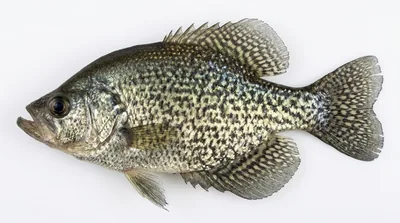
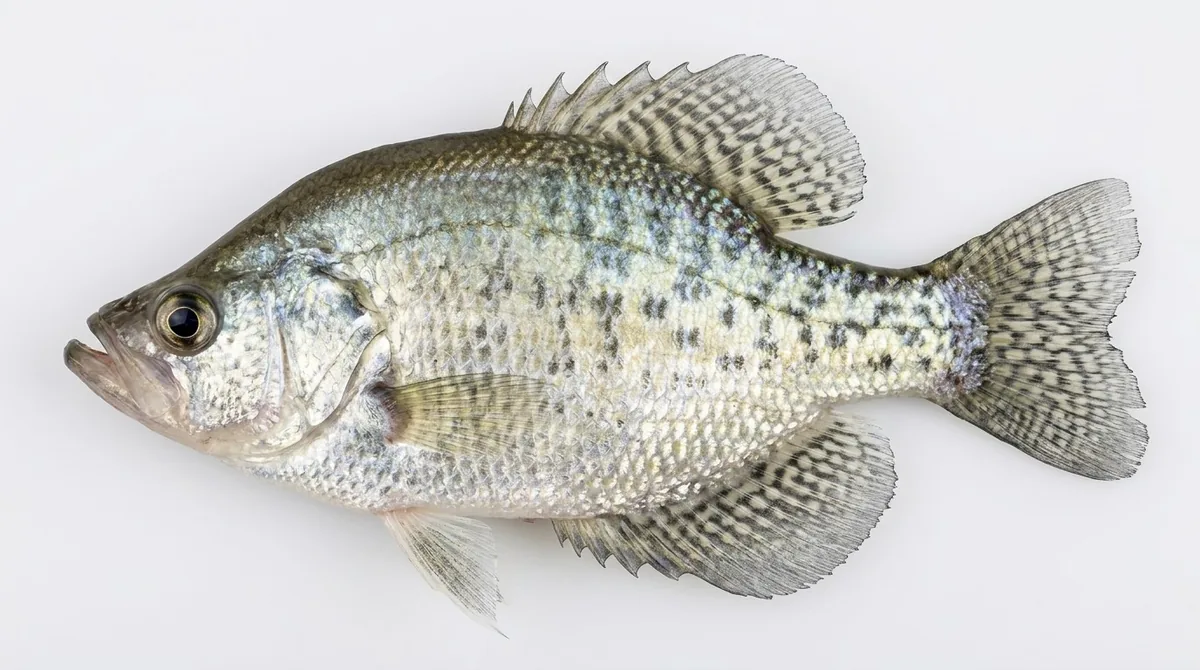
White crappie
Pomoxis annularis
- Freshwater
- Least Concern
- Max length
- 25 cm
- Class
- Teleostei
- Order
- Centrarchiformes
- Family
- Centrarchidae
- Genus
- Pomoxis
- North America - Inland waters
- Asia - Inland waters
About the white crappie
The white crappie (Pomoxis annularis) is a freshwater fish found in North America, one of the two species of crappies. Alternate common names for the species include goldring, silver perch, white perch and sac-a-lait. USS Goldring is named for the fish. The genus name Pomoxis refers to crappies' sharp operculum, while the species name annularis means 'having rings', i.e., it has vaguely vertical bars on the body.
Habitat
White crappies can be found in large rivers, reservoirs, and lakes. White crappies are more tolerant of turbid (murky) waters than black crappies, and the white crappie usually outnumbers the black crappie in turbid waters. White crappies also generally outnumber black crappies in areas with little rooted aquatic vegetation. White crappies are most commonly found in rivers and low-velocity areas such as pools and backwaters of rivers. They are most abundant in lakes and reservoirs larger than 5 acres. The white crappie can be found in the open water during the mornings and evenings, but during the day this species is found in shallower, quiet waters (6–12 feet (1.8–3.7 m) deep) surrounded by structure.
Distribution
White crappies are native to the Great Lakes, Hudson Bay, and the Mississippi River basins expanding from New York and southern Ontario westward to South Dakota and southward to Texas. This species has a large geographic range in the United States and currently has a stable population. Currently, this species is listed as a least concern species for conservation efforts.
Behaviour
White crappies are neither cruise- nor ambush-feeding strategists. Instead, they swim intermittently and only search for prey when stationary. This strategy is considered saltatory, or pause-and-travel search. Using this strategy, juveniles can grow rapidly in the first few days of life. This strategy is energetically favored to reduce search time for the species. White crappies in the larval and juvenile stages of life eat zooplankton and continue to feed primarily on small invertebrates during their first year of life.
When white crappies reach a length of 12–15 centimetres (4.7–5.9 in), they are considered adult. The adults feed mainly on small fish such as minnows and young American shad, and large invertebrates such as crayfish and hellgrammites. Their diet can vary depending on their location. They feed the most in June through October. In the spring, they feed moderately, with their activity slowing during the winter months. In Mississippi, they feed on mayflies such as Hexagenia atrocaudata and Pentagenia vittigera. In Illinois, and probably elsewhere, they feast on American gizzard shad. In Pennsylvania and Ohio, adults eat small common carp, yellow perch, bluegill, and other white crappies. The terminal mouth position, sometimes known as the normal position, allows for this species to feed on what is in front of it.
Description from Wikipedia, available under CC BY-SA.
Where the white crappie lives
Distribution data from GBIF (DOI: 10.15468/dl.8rzs8d).
Also known as
- Hopea-aurinkoahven
- دهانکاغذی سفید
- Краппи
- 白刺蓋太陽魚
Where to catch white crappie
- Arkansas River at Salida United States River · live river data
- Cape Fear River United States River · North Carolina
- Green River (Flaming Gorge) United States River · live river data
- Kenai River United States River · Alaska
- Kentucky Lake United States Reservoir · Kentucky-Tennessee
- Lake Champlain United States Lake · live river data