Fishing Calendar App
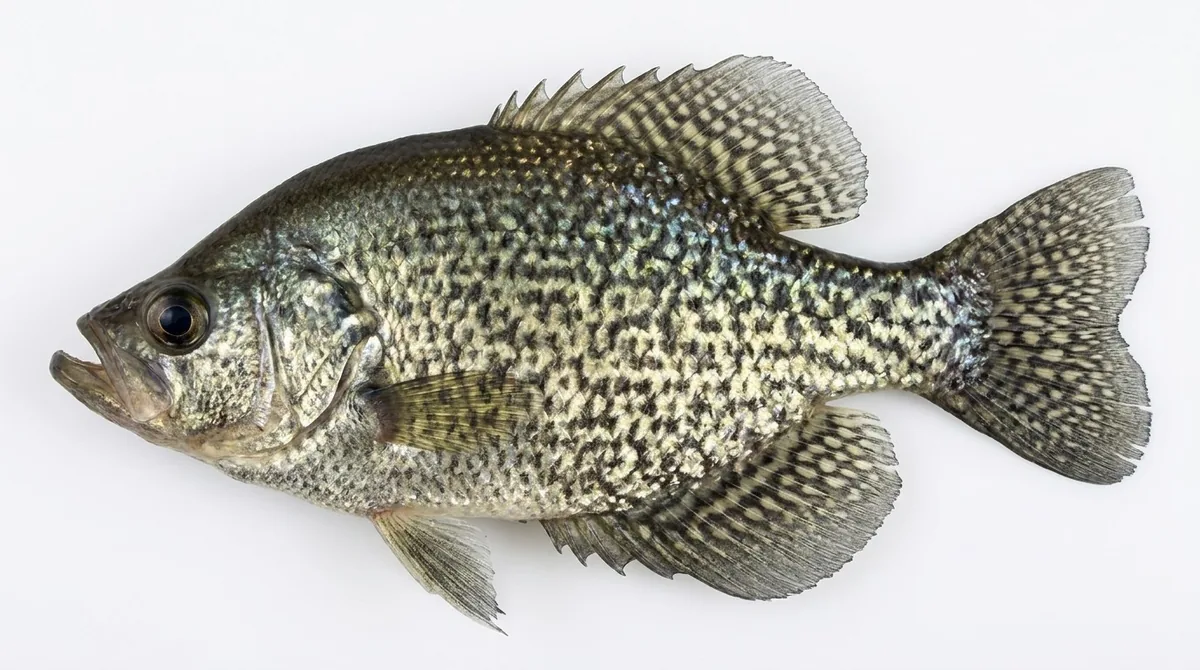
Black crappie
Pomoxis nigromaculatus
- Freshwater
- Least Concern
- Max length
- 49 cm
- Class
- Teleostei
- Order
- Centrarchiformes
- Family
- Centrarchidae
- Genus
- Pomoxis
- North America - Inland waters
About the black crappie
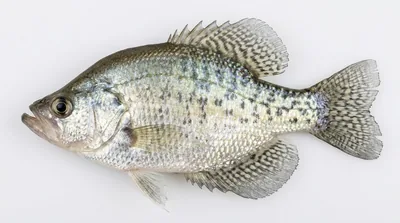
The black crappie (Pomoxis nigromaculatus) is a freshwater fish in the sunfish family (Centrarchidae). It is endemic to North America, one of the two types of crappies. It is very similar to the white crappie (P. annularis) in size, shape, and habits, except that it is darker, with a pattern of black spots. Alternate names for the species include calico bass, speck, speckled perch, speckled bass, moonfish, grass bass, strawberry bass, shiner, crappie, oswego bass, sac-a-lait, and marigane noire.
Habitat
The black crappie's habitats are lakes, reservoirs, borrow pits, and navigation pools in large rivers. They prefer areas with little or no current, clear water, and abundant cover such as submerged timber or aquatic vegetation, as well as sand or mud bottoms like those found in lakes, ponds, streams, and sloughs.
Like P. annularis, P. nigromaculatus is very prolific and can tend to overpopulate its environment, with negative consequences both for the crappie and for other fish species. A commercial supplier of the fish, however, claims that it can be safely stocked in ponds as small as one acre (0.40 hectares) in area.
Distribution
The black crappie's range is uncertain, since it has been widely transplanted, but it is presumed to be similar to the white crappie's. Its native range is suspected to be in the eastern United States and Canada, and as of 2005, populations existed in all of the 48 contiguous U.S. states. Introduced populations also exist in Mexico and Panama.
Behaviour
Crappies feed early in the morning and from about midnight until approximately 2 am. Individuals smaller than about 16 centimetres (6.3 in) in length eat plankton and minuscule crustaceans, while larger individuals feed on small fish (like shad), as well as minnows. Adult black crappies feed on fewer fish than white crappies do; instead they consume a larger volume of insects, insect larvae and crustaceans. According to scientific studies carried out in California, the mysid shrimp Neomysis awatschensis and amphipods of genus Corophium were most commonly eaten by all sizes of black crappie, followed by copepods, cladocerans and chironomid larvae and pupae. Although this diet is popular among black crappies in general, their diet may significantly change based on habitat, availability of food, and other biotic factors such as amount of resource competition. The same study also showed that young, small crappie tend to feed on small aquatic invertebrate animals and changed to a fish-filled diet as they matured to adulthood. Its diet, as an adult, tends to be less dominated by other fish than that of the white crappie.
Description from Wikipedia, available under CC BY-SA.
Where the black crappie lives
Distribution data from GBIF (DOI: 10.15468/dl.8rzs8d).
Also known as
- Marigane noire
- Schwarzflecken-Sonnenbarsch
- Svart solabborre
- Mojarra negra
- Mustapilkkuahven
- Juodadėmė krapė
- Чёрный краппи
- دهانکاغذی سیاه
- Калико
- 黑斑刺蓋太陽魚
Where to catch black crappie
- Arkansas River at Salida United States River · live river data
- Cape Fear River United States River · North Carolina
- Green River (Flaming Gorge) United States River · live river data
- Kenai River United States River · Alaska
- Kentucky Lake United States Reservoir · Kentucky-Tennessee
- Lake Champlain United States Lake · live river data