Fishing Calendar App
White bass
Morone chrysops
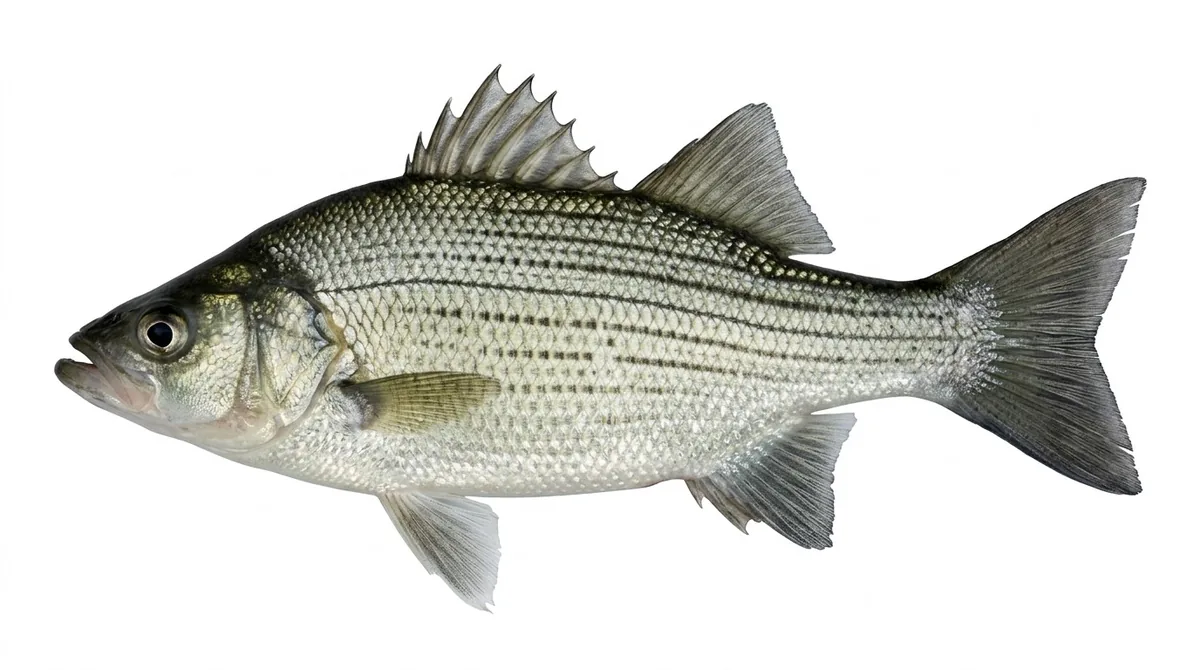
- Freshwater
- Least Concern
- Max length
- 46 cm
- Class
- Teleostei
- Order
- Eupercaria incertae sedis
- Family
- Moronidae
- Genus
- Morone
- North America - Inland waters
- Asia - Inland waters
About the white bass
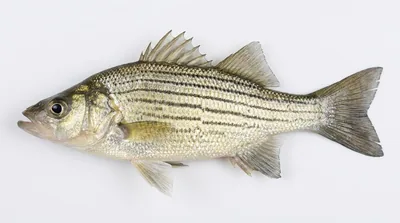
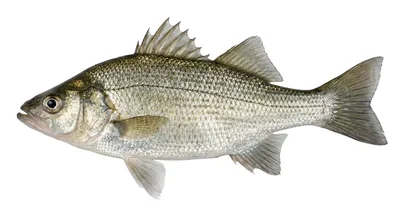
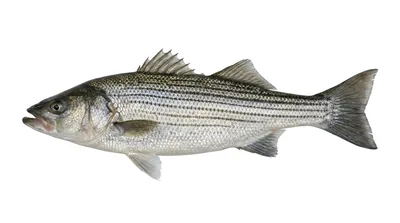
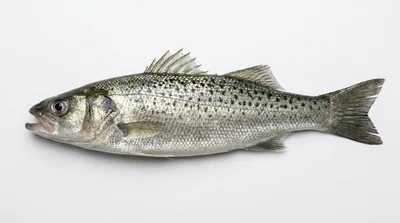
The white bass, silver bass, or sand bass (Morone chrysops) is a freshwater fish of the temperate bass family Moronidae, and is commonly around 12–15 inches long. The species' main color is silver-white to pale green. Its back is dark, with white sides and belly, and with narrow dark stripes running lengthwise on its sides. It has large, rough scales and two dorsal fins. They are widely distributed across North America, inhabiting large reservoirs and rivers. When mating in the spring, they are more often found in shallow rivers, creeks, and streams. They have been introduced in some places as sport fish and also to predate on nuisance fish, such as gizzard shad. It is the state fish of Oklahoma.
Habitat
White bass are found in high densities in the upstream segment of rivers. This portion of the river becomes the most degraded, as a number of different kinds of fish live in this segment, as well.
Distribution
White bass are distributed widely across the United States, especially in the Midwest. They are very abundant in Pennsylvania and the area around Lake Erie. Some native ranges of the white bass are the Arkansas River, western Lake Erie, the Detroit River, and Lake Poinsett in South Dakota; they are abundant in the Winnebago lakes system of Wisconsin; and they are also very abundant in Oklahoma. White bass have also been found in rivers that flow to the Mississippi. Native to many northern habitats, they have been introduced in many different waters around the United States, particularly in southern locations. They were also successfully introduced to Manitoba starting in the 1960s, where they have gained importance as a sport fish.
Behaviour
White bass are carnivores. They have four main taxa in their diet: calanoid copepods, cyclopoid copepods, daphnia, and leptodora. They are visual feeders. When not frightened, they will bite readily at live bait such as worms and minnows. Only the largest fish will feed on other fish, and as the summer season progresses, there is an overall trend towards eating fewer fish. Fish that are able to accumulate lipids over the summer are better able to survive cold winters. When looking at midwestern white bass, particularly in South Dakota, diet overlap occurs between the bass and the walleye. As seasons progress through the summer and fall, the amount of diet overlap decreases as a result of both fish increasing in length.
Description from Wikipedia, available under CC BY-SA.
Where the white bass lives
Distribution data from GBIF (DOI: 10.15468/dl.8rzs8d).
Also known as
- Bar blanc
- Vitbass
- Valkobassi
- Fehér sügér
- Witte baars
- ホワイトバス
- 金眼狼鱸
Where to catch white bass
- Arkansas River at Salida United States River · live river data
- Cape Fear River United States River · North Carolina
- Green River (Flaming Gorge) United States River · live river data
- Kenai River United States River · Alaska
- Kentucky Lake United States Reservoir · Kentucky-Tennessee
- Lake Champlain United States Lake · live river data