Fishing Calendar App
Starry flounder
Platichthys stellatus
- Freshwater & Saltwater
- Least Concern
- Max length
- 91 cm
- Class
- Teleostei
- Order
- Pleuronectiformes
- Family
- Pleuronectidae
- Genus
- Platichthys
- Arctic Sea
- Atlantic, Northwest
- North America - Inland waters
- Pacific, Eastern Central
- Pacific, Northeast
- Pacific, Northwest
About the starry flounder
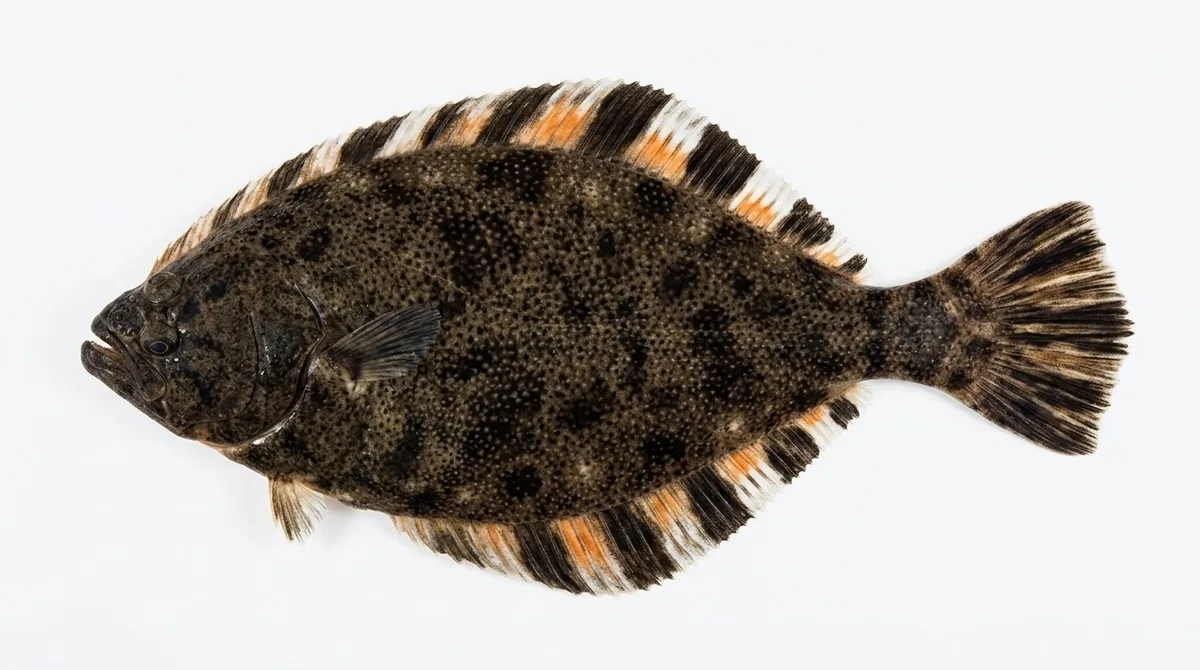
The starry flounder (Platichthys stellatus), also known as the grindstone, emery wheel and long-nosed flounder, is a common flatfish found around the margins of the North Pacific.
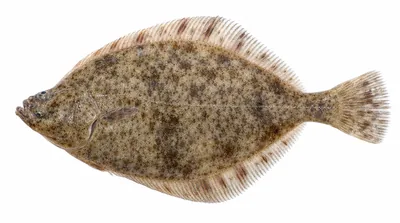
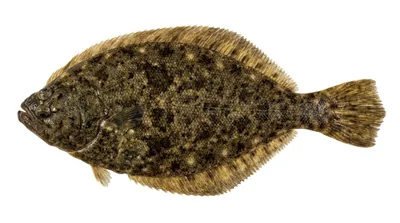
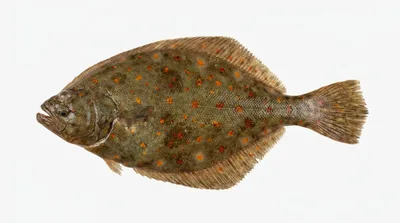
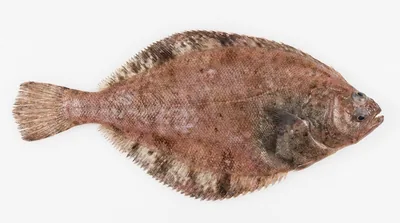
The distinctive features of the starry flounder include the combination of black and white-to-orange bar on the dorsal and anal fins, as well as the skin covered with scales modified into tiny star-shaped plates or tubercles (thus both the common name and species epithet), resulting in a rough feel. The eyed side is black to dark brown, while the lower side is white or cream-colored. Although classed as "righteye flounders," individuals may have their eyes on either the right or left side. They have been recorded at up to 91 cm and 9 kg.
Starry flounders are inshore fish, ranging up estuaries well into the freshwater zone, to the first riffles, with young found as much as 120 km inland. In marine environments, they occur as deep as 375 m. They glide over the bottom by rippling their dorsal and anal fins, feeding on a variety of benthic invertebrates. Larvae start out consuming planktonic algae and crustaceans, then as they metamorphose they shift to larger prey.
Like all flounders, when they are young, starry flounders swim around like normal fish in a vertical position, but soon they begin to tilt to one side as they swim and eventually live lying on the sandy floor. As well as many other changes in body structure, the migration of one of the eyes to the other side of the head is one of the most crucial changes. Other changes include the loss of dark color on the under side.
On the western side of the Pacific they occur as far south as Japan and Korea, ranging through the Aleutian Islands, the coast of Alaska, Canada, and down the West Coast of the U.S. as far as the mouth of the Santa Ynez River in Santa Barbara County, California. They are an important game and food fish across their range.
Habitat
The primary habitat for this species is within mud, sand, or gravel bottoms from 0–375 m (1230 ft), but most commonly above 146 m (479 ft). They are usually found near shore and often enter brackish or even fresh water on occasion. Highly salinated water is something this fish stays away from because of its inability to keep its cells from becoming hypersalinated.
Distribution
The starry flounder has a relatively large home range, going from the North Pacific Ocean all the way to Southern California. Within the Pacific Ocean they are located in Korea and Southern Japan through Bering Strait and Arctic Alaska to the Coronation Gulf. They have also been prominently found in Canada, Santa Barbara and Southern California.
Behaviour
The starry flounder has a multitude of well studied behaviors that are exhibited on a daily basis. At a normal resting position the dorsal and anal fins are angled so to prevent the body from resting upon the substrate, support being given by the fins, so as to create a cushion of water between the fish and the substrate. This is also for water to escape through an opening on the blind side, gill slit, of the fish and lessens the amount of effort needed to move.
Movement of this fish has been described to look much like crawling, with the first few rays of the dorsal and anal fins moving in a rowing motion that progresses caudally along the fish creating a waving movement of the fins, propelling the fish forward. Flounders are also capable of backwards locomotion, which is achieved with the same waving movement of the fins but the rowing motion progresses anteriorly. This movement is used as a method of escape or if it encounters an obstacle. When quick movements are needed from this fish, such as when feeding or frightened, the pectoral fin is extended at a right angle from the body, and used as an additional paddle.
Another key behavioral ability displayed by the P. stellatus is its ability to change its body coloration depending upon the substrate or environment that it is in. This process is done by changing pigment granule concentration in chromatophores, which will the result in the shade variations seen within this species.
Description from Wikipedia, available under CC BY-SA.
Where the starry flounder lives
Distribution data from GBIF (DOI: 10.15468/dl.8rzs8d).
Also known as
- Flet étiolé
- Flet étoilé
- Sternflunder
- Ulduz kambalası
- Tähtikampela
- Звёздчатая камбала
- 강도다리
- ヌマガレイ
- دملوكة نجمية
- دملوكه نجميه
- کفشک ستارهای
- Камбала зірчаста
- 星突江鲽
Where to catch starry flounder
- Arkansas River at Salida United States River · live river data
- Bristol Bay United States Bay · Alaska
- Cape Cod Bay United States Bay · Massachusetts
- Cape Fear River United States River · North Carolina
- Chesapeake Bay United States Estuary · Maryland and Virginia
- Columbia River at Astoria United States River · Oregon-Washington