Fishing Calendar App
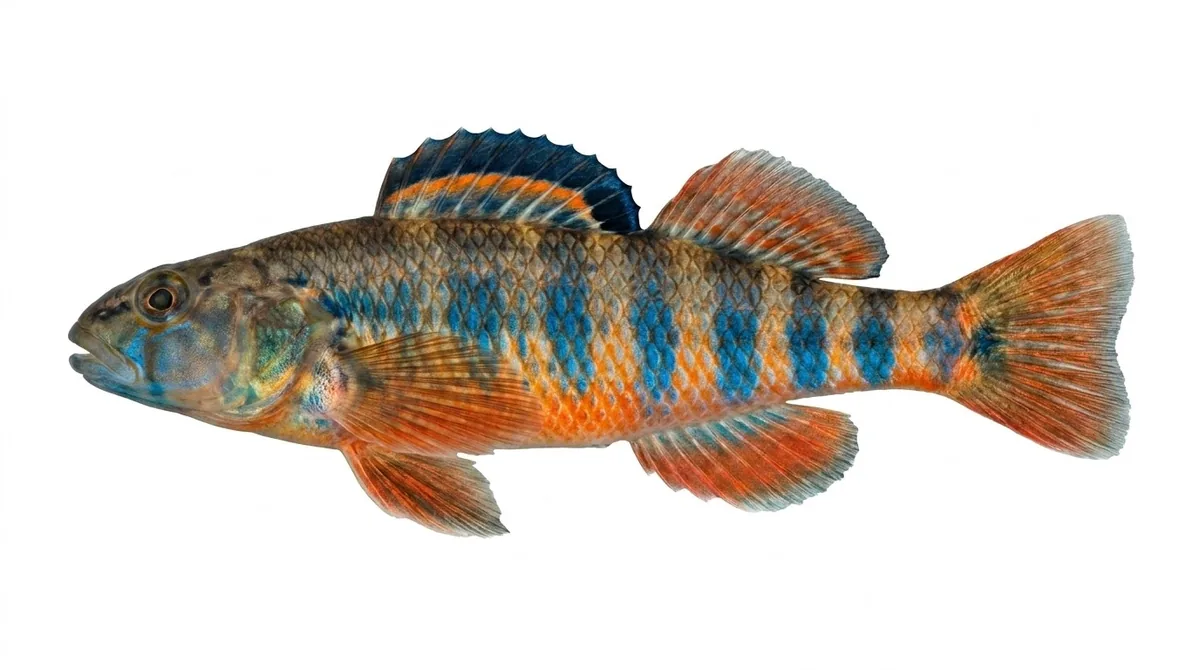
Rainbow darter
Etheostoma caeruleum
- Freshwater
- Least Concern
- Max length
- 8 cm
- Class
- Teleostei
- Order
- Perciformes
- Family
- Percidae
- Genus
- Etheostoma
- North America - Inland waters
About the rainbow darter
The rainbow darter (Etheostoma caeruleum) is a small species of freshwater ray-finned fish, a darter from the subfamily Etheostomatinae, part of the family Percidae, which also contains the perches, ruffes and pikeperches. It is native to North America where it is found in small, fast-moving streams and small to medium-sized rivers. It grows to 2 to 3 inches (51 to 76 mm) in length. The species is very sensitive to pollution and silt, staying in clean, pollution-free water. The rainbow darter is easily identified by three dark spots on the back, and blue and orange in the dorsal and anal fins.
Habitat
The rainbow darter is classified as insectivorous, feeding on small invertebrates such as insects and crayfish, but it has also been known to feed on some fly larvae. In Four-Mile Creek in Ohio, the rainbow darter lives primarily on trichopterans (i.e. caddisflies), having two feeding peaks: one in the morning and a second in the late afternoon or early evening.
The primary predators of the rainbow darter are larger freshwater fish, such as burbots (Lota lota), stonecats (Noturus flavus), and smallmouth bass (Micropterus dolomieu). Like many other darter species, it has the ability to maintain position on the substrate in flowing water. This unique characteristic plays a key role in its microhabitat preference. E. caeruleum has been shown to prefer creeks and rivers with rocky substrates and swift-moving riffles. This microhabitat preference has been suggested to be due to oxygen levels in the water during season changes or other factors, such as feeding or shelter-related habitat preferences. Because E. caeruleum has such a low tolerance for brackish water, human-induced changes such as pollution or sewer drainage has the potential to cause a significant negative impact on its abundance.
Distribution
The rainbow darter is a small, benthic freshwater fish found in many creeks and small to medium-sized rivers throughout North America. In particular, it is common throughout the eastern United States, specifically throughout the Great Lakes and Ohio River Valley regions. Its distribution extends south to northern parts of Alabama and as far west as Missouri and Arkansas. This distribution has been suggested to be due to once existing glaciers and to its intolerance of brackish water. One study to examine the phylogeography of E. caeruleum and its colonization patterns found its distribution is greatly due to historic glaciations, and furthermore, due to distributions from drainages which have since then resulted in the current morphological diversity of the rainbow darter. Geographically, the rainbow darter is one of the most abundant and common darter species. Current distribution shown may be outdated and should be verified with state agencies. Particularly Texas where the species exists in limited number.
Description from Wikipedia, available under CC BY-SA.
Where the rainbow darter lives
Distribution data from GBIF (DOI: 10.15468/dl.8rzs8d).
Also known as
- Dard arc-en-ciel
- Gwibiwr glas
- Sateenkaarivilistäjä
- 藍鏢鱸
Where to catch rainbow darter
- Arkansas River at Salida United States River · live river data
- Cape Fear River United States River · North Carolina
- Green River (Flaming Gorge) United States River · live river data
- Kenai River United States River · Alaska
- Kentucky Lake United States Reservoir · Kentucky-Tennessee
- Lake Champlain United States Lake · live river data