Fishing Calendar App
Sauger
Sander canadensis
- Freshwater
- Least Concern
- Max length
- 76 cm
- Class
- Teleostei
- Order
- Perciformes
- Family
- Percidae
- Genus
- Sander
- North America - Inland waters
About the sauger
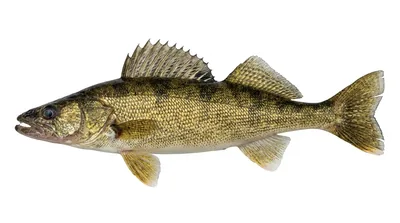
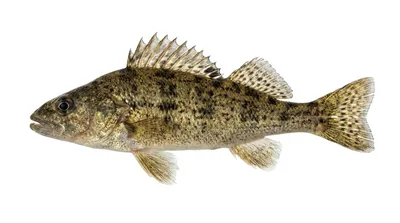
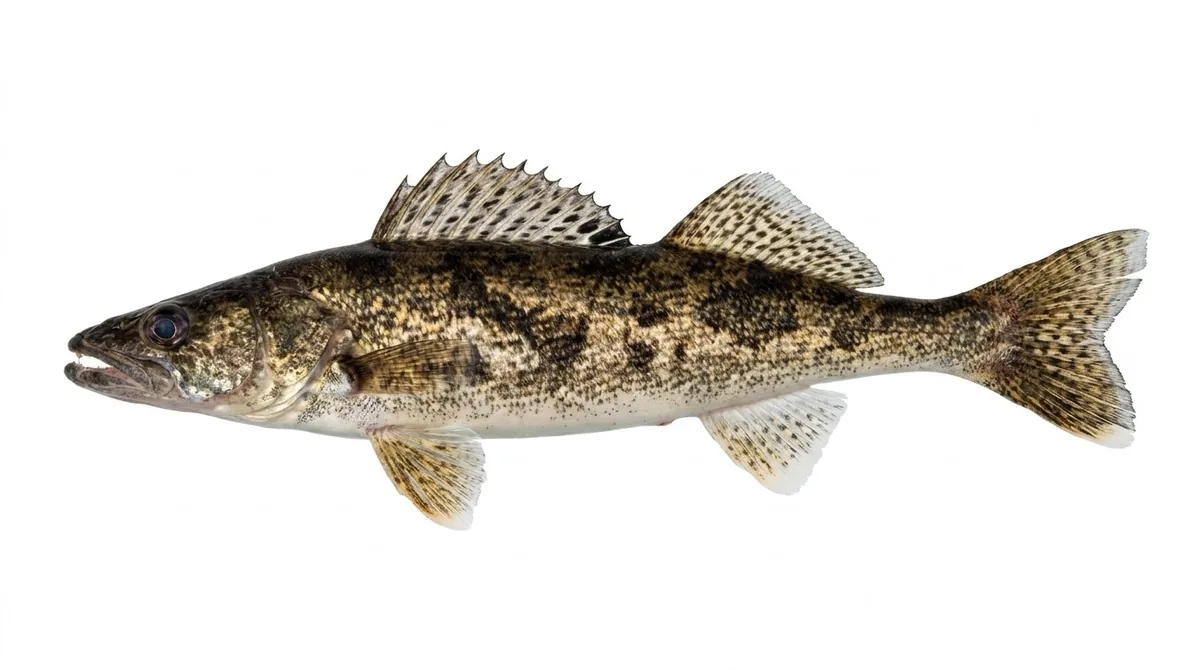
The sauger (Sander canadensis) is a freshwater perciform fish of the family Percidae that resembles its close relative, the walleye. The species is a member of the largest vertebrate order, the Perciformes. It is the most migratory percid species in North America. Saugers have two dorsal fins; the first is spiny and the posterior dorsal fin is soft-rayed. Their paired fins are in the thoracic position and their caudal fin is truncated, which means squared off at the corners, a characteristic of the family Percidae. Another physical characteristic of saugers is their ctenoid scales, which are common in advanced fishes. Saugers have a fusiform body structure, and as a result are well adapted predatory fishes and are capable of swimming into fast currents with minimal drag on their bodies. They may be distinguished from walleyes by the distinctly spotted dorsal fin, by the lack of a white splotch on the caudal fin, by the rough skin over their gills, and by their generally more brassy color, or darker (almost black) color in some regions. The typical sauger is 300 to 400 g (11 to 14 oz) in weight.
Habitat
Saugers are more likely to be found in large rivers with deep pools (depths greater than 0.6 m). They encounter a variety of habitats because of their migratory tendencies. They are usually found in natural rivers because they have more abundant pools and their flows have not been altered by dams or diversions. They are still common in impounded river systems. Diversions and dams affect habitat and spawning areas of saugers. They are usually found in areas with high turbidity, low channel slope, low stream velocity, and deep water. Saugers tend to select pools with sand and silt substrates, and habitat features that provide cover from the river current. They tend to avoid runs and riffles. They are most commonly found in pools that are at least 1.5 m deep. They can also be found in shallower pools, but in lesser numbers. No differences in habitat preference between males and females has been observed. The number of saugers observed increases with mean summer water temperature, maximum water depth, and alkalinity.
Distribution
Saugers are widely distributed; their historical range consisted of the eastern U.S. west of the Appalachian Mountains, mostly southern, central, and western U.S., and north into southern Canada. Sauger distribution and range has decreased from historical ranges because of degraded and fragmented habitat conditions. Sauger distribution within their home range varies by time of year because they are migratory. Saugers are more typical in rivers, whereas walleyes are more common in lakes and reservoirs. In many parts of their range, saugers are sympatric with walleyes. Hybridization between saugers and walleyes is not unknown; the hybrids, referred to as saugeyes, exhibit traits of both species. Being intermediate in appearance between the two species, saugeyes are sometimes difficult to differentiate, but they generally carry the dark blotches characteristic of the sauger. Saugers, however, are usually smaller and better tolerate waters of higher turbidity than walleyes. Saugers require warmer summer water temperatures of 20–28 °C (68–82 °F). Their need for warm water is thought to affect the northern and western boundaries of their range.
Behaviour
Saugers feed on a variety of invertebrates and small fishes depending on the time of year and size of the sauger. Channel catfish Ictalurus punctatus and freshwater drum Aplodinotus grunniens are midsize (300–379 mm) and large (>379 mm) saugers' main food source during spring. The diet of a small sauger (200–299 mm) is slightly different from a larger sauger's. Smaller saugers generally feed on benthic invertebrates, mayfly larvae, and catfish during spring and summer. Midsized and large saugers feed mainly on fish from spring to autumn, but their diets alter during summer. Midsized and large saugers feed predominantly on mayfly larvae but only during summer. Freshwater drum Aplodinotus grunniens and gizzard shad Dorosoma cepedianum are predominant food sources for saugers of all sizes during autumn. Fish accounted for over 99% of a sauger's diet during autumn. Saugers also prey on shiners during spring and summer, but they do not account for a significant part of their diet. Shiners are absent from a sauger's diet in autumn probably due to their availability.
Description from Wikipedia, available under CC BY-SA.
Where the sauger lives
Distribution data from GBIF (DOI: 10.15468/dl.8rzs8d).
Also known as
- Doré noir
- Kanadischer Zander
- Kanadagös
- Smalbekbaars
- Канадский судак
- سوجر
- Канадска бяла риба
- Судак канадський
- 加拿大梭鱸
Where to catch sauger
- Yellowstone River (Montana) United States River · live river data
- Arkansas River at Salida United States River · live river data
- Cape Fear River United States River · North Carolina
- Green River (Flaming Gorge) United States River · live river data
- Kenai River United States River · Alaska
- Kentucky Lake United States Reservoir · Kentucky-Tennessee