Fishing Calendar App
Clown featherback
Chitala ornata
- Freshwater
- Least Concern
- Max length
- 100 cm
- Class
- Teleostei
- Order
- Osteoglossiformes
- Family
- Notopteridae
- Genus
- Chitala
- North America - Inland waters
- Asia - Inland waters
About the clown featherback
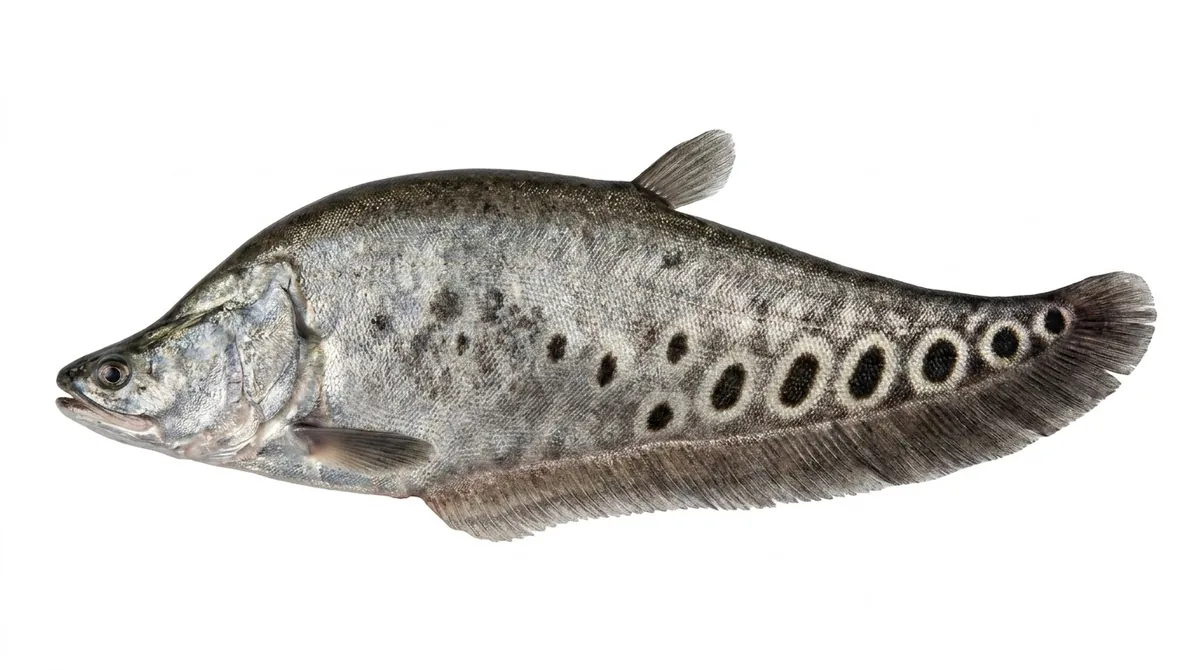
The clown featherback (Chitala ornata), also known as the clown knifefish and spotted knifefish, is a nocturnal species of tropical fish with a long, knife-like body. This knifefish is native to freshwater habitats in Cambodia, China, Hong Kong, Laos, Macau, Thailand, and Vietnam, but it has also been introduced to regions outside its native range. It is one of the world's most invasive species.
It is often seen in aquaculture and the aquarium trade, where it is frequently confused with Chitala chitala; the latter species is very rare in the aquarium trade. The clown featherback reaches 1 m (3.3 ft) in length, outgrowing all but the largest aquaria, yet it is popular.
Distribution
Clown knifefish are ectotherms native to tropical fresh waters in Southeast Asia, specifically the Mekong, Chao Phraya, and Mae Klong Basins surrounding Laos, Thailand, Cambodia, and Vietnam. They are widely distributed in shallow, well oxygenated streams and rivers. Typically, they are found in lotic rather than lentic systems due to preference for flowing water and vegetation cover, but they can also be found in stagnant and sluggish water, supported by their modified swim bladder. This allows them to live for an indefinite period in confined water. They are nocturnal, remaining inactive in covered areas during the day and out hunting at night.
While native to the tropics of Asia, they are also found in Florida and Sri Lanka. They are widely known to be an invasive species outside their native region. Past high demands in aquaculture and aquarium trading have introduced the clown knifefish to new waters. They are usually exported as juveniles and raised by ornamental fish breeders that have accidentally and deliberately released the invasive species. Their ability to tolerate high salinity and polluted waters have led to the predation of several endemic and endangered native species.
Behaviour
These fish are primarily carnivorous, allowing them to widen their food spectrum in response to environmental changes In their native habitat, they have very few natural predators; they are at the top of the food chain in newly inhabited waters, often preying on smaller fish, crustaceans, and insects. Juveniles tend to hunt near vegetation and congregate for protection, becoming independent as they mature. Adults are known to be territorial and prefer to travel alone. Clown knifefish migrate locally, but are not migratory spawners like salmon.
Spawning is observed from March to August, peaking from April to May, when 300 to 500 eggs are laid at a time. Spawning occurs in vegetation and submerged wood because it is stable and safer. The effort and productivity of females' spawning, their gonadosomatic index, begins in March and peaks in May until it gradually begins to decrease until August. They produce larger eggs than species that do not care for their eggs, and the extent of care depends on the egg sizes. All Chitala species demonstrate the same parental care method. The nests are actively cared for by both parents, but the males guard the nest. When guarding, males become defensive and hostile towards potential predators. They exhibit a rolling motion that exposes their broad, silvery side. Fertilized eggs are hatched by fanning, which helps supply dissolved oxygen. The eggs are spherical in shape, transparent with a milky yellow tone, and adhesive surface with projections. Adults can reach up to 3.3 ft long in the wild, but their developmental timing is different between natural and laboratory-reared conditions.
The adult mortality ratio is male biased because clown knifefish have few natural predators in their native habitat. They are at the top of their food chain, so sex-specific mortality in the guarding parent is lower than expected. Males are concentrated in nesting sites during incubation and early development stages where nests are constructed and eggs are constantly fanned. Males have smaller bodies because their body condition declines from the energy exerted in guarding the eggs and juveniles. Females have larger bodies for greater reproductive success. Size is assumed to be directly correlated with fecundity, so larger females have a higher chance of being courted.
Description from Wikipedia, available under CC BY-SA.
Where the clown featherback lives
Distribution data from GBIF (DOI: 10.15468/dl.8rzs8d).
Also known as
- Clown knifefish
- Spotted knifefish
- Tausenddollarfisch
- 광대칼고기
Where to catch clown featherback
- Arkansas River at Salida United States River · live river data
- Cape Fear River United States River · North Carolina
- Green River (Flaming Gorge) United States River · live river data
- Kenai River United States River · Alaska
- Kentucky Lake United States Reservoir · Kentucky-Tennessee
- Lake Champlain United States Lake · live river data