Fishing Calendar App
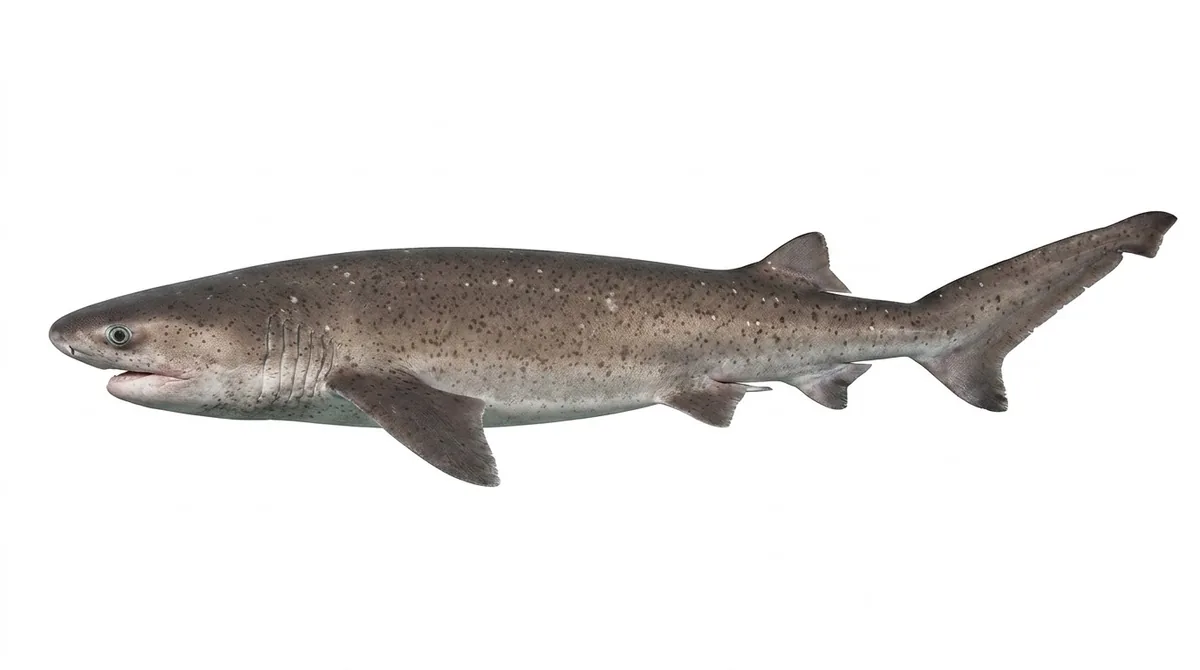
Broadnose sevengill shark
Notorynchus cepedianus
- Saltwater
- Vulnerable
- Max length
- 208 cm
- Class
- Elasmobranchii
- Order
- Hexanchiformes
- Family
- Hexanchidae
- Genus
- Notorynchus
- Atlantic, Southeast
- Indian Ocean, Eastern
- Pacific, Eastern Central
- Pacific, Northeast
- Pacific, Southwest
About the broadnose sevengill shark
The broadnose sevengill shark (Notorynchus cepedianus) is the only extant member of the genus Notorynchus, in the family Hexanchidae. It is recognizable because of its seven gill slits, while most shark species have five gill slits, with the exception of the members of the order Hexanchiformes and the sixgill sawshark. This shark has a large, thick body, with a broad head and blunt snout. The top jaw has jagged, cusped teeth and the bottom jaw has comb-shaped teeth. Its single dorsal fin is set far back along the spine towards the caudal fin, and is behind the pelvic fins. In this shark the upper caudal fin is much longer than the lower, and is slightly notched near the tip. Like many sharks, this sevengill is counter-shaded. Its dorsal surface is silver-gray to brown in order to blend with the dark water and substrate when viewed from above. In counter to this, its ventral surface is very pale, blending with the sunlit water when viewed from below. The body and fins are covered in a scattering of small black & white spots. In juveniles, their fins often have white margins.
It is also known as sevengill shark or simply sevengill and was formerly known as cow shark and mud shark; it is called sevengill due to its seven gill slits. Because of this, it was listed along with the sharpnose sevengill shark (Heptranchias perlo) by Guinness World Records as having the most gill slits. It is similar to the sharpnose sevengill shark but the latter has a pointed snout and lacks spots on its dorsal surface. The sevengill species are also related to ancient sharks as fossils from the Jurassic Period (200 to 145 million years ago) also had seven gills. As recently as the 1930s and 1940s, the shark was targeted by fisheries along the coast of California and, once the commercial fishery receded, recreational fishing of the shark started in the 1980s and 1990s.
Distribution
The broadnose sevengill has so far been found in the western Pacific Ocean off China, Japan, Australia, New Zealand, the eastern Pacific Ocean off Canada, United States and Chile, and the southern Atlantic Ocean off Argentina and South Africa. It is significantly found in the San Francisco Bay particularly near the Golden Gate Bridge and Alcatraz Island. Large, old individuals tend to live in deep offshore environments as far down as 446 feet (136 m). However, most individuals live in either the deep channels of bays, or in the shallower waters of continental shelves and estuaries. These sharks are mainly benthic in nature, cruising along the sea floor and making an occasional foray to the surface. Individuals that live closer to the coast in South Africa tend to prefer more open areas with a sandy sea floor and sparse clumps of kelp.
Behaviour
An opportunistic predator, the broadnose sevengill preys on a great variety of animals, and has been found at depths of 1,870 feet (570 m), in offshore waters. It has been found to feed on other sharks (including the gummy shark, one of its main prey choices, and cowsharks), rays, chimaeras, cetaceans, pinnipeds, bony fishes and animal falls (seafloor carrion). It will also feed on anything that fits in its mouth, such as shark egg cases, sea snails, crustaceans and any remains of rats, seabirds, and even deceased drowned humans. Research in 2003 found that its diet consisted of 30% mammals, with a frequency of occurrence of 35%. It is a frequent top predator in shallow waters, and has comb-like teeth, with the upper teeth having slender, smooth edged cusps to swallow small enough prey whole and lower teeth that are broad enough to bite flesh into pieces. These sharks occasionally hunt in packs to take larger prey, using tactics such as stealth to succeed. After feeding, it slowly digests for several days, and can go weeks until eating again. Larger, predatory sharks (such as the great white shark) can be a threat, and cannibalism among this species has also been recorded. The species has also been observed being preyed upon by orcas in False Bay, South Africa. When not actively hunting, it patrols the water, stealthily, while making very little movement except for moving its caudal fin; when prey is detected, they conserve their energy until ready to make an accelerated dash to attack.
It can be one of the most abundant predators in coastal waters in summer; for example, in southeastern Tasmania, there is a high abundance of elasmobranchs (including the gummy shark) in coastal regions in summer. In New Zealand, it is also one of the most common inshore sharks. While it is mainly a nocturnal forager, it may opportunistically feed on prey casually found during the day; however, research in 2010 noted even amounts of activity during day and night. During this research, the shark was consistently detected at many depths, from bottom to near the surface, although it was mainly near the seafloor during the day. It also found that, as Norfolk Bay does not have adequate shelter cover, this species may use group formation to avoid predation.
The sevengill, like all other members of Hexanchiformes, is ovoviviparous. The broadnose sevengill lives for about 30 years, although the Washington State Department of Fish and Wildlife lists a maximum of 49 years, with the males maturing at 4 to 5 years and the female 11 to 21 years; the average reproductive age for a female is 20 to 25 years. After a 12-month gestation period, the female moves to a shallow bay or estuary to give birth between April and May to a large litter of between 82 and 95 pups, measuring 40–45 cm (15.5–17.5 in).
In 2004 and 2005, along with research for the sand tiger shark, there was research for the broadnose sevengill shark for development techniques for semen collection and artificial insemination to potentially increase breeding and lower overreliance on natural mating. Research in 2010 found that this shark has very poorly calcified vertebrae that cannot be used for age and growth estimations. Research in 2009 in Ría Deseado (RD) and Bahía San Julián (SJ), Argentina found that females were larger in RD than SJ and the heaviest female in RD was 70 kg while it was 36.9 kg in SJ. For the males, the heaviest in RD was 40 kg while it was 32.5 in SJ. Both locations also found the most significant to occur December and January.
Research in 2014 also found that for the first time, reproductive hormones levels were found in the broadnose sevengill shark. for a few years before venturing out. The probable predators of this species are larger sharks. Research from 2002 showed that although juvenile sevengill sharks utilize nursery areas in a similar way, males mature faster than females even if they are the same size and thus males are more likely to leave the nursery area before females.
In 2004, John G Maisey of the American Museum of Natural History published a detailed analysis of the broadnose sevengill shark including imagery such as CT scans and morphology of its braincase.
Description from Wikipedia, available under CC BY-SA.
Where the broadnose sevengill shark lives
Distribution data from GBIF (DOI: 10.15468/dl.8rzs8d).
Also known as
- Sevengill shark
- Tiburón pinto
- Requin à sept branchies
- Breitnasen-Siebenkiemerhai
- Siedmioszpar plamisty
- Trubbnosig sjugälshaj
- Cação-bruxa
- Platneus-sewekiefhaai
- Žralok širokonosý
- Täpläkidushai
- Hétkopoltyús tehéncápa
- Gevlekte zevenkieuwshaai
- Плоскоголовая семижаберная акула
- 칠성상어
- エビスザメ
- エビスザメ[ミナミエビスザメ]
- قرش عريض الانف سيفنجيل
- کوسه هفتآبششی پهنبینی
- שש-זימי רחב-אף
- Семизяброва акула широконоса
- 扁头哈那鲨
Where to catch broadnose sevengill shark
- Bristol Bay United States Bay · Alaska
- Columbia River at Astoria United States River · Oregon-Washington
- Monterey Bay United States Bay · California
- Puget Sound at Seattle United States Sound · Washington
- San Diego Bay United States Bay · California
- San Francisco Bay United States Bay · California