Fishing Calendar App
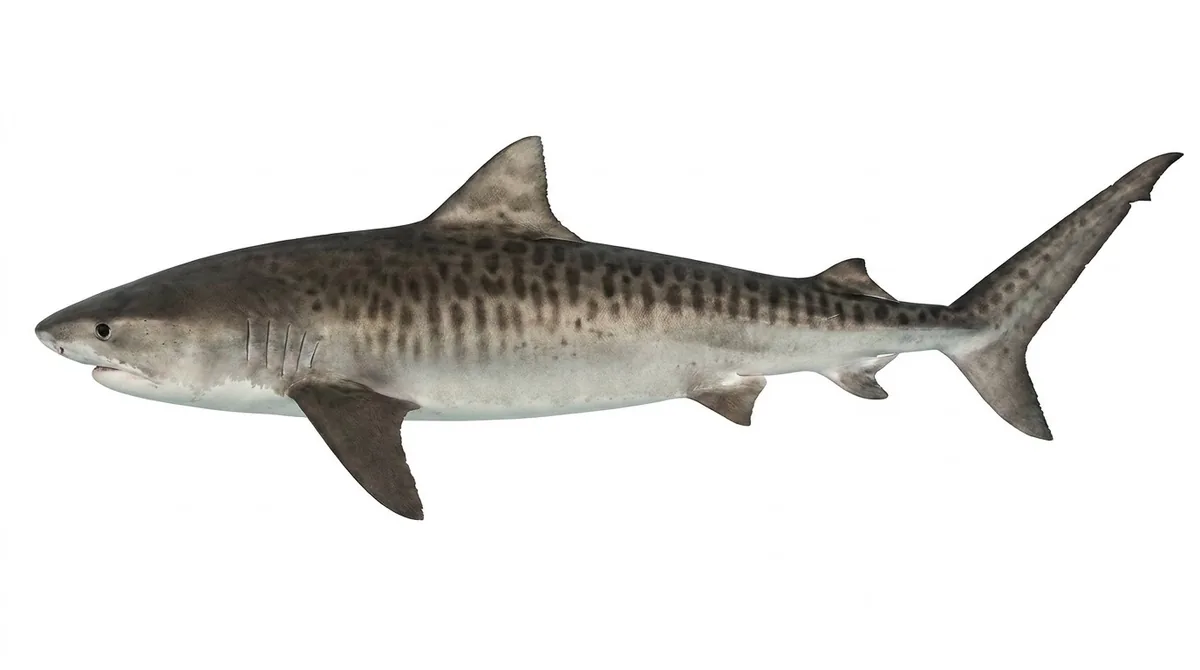
Tiger shark
Galeocerdo cuvier
- Saltwater
- Near Threatened
- Max length
- 550 cm
- Class
- Elasmobranchii
- Order
- Carcharhiniformes
- Family
- Galeocerdonidae
- Genus
- Galeocerdo
- Atlantic, Northeast
- Atlantic, Northwest
- Atlantic, Southeast
- Atlantic, Southwest
- Atlantic, Western Central
- Indian Ocean, Eastern
- Indian Ocean, Western
- Pacific, Eastern Central
- Pacific, Southeast
- Pacific, Southwest
- Pacific, Western Central
About the tiger shark
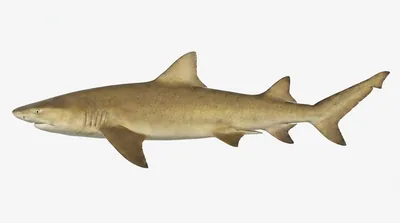
The tiger shark (Galeocerdo cuvier) is a species of ground shark, and the only extant member of the genus Galeocerdo and family Galeocerdonidae. It is a large predator, with females capable of attaining a length of over 5 m (16 ft 5 in). Populations are found in many tropical and temperate waters, especially around central Pacific islands. Its name derives from the dark stripes down its body, which resemble a tiger's pattern and fade as the shark matures.
The tiger shark is a solitary, mostly nocturnal hunter. It is notable for having the widest food spectrum of all sharks, with a range of prey that includes crustaceans, fish, seals, birds, squid, sea turtles, sea snakes, dolphins, and others, even smaller sharks. It also has a reputation as a "garbage eater", consuming a variety of inedible, man-made objects that linger in its stomach. Tiger sharks have only one recorded natural predator, the orca. It is considered a near-threatened species because of finning and fishing by humans.
The tiger shark is second only to the great white in recorded fatal attacks on humans, but these events are still exceedingly rare.
Distribution
The tiger shark is often found close to the coast, mainly in tropical and subtropical waters throughout the world. Its behavior is primarily nomadic, but is guided by warmer currents, and it stays closer to the equator throughout the colder months. It tends to stay in deep waters that line reefs, but it does move into channels to pursue prey in shallower waters. In the western Pacific Ocean, the shark has been found as far north as Japan and as far south as New Zealand. It has also been recorded in the Mediterranean Sea, but rarely, off Malaga (Spain), Sicily (Italy) and Libya.
Fuvahmulah, an island in the Maldives, has been identified as home to the world’s largest known aggregation of tiger sharks (Galeocerdo cuvier).
The finding is based on a long-term scientific study using non-invasive methods such as photo identification and laser photogrammetry, which recorded at least 239 individual tiger sharks in the waters around the island. The aggregation is considered unique due to its size and the high level of site fidelity shown by the sharks, particularly adult females.
Researchers suggest that the waters surrounding Fuvahmulah provide favourable conditions for gestation, including warm temperatures and a consistent food supply, making the area an important habitat for tiger shark reproduction and conservation.
The discovery has also been highlighted in regional reporting as a significant ecological feature of the Maldives, further establishing Fuvahmulah as a global hotspot for tiger shark aggregation.
Tiger sharks can be seen in the Gulf of Mexico, North American beaches, and parts of South America. It is also commonly observed in the Caribbean Sea. Other locations where tiger sharks are seen include off Africa, China, India, Australia, and Indonesia. Certain tiger sharks have been recorded at depths approaching 900 m (3,000 ft).
Behaviour
The tiger shark is an apex predator and has a reputation for eating almost anything. These predators swim close inland to eat at night, and during the day swim out into deeper waters. Young tiger sharks are found to feed largely on small fish, as well as various small jellyfish, and mollusks including cephalopods. Around the time they attain 2.3 m (7.5 ft), or near sexual maturity, their selection expands considerably, and much larger animals become regular prey. Numerous fish, mollusks (including gastropods and cephalopods), crustaceans, sea birds, sea snakes, marine mammals (e.g. bottlenose dolphins (Tursiops), common dolphins (Delphinus), spotted dolphins (Stenella), dugongs (Dugong dugon), seals and sea lions), and sea turtles (including the three largest species: the leatherback (Dermochelys coriacea), the loggerhead (Caretta caretta) and the green sea turtles (Chelonia mydas)), are regularly eaten by adult tiger sharks. In fact, adult sea turtles have been found in up to 20.8% of studied tiger shark stomachs, indicating somewhat of a dietary preference for sea turtles where they are commonly encountered. They also eat other sharks (including adult sandbar sharks (Carcharhinus plumbeus)), as well as rays, and sometimes even other tiger sharks.
Due to high risk of predation, dolphins often avoid regions inhabited by tiger sharks. Injured or ailing whales may also be attacked and eaten. A group was documented killing an ailing humpback whale (Megaptera novaeangliae) in 2006 near Hawaii. A scavenger, the tiger shark will feed on dead whales, and has been documented doing so alongside great white sharks. Tiger sharks have also been observed to feed on dead manta rays in the German Channel of Palau.
Evidence of dugong predation was identified in one study that found dugong tissue in 15 of 85 tiger sharks caught off the Australian coast. Additionally, examination of adult dugongs has shown scars from failed shark attacks. To minimize attacks, dugong microhabitats shift similarly to those of known tiger shark prey when the sharks are abundant.
The broad, heavily calcified jaws and nearly terminal mouth, combined with robust, serrated teeth, enable the tiger shark to take on these large prey. In addition, excellent eyesight and acute sense of smell enable it to react to faint traces of blood and follow them to the source. The ability to pick up low-frequency pressure waves enables the shark to advance towards an animal with confidence, even in murky water. The shark circles its prey and studies it by prodding it with its snout. When attacking, the shark often eats its prey whole, although larger prey are often eaten in gradual large bites and finished over time.
Notably, terrestrial mammals, including horses (Equus ferus caballus), goats (Capra aegagrus hircus), sheep (Ovis aries), dogs (Canis lupus familiaris), cats (Felis catus), and brown rats (Rattus norvegicus), are fairly common in the stomach contents of tiger sharks around the coasts of Hawaii. In one case, remains of two flying foxes were found in the stomach of this shark, and in another, an echidna (Tachyglossus aculeatus) was regurgitated by a tiger shark being tagged off Orpheus Island, Queensland. Because of its aggressive and indiscriminate feeding style, it often mistakenly eats inedible objects, such as automobile license plates, oil cans, tires, and baseballs. Due to their habits of eating essentially anything, Tiger sharks are often referred to as the "garbage can of the sea".
Description from Wikipedia, available under CC BY-SA.
Where the tiger shark lives
Distribution data from GBIF (DOI: 10.15468/dl.8rzs8d).
Also known as
- Morski tiger
- Tiburón tigre
- Tintorera
- Requin-tigre
- Tigerhai
- Żarłacz tygrysi
- Rekin tygrysi
- Tigerhaj
- Tubarão-tigre
- Tierhaai
- Kakia macan
- Pating tigre
- Rinkin-tigr
- Tauró tigre
- Žralok tygří
- Morgi rhesog
- Ƒumedadi
- Tigroŝarko
- Tiigerhai
- Tigre-marrazo
- Tiikerihai
- Qio saga
- Tigriscápa
- Hiu macan
- Hiyu macan
- Antsantsa tigra
- Yu harimau
- Tijgerhaai
- Žralok tigrí
- Kaplan köpek balığı
- Тигровая акула
- Акула тигровая
- 뱀상어
- イタチザメ
- قرش ببري
- قرش ببرى
- Pələng köpəkbalığı
- Тигрова акула
- বাঘ হাঙ্গর
- Καρχαρίας τίγρης
- کوسه ببری
- כריש טיגריסי
- Վագրային շնաձուկ
- Жолбарыс акула
- Ајкула-тигар
- കടുവാസ്രാവ്
- ကျားငါးမန်း
- Тигар ајкула
- புலிச்சுறா
- ปลาฉลามเสือ
- Акула тигрова
- Cá mập báo
- Тыгровая акула
- ٹائیگر شارک
- 鼬鯊
Where to catch tiger shark
- Limfjord Denmark Fjord · North Jutland
- Skagen Coast Denmark Coast · North Jutland
- Helsinki Archipelago Finland Archipelago · Uusimaa
- Rügen (Baltic Coast) Germany Coast · Mecklenburg-Vorpommern
- Sylt (Wadden Sea) Germany Coast · Schleswig-Holstein
- Dingle Bay Ireland Bay · Munster