Fishing Calendar App
Thornback guitarfish
Platyrhinoidis triseriata
- Saltwater
- Least Concern
- Max length
- 91 cm
- Class
- Elasmobranchii
- Order
- Torpediniformes
- Family
- Platyrhinidae
- Genus
- Platyrhinoidis
- Pacific, Eastern Central
About the thornback guitarfish
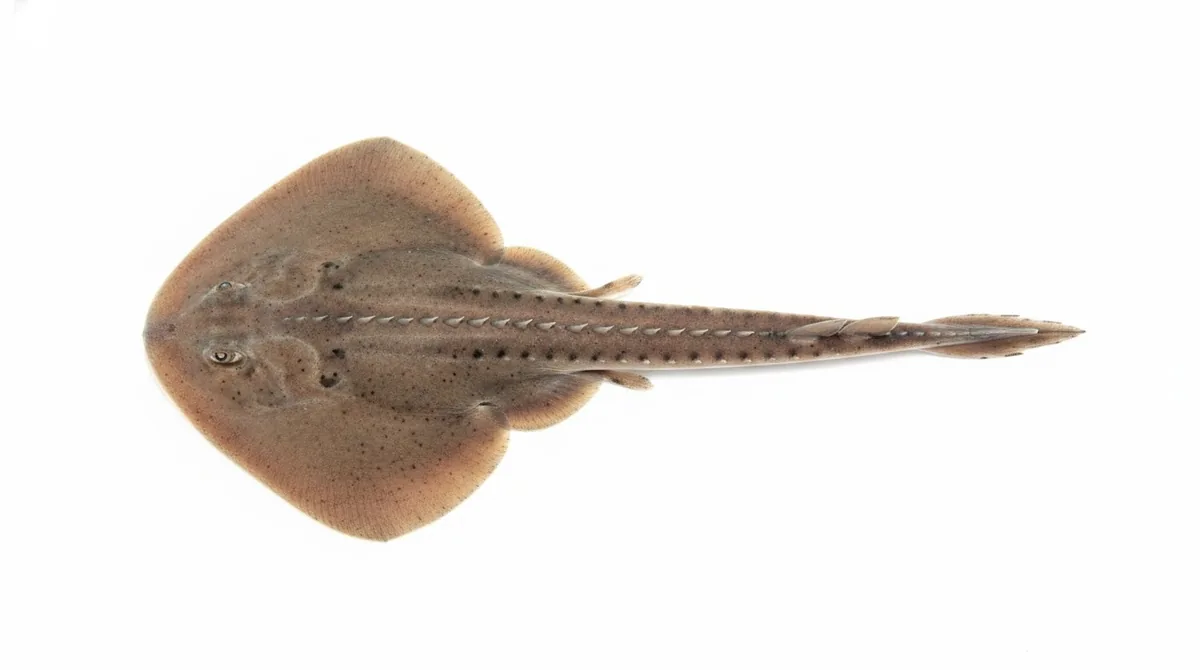
The thornback guitarfish (Platyrhinoidis triseriata) is a species of ray in the family Platyrhinidae, and the only member of its genus. Despite its name and appearance, it is more closely related to electric rays than to true guitarfishes of the family Rhinobatidae. This species ranges from Tomales Bay to the Gulf of California, generally in inshore waters no deeper than 6 m (20 ft). It can be found on or buried in sand or mud, or in and near kelp beds. Reaching 91 cm (36 in) in length, the thornback guitarfish has a heart-shaped pectoral fin disc and a long, robust tail bearing two posteriorly positioned dorsal fins and a well-developed caudal fin. The most distinctive traits of this plain-colored ray are the three parallel rows of large, hooked thorns that start from the middle of the back and run onto the tail.
Encountered singly or in groups, the thornback guitarfish feeds on small, benthic invertebrates and bony fishes. It is aplacental viviparous, with the developing young drawing sustenance from a yolk sac. Females give birth to 1–15 pups annually in late summer, following a roughly year-long gestation period. The International Union for Conservation of Nature (IUCN) has listed the thornback guitarfish under Least Concern because the majority of its range lies within United States waters, where it is common since it has no commercial value and is not heavily fished commercially or recreationally. The status of this species in Mexican waters is inadequately known but may be more precarious.
Distribution
Endemic to the northeastern Pacific Ocean, the thornback guitarfish is found from Tomales Bay to Magdalena Bay, with additional isolated populations in the Gulf of California. It is reportedly very abundant in some coastal waters off California and Baja California, such as in Elkhorn Slough, and uncommon north of Monterey and in the Gulf of California. Bottom-dwelling in nature, this species is typically found close to shore in less than 6 m (20 ft) of water, though it has been recorded from as deep as 137 m (449 ft). It inhabits coastal habitats with muddy or sandy bottoms, including bays, sloughs, beaches, and lagoons, and can also be found in kelp beds and adjacent areas.
Description from Wikipedia, available under CC BY-SA.
Where the thornback guitarfish lives
Distribution data from GBIF (DOI: 10.15468/dl.8rzs8d).
Also known as
- Thornback
- Guitarra espinuda
- Okalapiorausku
- Тихоокеанский дисковый скат
- ソーンバックギターフィッシュ
- شوكة الجيتار
- 棘背擬團扇鰩