Fishing Calendar App
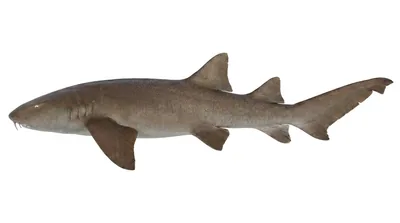
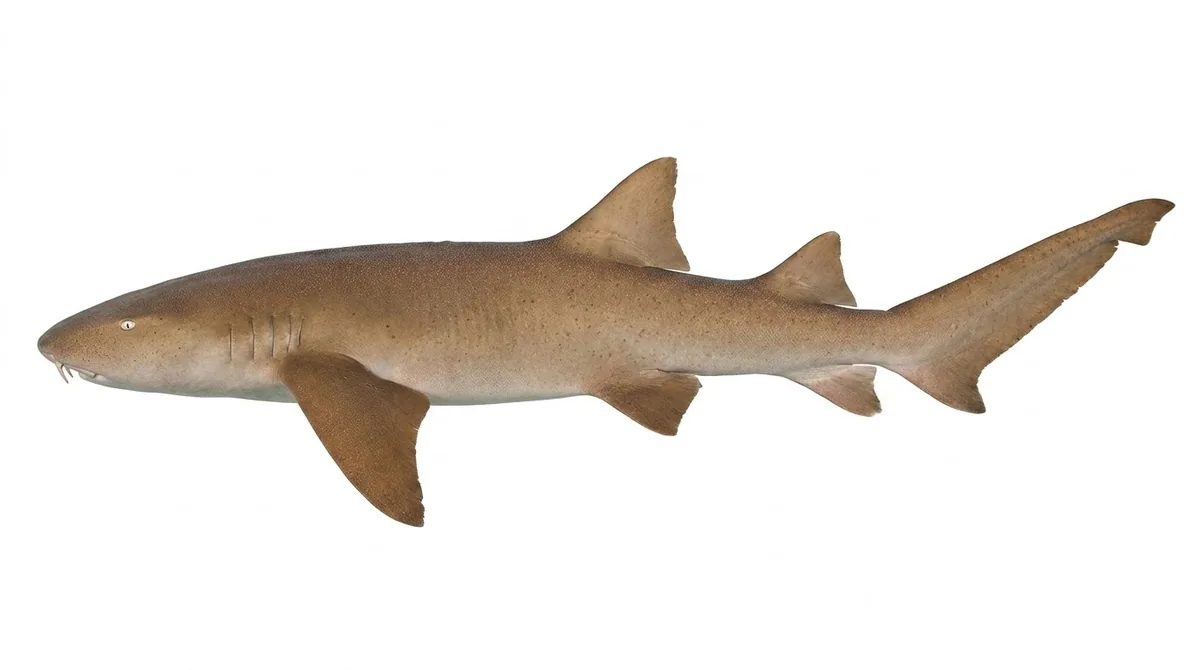
Tawny nurse shark
Nebrius ferrugineus
- Saltwater
- Vulnerable
- Max length
- 320 cm
- Class
- Elasmobranchii
- Order
- Orectolobiformes
- Family
- Ginglymostomatidae
- Genus
- Nebrius
- Indian Ocean, Eastern
- Indian Ocean, Western
- Pacific, Eastern Central
- Pacific, Northwest
- Pacific, Western Central
About the tawny nurse shark
The tawny nurse shark (Nebrius ferrugineus) is a species of carpet shark in the family Ginglymostomatidae, and the only extant member of the genus Nebrius.
It is found widely along coastlines in the Indo-Pacific, preferring reefs, sandy flats, and seagrass beds from very shallow water to a depth of 70 m (230 ft). With a cylindrical body and a broad, flattened head, the tawny nurse shark is quite similar in appearance to the nurse shark (Ginglymostoma cirratum) of the Atlantic and East Pacific, from which it can be distinguished by its pointed-tipped dorsal fins and narrow, sickle-shaped pectoral fins. The maximum recorded length of the tawny nurse shark is 3.2 m (10 ft).
Nocturnal in habits, the tawny nurse shark tends to spend the day resting in piles of two dozen or more individuals inside caves or under ledges. At night, it is an active-swimming predator that uses a powerful suction force to extract prey from inside holes and crevices. The diet of this species consists mainly of octopus, though they also take other invertebrates, small bony fishes, and rarely sea snakes. It is aplacental viviparous, meaning the embryos hatch from egg capsules inside the mother. It is the only carpet shark in which the embryos are oophagous, feeding on eggs produced by the mother while inside the uterus. The litter size may be as small as one or two, based on the large size of near-term embryos.
Compared to the nurse shark, the tawny nurse shark has a more placid disposition and will often allow divers to touch and play with it. However, it should be accorded respect due to its powerful jaws and sharp teeth. This species is caught by commercial fisheries across most of its range for meat, fins, liver oil, leather, and fishmeal. It is also esteemed as a game fish off Queensland, Australia, and is known for its habit of spitting water in the faces of its captors. The International Union for Conservation of Nature (IUCN) has assessed the tawny nurse shark as Vulnerable, with subpopulations in several areas already diminished or extirpated.
Distribution
The tawny nurse shark is widely distributed in the Indo-Pacific region. In the Indian Ocean, it is found from KwaZulu-Natal, South Africa northward to the Red Sea, Persian Gulf and India, including Madagascar, Mauritius, the Chagos Archipelago, the Seychelles, and the Maldives. In the western Pacific, it occurs from southern Japan and the coast of China to the Philippines, Southeast Asia, and Indonesia, to as far south as the northern coast of Australia. In the central Pacific, it has been reported from off New Caledonia, Samoa, Palau, the Marshall Islands, and Tahiti. Fossil teeth belonging to this species have been found in the Pirabas Formation of northern Brazil, dating back to the Lower Miocene (23–16 Ma). The presence of these fossils indicates that the range of the tawny nurse shark once extended to the tropical Atlantic Ocean, prior to the formation of the Isthmus of Panama.
An inshore species, the tawny nurse shark inhabits continental and insular shelves over sandy flats or beds of seagrass, as well as along the outer edges of coral or rocky reefs. This shark may be found from the surf zone, often in water barely deep enough to cover its body, to a maximum depth of 70 m (230 ft) on coral reefs; it is most common at a depth of 5–30 m (16–98 ft). Young sharks are generally found in the shallow areas of lagoons, while adults may be encountered across a variety of habitats.
Behaviour
The tawny nurse shark may be one of the few fishes specializing in preying on octopus. Other known food items include corals, sea urchins, crustaceans (e.g. crabs and lobsters), squid, small fishes (e.g. surgeonfish, queenfish, and rabbitfish), and the occasional sea snake. Hunting tawny nurse sharks swim slowly just above the sea floor, poking their heads into depressions and holes. When a prey item is found, the shark forcefully expands its large, muscular pharynx, creating a powerful negative pressure that sucks the prey into its mouth.
Description from Wikipedia, available under CC BY-SA.
Where the tawny nurse shark lives
Distribution data from GBIF (DOI: 10.15468/dl.8rzs8d).
Also known as
- Giant sleepy shark
- Madame X
- Rusty catshark
- Rusty shark
- Sleepy shark
- Spitting shark
- Tawny shark
- Gata nodriza atezada
- Requin nourrice fauve
- Roussette ferrugineuse
- Indopazifischer Ammenhai
- Ô-tenjikuzame
- Tauró nodrissa lleonat
- Ruosteviiksihai
- Homokszínű dajkacápa
- Hiu perawat kuning-kecokelatan
- Geelbruine verpleegsterhaai
- Ржавая акула-нянька
- オオテンジクザメ
- قرش حاضن أصحر
- سمكة القرش ممرضه اسمر
- ނިދަން މިޔަރު
- کوسه پرستار گندمگون
- זנבתן חלודי
- Ајкула-негувател
- കപിലവർണ്ണ നേഴ്സ് സ്രാവ്
- پعوری نرس شارک
- ปลาฉลามพยาบาลสีน้ำตาล
- Акула-нянька руда
- 鏽鬚鮫