Fishing Calendar App
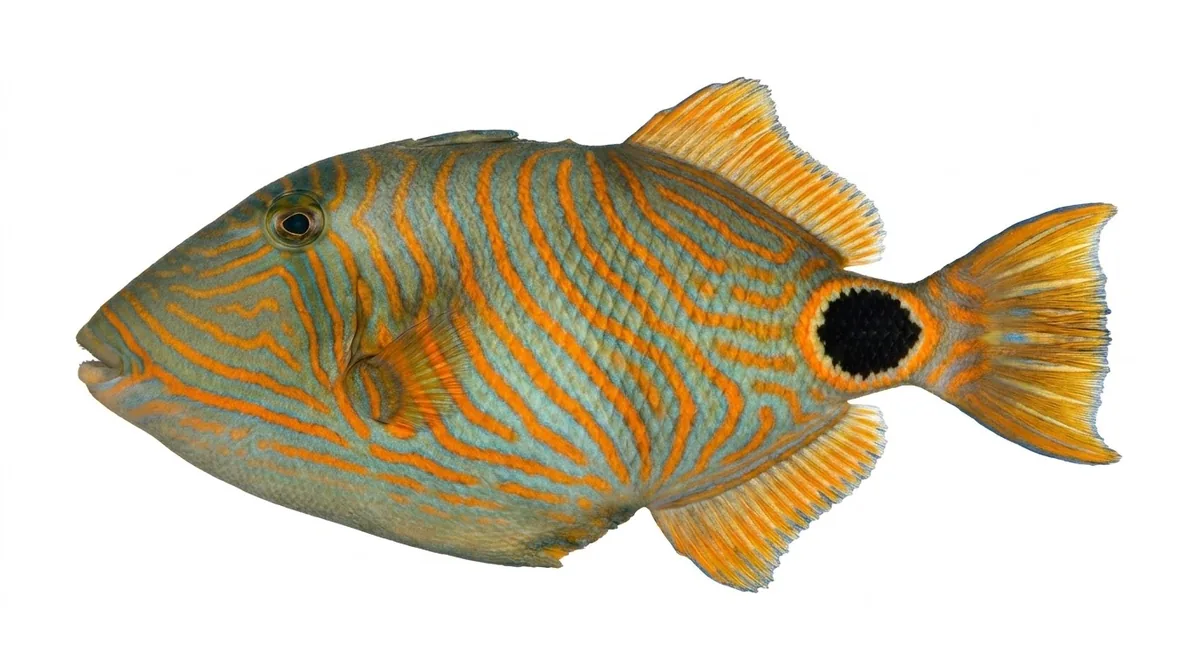
Orange-lined triggerfish
Balistapus undulatus
- Saltwater
- Least Concern
- Max length
- 30 cm
- Class
- Teleostei
- Order
- Tetraodontiformes
- Family
- Balistidae
- Genus
- Balistapus
- Indian Ocean, Eastern
- Indian Ocean, Western
- Pacific, Eastern Central
- Pacific, Northwest
- Pacific, Western Central
About the orange-lined triggerfish
The orange-lined triggerfish (Balistapus undulatus), also known as the orangestripe triggerfish, red-lined triggerfish, striped triggerfish or vermiculated triggerfish, is a species of marine ray-finned fish belonging to the family Balistidae, the triggerfishes. This species is the only species in the monospecific genus Balistapus, which is closely related to the genus Balistoides, if that genus is reclassified as a monospecific genus with the clown triggerfish as its only species. The orange-lined triggerfish has a wide Indo-Pacific range.
Distribution
While other balistoid fishes, such as the filefish and leatherjacks, are typically found all across the Indo-western Pacific, the triggerfish are typically found in coral reefs ecosystems, coral lagoons, and external reef slopes within this area, as well off the coast of East Africa, the Red Sea, and Japan. They tend to stay around their burrows and dens within the reef. Within coral reefs, the orange-lined triggerfish are more versatile than other triggerfish species and can be found at depths up to 50 meters, although studies have found that they prefer depths of 2 to 8 meters. No relationship between the area of the reef and depth has been found in juveniles, and adults were found to vary their depth based on the region; in general, the species was found to have a broad distribution across the reef. There is also a difference between the types of substrata that the adults and juvenile orange-lined triggerfish prefer: the adults were found to prefer rock and branching coral, while the juvenile fish were found to prefer softer surfaces.
Behaviour
The orange-lined triggerfish prefers parts of the reef where there are a lot of places to hide and are able to slide sideways into crevices or small openings to evade predation. Typically encountered as solitary fishes, their territory may overlap multiple female territories which are defended against intruding congeners. Once the female has accepted the male, the eggs are deposited on the substrate for the male to fertilise. The female then guards the eggs from predators. Triggerfish have a varied diet consisting of algae, sponges, crustaceans, molluscs, algae, sea urchins, tunicates, worms, fish eggs and detritus.
Description from Wikipedia, available under CC BY-SA.
Where the orange-lined triggerfish lives
Distribution data from GBIF (DOI: 10.15468/dl.8rzs8d).
Also known as
- Orangestriped
- Orangestripe triggerfish
- Red-lined triggerfish
- Striped triggerfish
- Vermiculated triggerfish
- Orangestreifen-Drückerfisch
- Rogatnica kolczasta
- Orangerandig tryckarfisk
- Baliste ondulé
- Baliste strié
- Leubiem kunèng
- Oranjestreep-snellervis
- Ostenec oranžovoproužkatý
- Aaltosäppikala
- Cumulacai
- Ikan kambing liris
- Jebung kelar jingga
- Groene trekkervis
- Оранжевополосый балистап
- 주황색선쥐치
- クマドリ
- سمكة الزند المتموجة
- কমলা-রেখাযুক্ত ট্রিগারফিশ
- ދަތްފުކު ރޮނޑު
- אחי-נצרן קווי
- ปลาวัวลายส้ม
- 鉤鱗魨