Fishing Calendar App
Spotted eagle ray
Aetobatus narinari
- Saltwater
- Endangered
- Max length
- 200 cm
- Class
- Elasmobranchii
- Order
- Myliobatiformes
- Family
- Aetobatidae
- Genus
- Aetobatus
- Atlantic, Southwest
- Atlantic, Western Central
- Indian Ocean, Eastern
- Indian Ocean, Western
- Pacific, Eastern Central
- Pacific, Southeast
- Pacific, Western Central
About the spotted eagle ray
The spotted eagle ray (Aetobatus narinari) is a cartilaginous fish of the eagle ray family, Aetobatidae. As traditionally recognized, it is found globally in tropical regions, including the Atlantic, Pacific and Indian Oceans. Recent authorities have restricted it to the Atlantic (including the Caribbean and Gulf of Mexico) with other populations recognized as the ocellated eagle ray (A. ocellatus) and Pacific white-spotted eagle ray (A. laticeps). Spotted eagle rays are most commonly seen alone, but occasionally swim in groups. They are ovoviviparous, the female retaining the eggs then releasing the young as miniature versions of the parent.
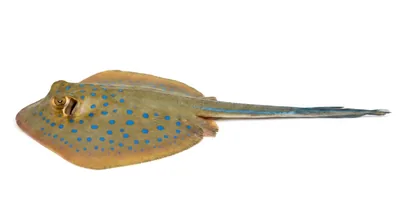
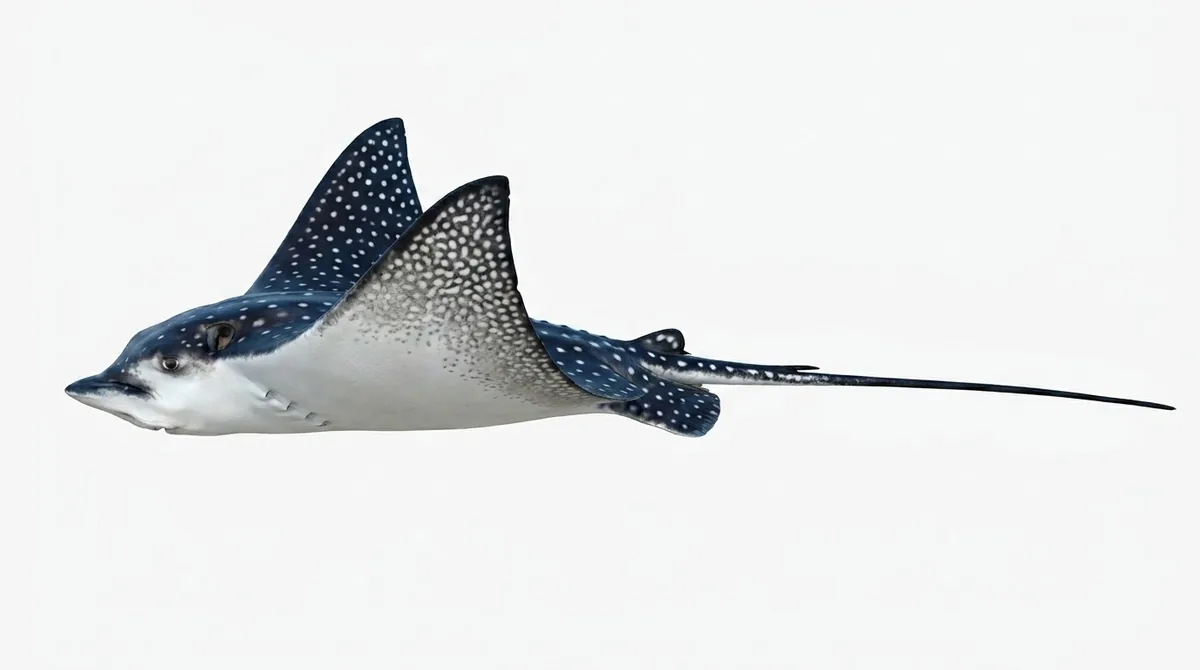
This ray can be identified by its dark dorsal surface covered in white spots or rings. Near the base of the ray's relatively long tail, just behind the pelvic fins, are several venomous, barbed stingers. Spotted eagle rays commonly feed on small fish and crustaceans, and will sometimes dig with their snouts to look for food buried in the sand of the sea bed. These rays are commonly observed leaping out of the water, and on at least two occasions have been reported as having jumped into boats, in one incident resulting in the death of a woman in the Florida Keys. The spotted eagle ray is hunted by a wide variety of sharks. The rays are considered near threatened on the IUCN Red List. They are fished mainly in Southeast Asia and Africa, the most common market being in commercial trade and aquariums. They are protected in the Great Barrier Reef.
Distribution
As traditionally defined, spotted eagle rays are found globally in tropical regions from the Indo-Pacific region from the western Pacific Ocean, the Indian Ocean, and the western Atlantic Ocean. They are found in shallow coastal water by coral reefs and bays, in depths down to 80 meters (262 ft).
Spotted eagle rays are found in warm and temperate waters worldwide. In the western Atlantic Ocean it is found off the eastern coast of United States of America, the Gulf Stream, the Caribbean, and down past the southern part of Brazil. In the Indian Ocean, it is found from the Red Sea down to South Africa and eastward to the Andaman Sea. In the Western Pacific Ocean it can be found near Japan and north of Australia. In the Central Pacific Ocean, it can be found throughout the Hawaiian Islands. In the Eastern-Pacific Ocean, it is found in the Gulf of California down through Puerto Pizarro, an area that includes the Galapagos Islands. Spotted eagle rays are most commonly seen in bays and reefs. They spend much of their time swimming freely in open waters, generally in schools close to the surface, and can travel long distances in a day.
Within these regions, there are significant variations in genetics and morphology. As a consequence, recent authorities have split it into three: This restricts the true spotted eagle ray (A. narinari) to the Atlantic, while the Indo-Pacific population is the ocellated eagle ray (A. ocellatus) and the East Pacific is the Pacific white-spotted eagle ray (A. laticeps).
Behaviour
Spotted eagle rays prefer to swim in waters of 24 to 27 °C (75 to 81 °F). Their daily movement is influenced by the tides; one tracking study showed that they are more active during high tides. Uniquely among rays they dig with their snouts in the sand, surrounding themselves in a cloud of sand that spews from their gills. They also exhibit two motions in which the abdomen and the pectoral fins are moved rapidly up and down: the pelvic thrust and the extreme pelvic thrust. The pelvic thrust is usually performed by a solitary ray, and repeated four to five times rapidly. The extreme pelvic thrust is most commonly observed when the ray is swimming in a group, from which it will separate itself before vigorously thrusting with its pectoral fins. The rays also performs dips and jumps; in a dip the ray will dive and then come back up rapidly, perhaps as many as five times consecutively. There are two main types of jump: in one, the ray propels itself vertically out of the water, to which it returns along the same line; the other is when the ray leaps at a 45° angle, often repeated multiple times at high speeds. When in shallow waters or outside their normal swimming areas, the rays are most commonly seen alone, but they do also congregate in schools. One form of travelling is called loose aggregation, which is when 3 to 16 rays are swimming in a loose group, with occasional interactions between them. A school commonly consists of 6 or more rays swimming in the same direction at exactly the same speed.
Description from Wikipedia, available under CC BY-SA.
Where the spotted eagle ray lives
Distribution data from GBIF (DOI: 10.15468/dl.8rzs8d).
Also known as
- Whip moray
- Chucho pintado
- Raie léopard
- Gefleckter Adlerrochen
- Orleń cętkowany
- Raia-pintada
- Arraia-chita
- Arraia-pintada
- Papagaio
- Pintada
- Raia-chita
- Raia-leopardo
- Ratão-pintado
- Pegasti narinari
- Spikkelarendrog
- Bulik
- Tähtikotkarausku
- Vai ikeli matailalai
- Foltos sasrája
- Pari elang tutul
- Gevlekte adelaarsrog
- Cá ó sao
- Обыкновенный пятнистый орляк
- マダラトビエイ
- Петнист орлов скат
- চিত্রা শঙ্খচিল
- טחן נקוד
- Дақты скат
- പുള്ളി കാക്കത്തിരണ്ടി
- வலுவாடி
- ปลากระเบนค้างคาว
- Скат плямистий
- 雪花鴨嘴燕魟
- شعاع النسر المرقط
Where to catch spotted eagle ray
- Cape Fear River United States River · North Carolina
- Florida Bay (Everglades) United States Bay · Florida
- Florida Keys United States Coast · Florida
- Galveston Bay United States Bay · Texas
- Lake Pontchartrain United States Lake · Louisiana
- Port Aransas United States Coast · Texas