Fishing Calendar App
Shy hamlet
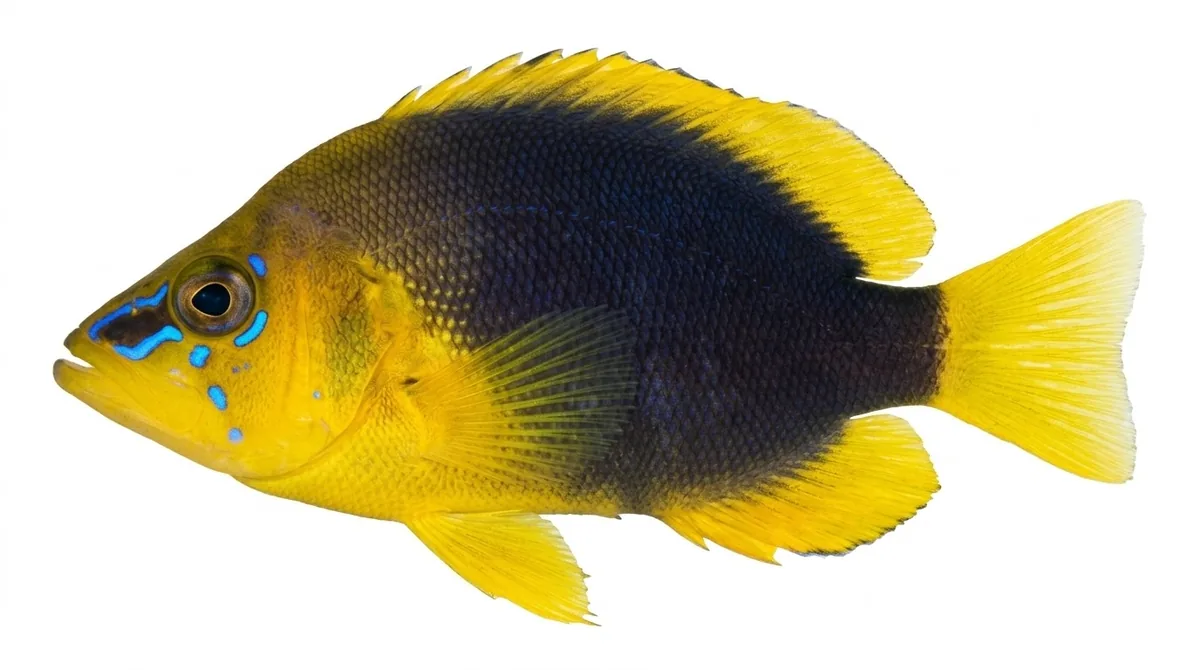
Hypoplectrus guttavarius
- Saltwater
- Least Concern
- Max length
- 13 cm
- Class
- Teleostei
- Order
- Perciformes
- Family
- Serranidae
- Genus
- Hypoplectrus
- Atlantic, Western Central
About the shy hamlet
The shy hamlet (Hypoplectrus guttavarius) is a small Western Atlantic serranid fish, which belongs to the subclass perciformes in the class Actinopterygii (ray-finned fishes). To this date, seventeen species of the genus Hypoplectrus have been recognized, a third of which have been discovered in the past few years.
They are synchronous hermaphrodites; ecologically and morphologically, all are remarkably similar in major features except for their color pattern which is how they are differentiated into different species.
The name is derived from its personality because they are a solitary species that travel in pairs. They are mostly found in the Western Atlantic Ocean on Caribbean inshore areas in low depths (3–30 m or 10–100 ft) and in temperatures of about 22–27 °C (72–81 °F). Their habitat is rocks and corals. Hamlets are small and bright colored, specifically, shy hamlets have a yellow head and fins followed by a brown-black body. In addition, there are bright blue stripes around the eye and on the snout. They are carnivores and mostly feed on crustaceans such as shrimp, clam, squid etc. as well as other bony fish.
Shy hamlets were first formally described as Plectropoma guttavarium in 1852 by the Cuban zoologist Felipe Poey (1799–1891) with Havana given as the type of locality.
Distribution
The shy hamlet inhabits the tropical Caribbean seas. The fish is primarily pelagic and can be found on inshore areas in low depths (3–30 m or 10–100 ft) and in temperatures of about 22–27 °C (72–81 °F). They are coral reef fishes that vary in their distribution but tend to be highly sympatric, with up to nine species found on a single reef.
In a study of the distribution of hamlets in the Greater Caribbean region using cluster and nMDS analyses, where hamlets were divided into three major groups: widespread, less widespread, where the shy hamlets belong to and geographically confined or segregated.
Behaviour
Shy hamlets are reef-associated carnivorous predatory fishes. While little is known about what the shy hamlet specifically eats, other species of hamlets have been known to feed on smaller fish, crustaceans, and shrimp. For crustaceans, hamlets have been known to eat mysid shrimp, crabs, and mantis shrimps. Hamlets have also been observed to eat fish such as Chromis cyanea.
Description from Wikipedia, available under CC BY-SA.
Where the shy hamlet lives
Distribution data from GBIF (DOI: 10.15468/dl.8rzs8d).
Also known as
- Ujoperhoahven
- 半黃半紫低紋鮨
Where to catch shy hamlet
- Cape Fear River United States River · North Carolina
- Florida Bay (Everglades) United States Bay · Florida
- Florida Keys United States Coast · Florida
- Galveston Bay United States Bay · Texas
- Lake Pontchartrain United States Lake · Louisiana
- Port Aransas United States Coast · Texas