Fishing Calendar App
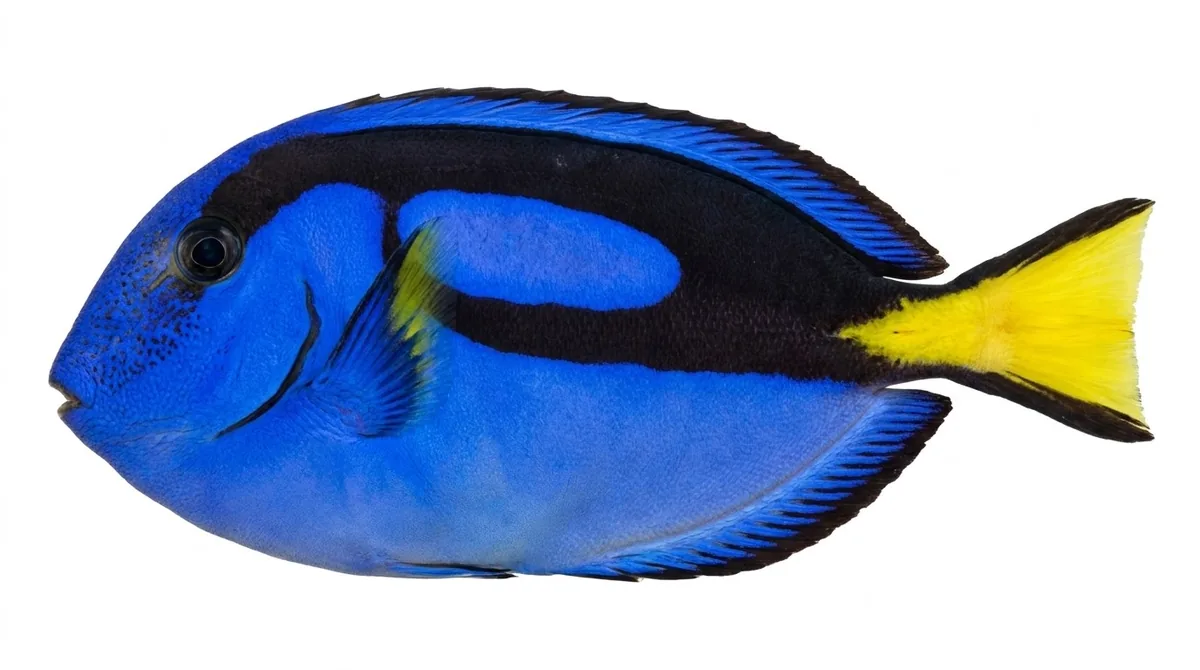
Palette surgeonfish
Paracanthurus hepatus
- Saltwater
- Least Concern
- Max length
- 31 cm
- Class
- Teleostei
- Order
- Acanthuriformes
- Family
- Acanthuridae
- Genus
- Paracanthurus
- Atlantic, Western Central
- Indian Ocean, Eastern
- Indian Ocean, Western
- Pacific, Eastern Central
- Pacific, Northwest
- Pacific, Southwest
- Pacific, Western Central
About the palette surgeonfish
Paracanthurus hepatus is a species of Indo-Pacific surgeonfish. A popular fish in marine aquaria, it is the only member of the genus Paracanthurus.
A number of common names are attributed to the species, including regal tang, palette surgeonfish, blue tang (leading to confusion with the Atlantic species Acanthurus coeruleus), royal blue tang, hippo tang, blue hippo tang, flagtail surgeonfish, Pacific regal blue tang, blue surgeonfish, hepatus tang, Indo-Pacific blue tang, regal blue surgeonfish, wedge-tailed tang, and wedgetail blue tang.
It is most closely related to genus Zebrasoma, with which it forms a sister group.
Habitat
Paracanthurus is a diurnal marine species that occupies marine neritic habitats along coastlines. It is found in clear water on exposed outer reef areas or in channels with a moderate or strong current. It primarily utilizes coral reef habitats, but is also known to utilize seagrass beds, mangroves, algal beds, and rocky reefs [1]. It has an upper and lower depth limit of 2 meters and 40 meters, respectively . They live in pairs or small groups of 8 to 14 individuals. They can also be found near cauliflower corals on the seaweed side of coral reefs. Juveniles can be found in schools using Acropora for shelter. Numbers of males and females tend to maintain a 1:1 ratio.
The fish is important for coral health, as it eats algae that may otherwise choke it by overgrowth.
Distribution
The regal blue tang can be found throughout the Indo-Pacific. It is seen in the reefs of the Philippines, Indonesia, Japan, the Great Barrier Reef of Australia, New Caledonia, Samoa, East Africa, and Sri Lanka. A single specimen was photographed in 2015 in the Mediterranean Sea off Israel. Vagrants were found two separate occasions in Hawaii, and are assumed to be aquarium releases.
Paracanthurus is an extant resident in the following territories: American Samoa; Australia; British Indian Ocean Territory; Brunei Darussalam; Christmas Island; Cocos (Keeling) Islands; Comoros; Cook Islands; Disputed Territory (Paracel Is., Spratly Is.); Fiji; French Southern Territories (Mozambique Channel Is.); Guam; India (Nicobar Is., Andaman Is.); Indonesia; Japan; Kenya; Kiribati (Kiribati Line Is., Phoenix Is., Gilbert Is.); Madagascar; Malaysia; Maldives; Marshall Islands; Mauritius; Mayotte; Micronesia, Federated States of ; Myanmar; Nauru; New Caledonia; Niue; Northern Mariana Islands; Palau; Papua New Guinea; Philippines; Réunion; Samoa; Seychelles; Singapore; Solomon Islands; Somalia; South Africa; Sri Lanka; Taiwan, Republic of China; Tanzania, United Republic of; Thailand; Timor-Leste; Tokelau; Tonga; Tuvalu; United States (Hawaiian Is.); United States Minor Outlying Islands (US Line Is., Howland-Baker Is.); Vanuatu; Viet Nam; Wallis and Futuna.
Behaviour
As a juvenile, its diet consists primarily of plankton. Adults are omnivorous and feed on zooplankton, but will also graze on filamentous algae.
Description from Wikipedia, available under CC BY-SA.
Where the palette surgeonfish lives
Distribution data from GBIF (DOI: 10.15468/dl.8rzs8d).
Also known as
- Paletten-Doktorfisch
- Pokolec królewski
- Palettkirurg
- Cirurgião-patela
- Cirurgião
- Modri kirurg
- Chirurgien bleu
- Chirurgien-palette
- Palet-doktervis
- Peix cirurgià blau indopacífic
- Bodlok pestrý
- Palettivälskäri
- Palettás doktorhal
- Vėliaviniai chirurgai
- Debam ekor kuning
- Picassodoktersvis
- Голубой хирург
- 남양쥐돔
- ナンヨウハギ
- ދޮންނޫ ކާޅު
- جراحماهی آبی
- נתחן כחול
- പാരകാന്തുറസ്
- نیلی مجاجنی
- Плави танг
- ปลาขี้ตังเบ็ดฟ้า
- Cá bắp nẻ xanh
- 拟刺尾鲷
- 擬刺尾鯛
- الهيبو تانج
Where to catch palette surgeonfish
- Cape Fear River United States River · North Carolina
- Florida Bay (Everglades) United States Bay · Florida
- Florida Keys United States Coast · Florida
- Galveston Bay United States Bay · Texas
- Lake Pontchartrain United States Lake · Louisiana
- Port Aransas United States Coast · Texas