Fishing Calendar App
Yellow tang
Zebrasoma flavescens
- Saltwater
- Least Concern
- Max length
- 20 cm
- Class
- Teleostei
- Order
- Acanthuriformes
- Family
- Acanthuridae
- Genus
- Zebrasoma
- Atlantic, Western Central
- Pacific, Eastern Central
- Pacific, Northwest
- Pacific, Western Central
About the yellow tang
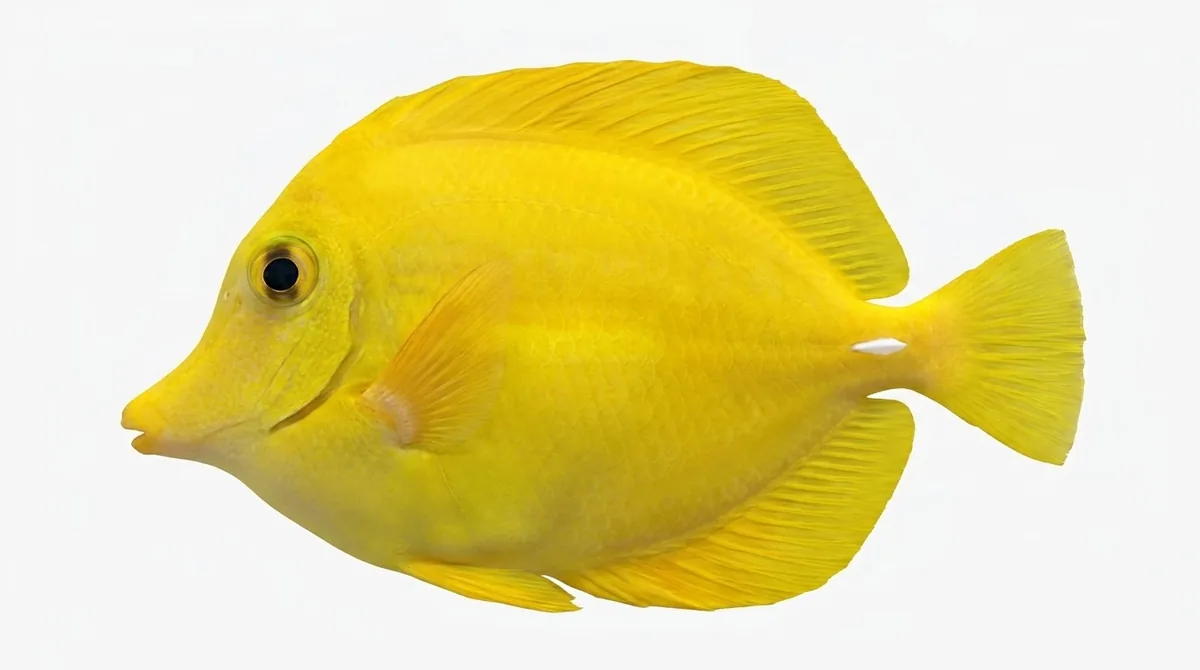
The yellow tang (Zebrasoma flavescens), also known as the lemon sailfin, yellow sailfin tang or somber surgeonfish, is a species of marine ray-finned fish belonging to the family Acanthuridae which includes the surgeonfishes, unicornfishes and tangs. Bright yellow in color, it is one of the most popular marine aquarium fish, though in its natural state, it lives in reefs. The yellow tang spawns around a full moon, eats algae, and has a white barb, located just before the tail fin, to protect itself.
Distribution
It is commonly found in shallow reefs, from 2–46 metres (6.6–150.9 ft) deep, in the Pacific Ocean (Ryukyu, Mariana, Marshall, Marcus, Wake, and Hawaiian islands), west of Hawaii and east of Japan. There have also been reports that they have been found off the coast of Florida in the Western Central Atlantic. A single specimen was filmed in the Mediterranean Sea in Spanish waters in 2008, a likely aquarium release. As of July of 2024, yellow tangs have been spotted several times on the shallow reefs of Mexico's Riviera Maya.
Their habitat is tropical with a temperature range of 24–28 °C (75–82 °F). Hawaii was the most common place for aquarium harvesting, prior to the export ban, where up to 70% of the yellow tangs for the aquarium industry were sourced from. Over 70% of the yellow tang's natural range is protected from collection and fishing. The yellow tang is listed as "Least Concern" by the International Union for Conservation of Nature (IUCN).
Behaviour
In the wild, yellow tangs feed on benthic turf algae and other marine plant material. In captivity, they are commonly fed meat/fish-based aquarium food, but the long-term health effects of this diet are questionable. However, most experts in the marine aquarium industry express little scepticism that such a well rounded and balanced diet including plant and animal material would be in any way detrimental to mostly herbivorous fishes like tangs since they still need on occasion, complex amino acids and nutrients that only ocean animals can provide. In the wild, yellow tangs provide cleaner services to marine turtles, by removing algal growth from their shells.
Description from Wikipedia, available under CC BY-SA.
Where the yellow tang lives
Distribution data from GBIF (DOI: 10.15468/dl.8rzs8d).
Also known as
- Lemon sailfin
- Somber surgeonfish
- Yellow sailfin tang
- Chirurgien jaune
- Gelber Segelflossendoktor
- Gelber Segeldoktorfisch
- Hawaii-Doktorfisch
- Zebrasoma żółta
- Gul kirurg
- Bodlok žlutý
- Keltavälskäri
- Sárga doktorhal
- Botana kuning
- Geltonoji chirurgžuvė
- Gele doktersvis
- Cá đuôi gai vàng
- 노랑양쥐돔
- キイロハギ
- سمكة صفراء
- سمكه صفراء
- جراحماهی زرد
- पीला तांग
- پیلی پتنگ
- Жути танг
- மஞ்சள் தாங் மீன்
- 黃高鰭刺尾魚
Where to catch yellow tang
- Cape Fear River United States River · North Carolina
- Florida Bay (Everglades) United States Bay · Florida
- Florida Keys United States Coast · Florida
- Galveston Bay United States Bay · Texas
- Lake Pontchartrain United States Lake · Louisiana
- Port Aransas United States Coast · Texas