Fishing Calendar App
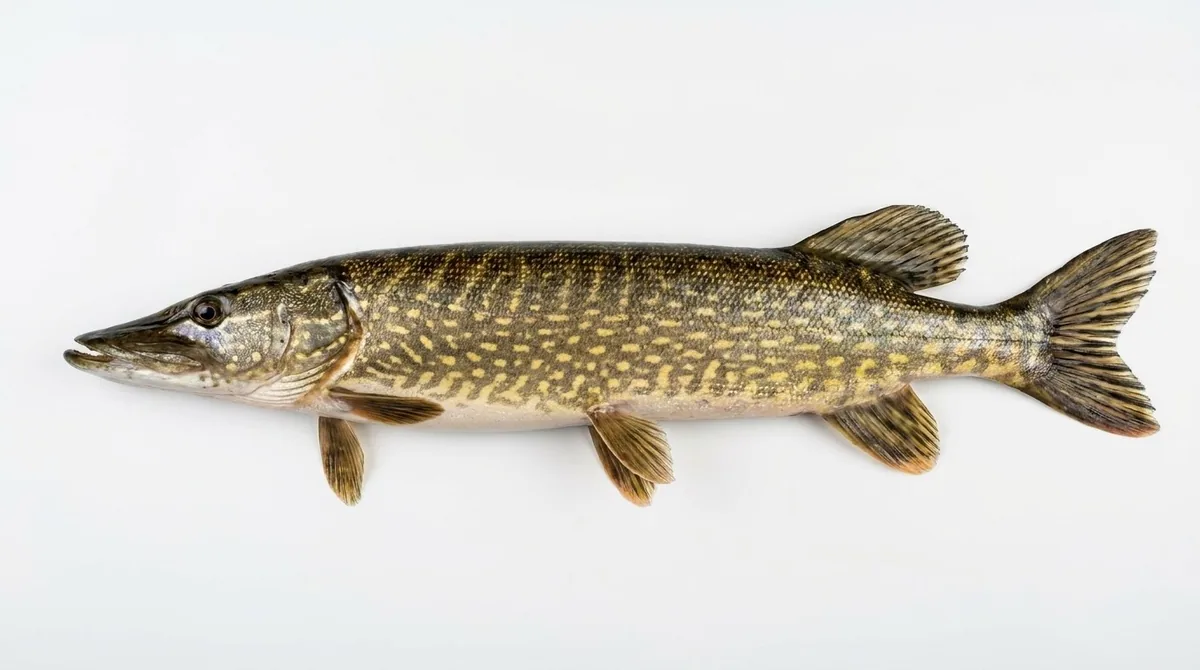
Northern pike
Esox lucius
- Freshwater
- Least Concern
- Max length
- 150 cm
- Class
- Teleostei
- Order
- Esociformes
- Family
- Esocidae
- Genus
- Esox
- North America - Inland waters
- Asia - Inland waters
- Europe - Inland waters
About the northern pike
The northern pike (Esox lucius), also known as pickerel, jack, northern or simply pike, is a species of carnivorous fish of the genus Esox (pikes). It is commonly found in fresh waters of the Northern Hemisphere (i.e. it has a holarctic distribution).
Pike can grow to a relatively large size. Their average length is about 40–55 cm (16–22 in), with maximum recorded lengths of up to 150 cm (59 in) and maximum weights of 28.4 kg (63 lb). The IGFA currently recognises a 25 kg (55 lb) pike caught by Lothar Louis on Greffern Lake, Germany, on 16 October 1986, as the all-tackle world-record holding northern pike. Northern pike grow to larger sizes in Eurasia than in North America, and in coastal Eurasian regions than inland ones.
Habitat
Pike are found in sluggish streams and shallow, weedy places in lakes and reservoirs, as well as in cold, clear, rocky waters. They are typical ambush predators; they lie in wait for prey, holding perfectly still for long periods, and then exhibit remarkable acceleration as they strike. They inhabit any water body that contains fish, but suitable places for spawning are also essential. Because of their cannibalistic nature, young pike need places where they can take shelter between plants so they are not eaten. In both cases, rich submerged vegetation is needed. Pike are seldom found in brackish water, except for the Baltic Sea area, here they can be found spending time both in the mouths of rivers and in the open brackish waters of the Baltic Sea. It is normal for pike to return to fresh water after a period in these brackish waters. They seem to prefer water with less turbidity, but that is likely related to their dependence on the presence of vegetation.
Distribution
Esox lucius is found in fresh water throughout the Northern Hemisphere, including Russia, Europe, and North America. It has also been introduced to lakes in Morocco, and is even found in brackish water of the Baltic Sea, but they are confined to the low-salinity water at the surface of the sea, and are seldom seen in brackish water elsewhere.
Within North America, northern pike populations are found in Maine, New Hampshire, Vermont, Massachusetts, Rhode Island, Connecticut, New York, New Jersey, Pennsylvania, Maryland, West Virginia, Ohio, Michigan, Indiana, Illinois, Wisconsin, Minnesota, Iowa, Missouri, North Dakota, South Dakota, Nebraska, Kansas, Montana, Idaho, Utah, Colorado, Oklahoma, northern Texas, northern New Mexico, northern Arizona, Alaska, the Yukon, the Northwest Territories, Alberta, Saskatchewan, Manitoba, Ontario, and Québec (pike are rare in British Columbia and east coast provinces). Watersheds in which pike are found include the Ohio Valley, the upper Mississippi River and its tributaries, and the Great Lakes Basin. They are also stocked in, or have been introduced to, some western lakes and reservoirs for sport fishing, although some fisheries managers believe this practice often threatens other species of fish such as bass, trout, and salmon, causing government agencies to attempt to exterminate the pike by poisoning lakes, such as Stormy Lake, Alaska. E. lucius is a severe invasive predator in Box Canyon Reservoir on the Pend Oreille River in northeastern Washington.
Behaviour
Pike are capable of "fast start" movements, which are sudden high-energy bursts of unsteady swimming. Many other fish exhibit this movement as well. Most fish use this mechanism to avoid life-threatening situations. For the pike, however, it is a tool used to capture prey from their sedentary positions. They flash out in such bursts and capture their prey. These fast starts terminate when the pike has reached maximum velocity. During such motions, pike make "S" conformations while swimming at high rates. To decelerate, they, simply make a "C" conformation, exponentially slowing down their speed so that they can "stop". An interesting behavioural trait that pike have is that they have short digestion times and long feeding periods. They can undergo many of these fast bursts to collect as much prey as they can. Pike are least active during the night.
Description from Wikipedia, available under CC BY-SA.
Where the northern pike lives
Distribution data from GBIF (DOI: 10.15468/dl.8rzs8d).
Also known as
- Pike
- Jack
- Pickerel
- Grand brochet
- Brochet
- Brochet du Nord
- Hecht
- Gädda
- Luccio
- Evropska ščuka
- Ščuka
- Lucio
- Szczupak pospolity
- Szczupak
- Gjedde
- Kinocew
- Adi durnabalığı
- Līdeka
- Beked
- Lluç de riu
- Hevéesénoma'ne
- Štika obecná
- Szczëka
- Penhwyad
- Gedde
- Lus
- Ezoko
- Lutxo arrunt
- Hauki
- Liús
- Šćuka
- Csuka
- Gedda
- Europinė lydeka
- Līdaka
- Haugi
- Broeché
- Știucă
- Ged
- Hávga
- Šťuka severná
- Puško
- Brotchet
- Štuka
- Haug
- Snoek
- 강꼬치고기
- Щука
- Щука обыкновенная
- ノーザンパイク
- كراكي رمحي
- كراكى رمحى
- Λούτσος των ποταμών
- اردکماهی
- זאב נהרות צפוני
- Գայլաձկներ
- წერი
- Шортан
- Ведьгаз
- Ердийн цурхай
- Нужгол
- Нучко
- Хихор
- Сордоҥ
- Чуртан
- Шуруш
- Щука звичайна
- Cá chó phương bắc
- 白斑狗鱼
- Шчупак звычайны
- Штука
- 白斑狗魚
Where to catch northern pike
- Attersee Austria Lake · live river data
- Neusiedler See Austria Lake · live river data
- Wolfgangsee Austria Lake · live river data
- Zeller See Austria Lake · live river data
- Ammersee Germany Lake · live river data
- Bodensee (Lake Constance) Germany Lake · live river data