Fishing Calendar App
Great barracuda
Sphyraena barracuda
- Saltwater
- Least Concern
- Max length
- 200 cm
- Class
- Teleostei
- Order
- Carangaria incertae sedis
- Family
- Sphyraenidae
- Genus
- Sphyraena
- Atlantic, Eastern Central
- Atlantic, Northeast
- Atlantic, Southwest
- Atlantic, Western Central
- Indian Ocean, Eastern
- Indian Ocean, Western
- Pacific, Eastern Central
- Pacific, Northwest
- Pacific, Western Central
About the great barracuda
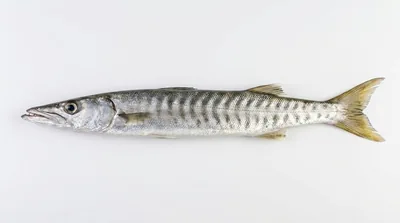
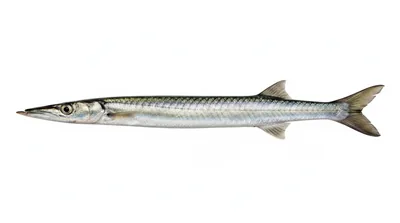
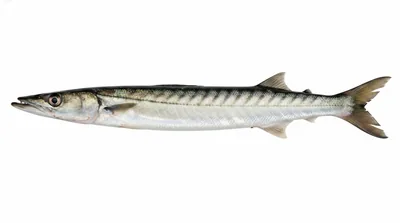
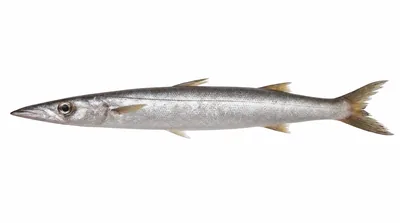
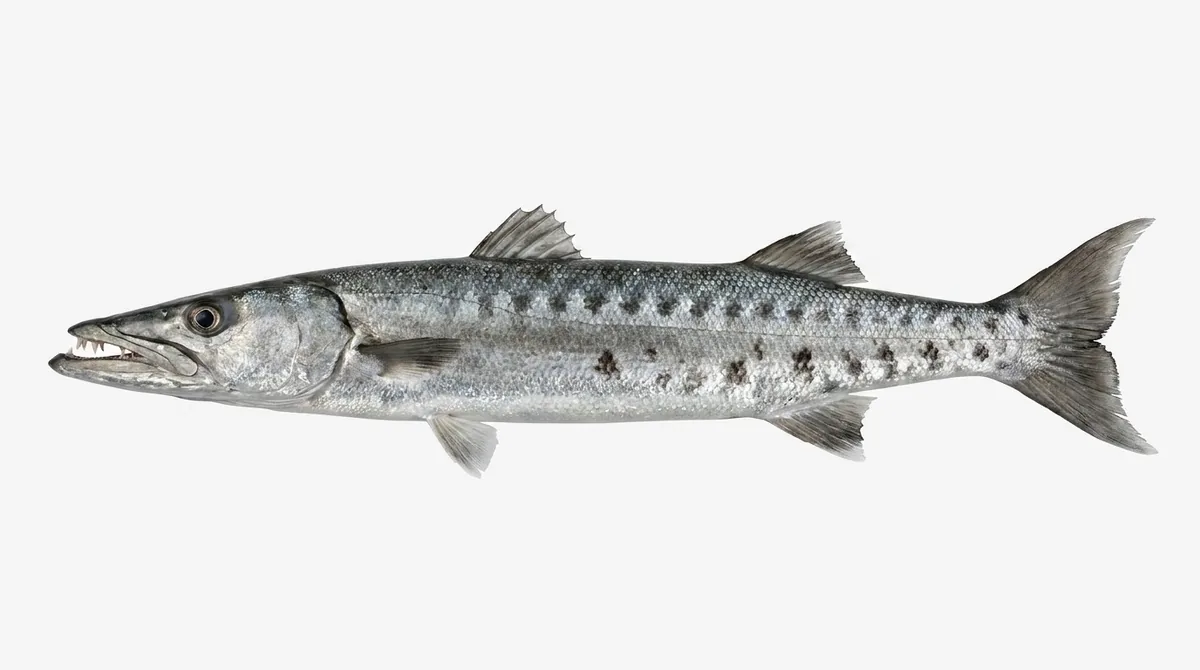
Sphyraena barracuda, commonly known as the great barracuda, is a species of barracuda, a genus of 27 species of large ray-finned fish found in subtropical oceans worldwide. In its natural habitat, the great barracuda is an apex predator.
Distribution
The great barracuda is present in tropical to warm temperate waters, in subtropical parts of the Indian, Pacific, and Atlantic oceans. Primarily found in oceans near the equator, the great barracuda finds refuge in mangroves to deep reefs, and seagrass beds, up to depths of 110 m (360 ft). Juveniles and small adults typically inhabit locations near the shore, such as mangroves and seagrass meadows, while adults are typically found further away from shore around artificial structures, reefs, and rock outcroppings. These fish use these structures as a form of refuge. Studies conducted by a research group that tagged and monitored these fish in the Bahamas concluded that a significant proportion of the population stayed in their residential habitats for a long period of time; however, a small portion of the population have traveled outwards, suggesting they are capable of large-scale migration.
Behaviour
Barracudas live in open seas. They are voracious predators and hunt by ambush. They rely on surprise and short bursts of speed up to 36 mph (58 km/h) to overrun their prey, sacrificing maneuverability. The Barracuda's dorsal and anal fin are located in the posterior segment of its body. This is an evolutionary trait that allows the fish to move quickly and have an ambush attack style. The gill covers do not have spines and are covered with small scales. The two dorsal fins are widely separated, with the first having five spines and the second having one spine and nine soft rays. The second dorsal fin equals the anal fin in size and is situated more or less above it. The lateral line is prominent and extends straight from head to tail. The spinous dorsal fin is situated above the pelvis. The hind end of the caudal fin is forked or concave, and it is set at the end of a stout peduncle. The pectoral fins are low down on the sides. The barracuda has a large swim bladder.
Barracudas are more or less solitary. Young and half-grown fish frequently congregate in schools. The great barracuda captures small prey through the ram-capturing method. This is done by opening their mouth and engulfing the prey with just one bite. While with bigger prey, the ram capture method is still used. But requires multiple bites and lateral shaking of the head to reduce the prey to smaller pieces and move towards the anterior portion of the mouth to be eaten.
Barracudas can reach at least 14 years of age. The spawning season lasts from April to October. Females can release about 5,000 to 30,000 eggs. The highest spawn rate occurs in July, August, and September, then drops off in the months after (especially in winter). Studies conducted on S. barracuda in Florida have found that females reach sexual maturity as early as 1–2 years of age and males at 3–4 years of age, concluding that females reach maturity about 1 year earlier than males.
The diets of these top predators are composed almost totally of fish (such as killifishes, herrings, sardines, gobies, silversides, anchovies, small mullets, and lizardfish), cephalopods, and occasionally shrimp. Large barracudas, when gorged, may attempt to herd a school of prey fish in shallow water, where they guard over them until they are ready for another hunt.
Description from Wikipedia, available under CC BY-SA.
Where the great barracuda lives
Distribution data from GBIF (DOI: 10.15468/dl.8rzs8d).
Also known as
- Barracuda
- Großer Barrakuda
- Barrakuda wielka
- Barrakuda
- Tabangko
- Soltýn barakuda
- Ongo
- Nagy barrakuda
- Barakuda besar
- Barakuda
- Alu-alu besar
- Grote barracuda
- Picuda
- Baracudă mare
- Rumpe
- Большая барракуда
- 큰꼬치고기
- オニカマス
- بركودة كبيرة
- الباراكودا الكبيره
- نیزهماهی بزرگ
- ברקודה ענקית
- Голема баракуда
- ปลาสากใหญ่
- Баракуда велика
- Cá nhồng lớn
- 大鱗魣
Where to catch great barracuda
- Limfjord Denmark Fjord · North Jutland
- Skagen Coast Denmark Coast · North Jutland
- Helsinki Archipelago Finland Archipelago · Uusimaa
- Rügen (Baltic Coast) Germany Coast · Mecklenburg-Vorpommern
- Sylt (Wadden Sea) Germany Coast · Schleswig-Holstein
- Dingle Bay Ireland Bay · Munster