Fishing Calendar App
Garibaldi
Hypsypops rubicundus
- Saltwater
- Least Concern
- Max length
- 30 cm
- Class
- Teleostei
- Order
- Ovalentaria incertae sedis
- Family
- Pomacentridae
- Genus
- Hypsypops
- Pacific, Eastern Central
- Pacific, Northeast
About the garibaldi
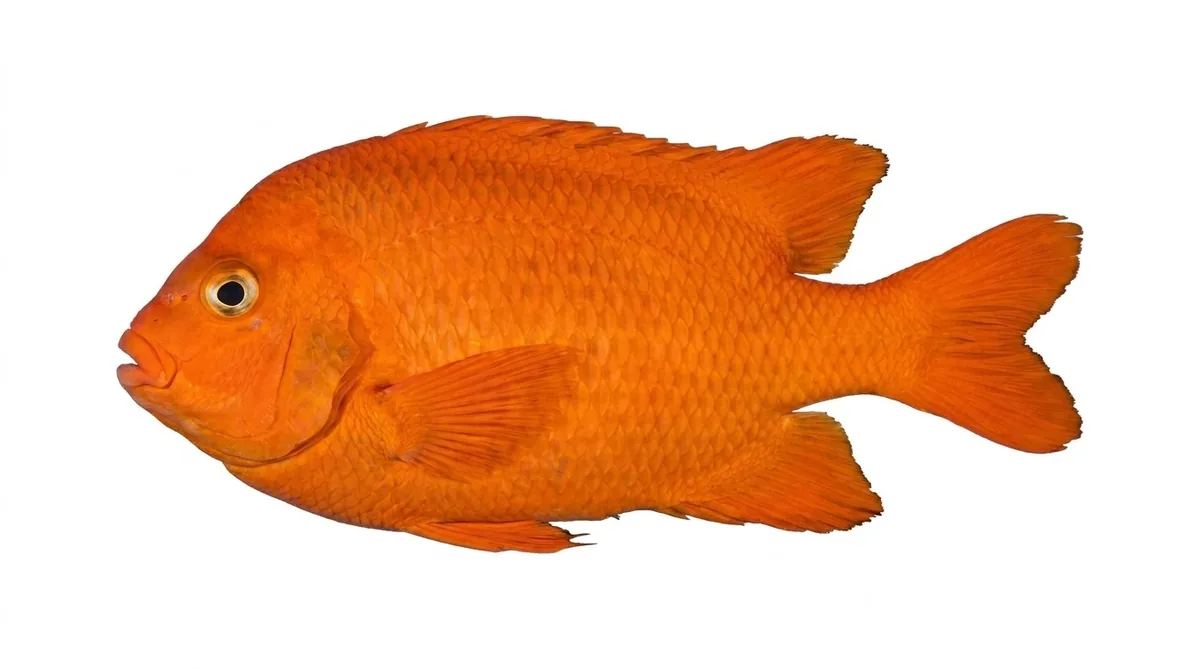
The Garibaldi, known historically also as the Catalina goldfish and marine goldfish and now commonly as the Garibaldi damselfish (Hypsypops rubicundus) is a species of bright orange fish in the damselfish family. It occurs in the subtropical northeastern part of the Pacific Ocean. The Garibaldi is the official marine state fish of California as of 1995, and has since been protected in California coastal waters from recreation and commercial fishing.
The English name, Garibaldi, is based on an Italian surname and is a reference to the Italian general and political figure Giuseppe Garibaldi, whose followers often wore a characteristic scarlet or red shirt. As is the case in all damselfish, male Garibaldis aggressively defend the nest site after the female lays eggs.
Distribution
Garibaldis are found in water from a depth of up to 30 metres (98 ft) depth, usually in association with rock reefs and typically over rocky sea-bottoms. They prefer to live over rocky bottoms on exposed or semi-protected coasts with clear water and plenty of crevices as well as small caves for cover. Juveniles can be found in tide pools and up to depths of 40 feet (just over 12 m). This species is native to the northeastern subtropical parts of the Pacific Ocean, ranging from Monterey Bay, California, to Guadalupe Island, Baja California.
Behaviour
Classified as generalist omnivores, Garibaldi feed mainly on invertebrates, which they remove from the rocks. Their diet also includes a variety of algae and occasionally their own eggs. Garibaldi are found to most commonly feed upon fleshy red algae, polychaete worms, anemones, and sponge fragments. But they have also been found to eat encrusting bryozoans, hydroids, branching bryozoans, mollusks, and brown algae.
Description from Wikipedia, available under CC BY-SA.
Where the garibaldi lives
Distribution data from GBIF (DOI: 10.15468/dl.8rzs8d).
Also known as
- Garibaldifisch
- Garibaldifisk
- Jaqueta garibaldi
- Garibaldiahven
- Гарибальдия
- سمكة غاريبالدي
- سمكه غاريبالدى
- دوشیزهماهی گاریبالدی
- גריבלדי
- 紅尾高歡雀鯛
Where to catch garibaldi
- Bristol Bay United States Bay · Alaska
- Columbia River at Astoria United States River · Oregon-Washington
- Monterey Bay United States Bay · California
- Puget Sound at Seattle United States Sound · Washington
- San Diego Bay United States Bay · California
- San Francisco Bay United States Bay · California