Fishing Calendar App
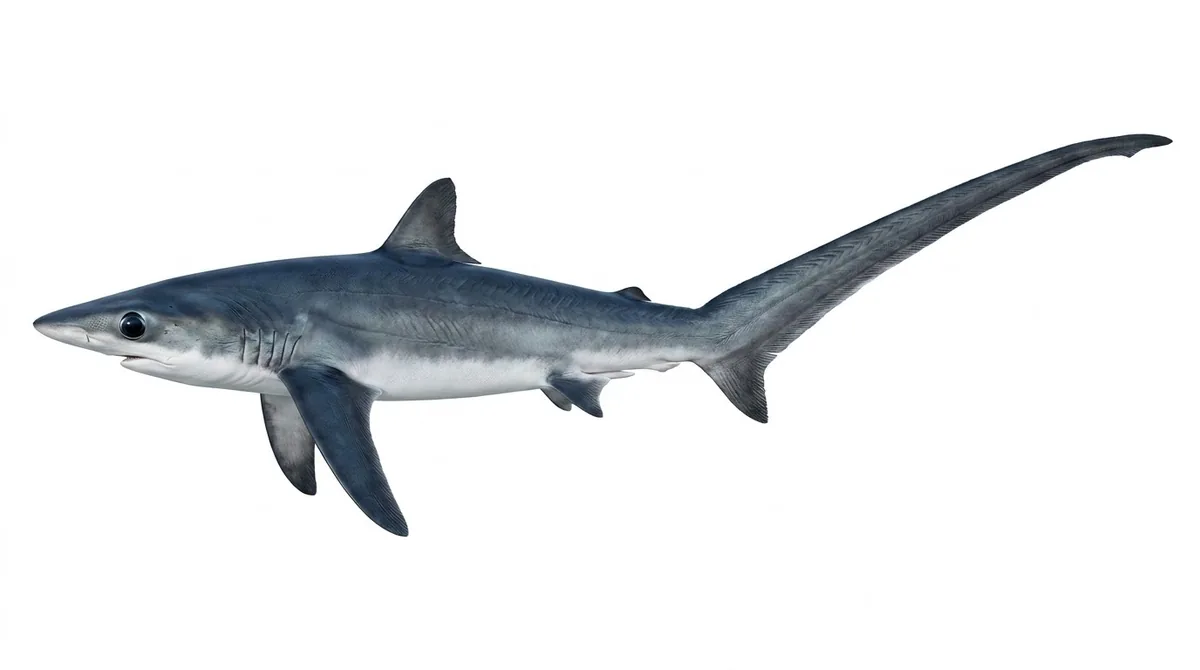
Common thresher
Alopias vulpinus
- Saltwater
- Vulnerable
- Max length
- 575 cm
- Class
- Elasmobranchii
- Order
- Lamniformes
- Family
- Alopiidae
- Genus
- Alopias
- Atlantic, Northeast
- Atlantic, Northwest
- Indian Ocean, Eastern
- Mediterranean and Black Sea
- Pacific, Eastern Central
- Pacific, Northeast
- Pacific, Southwest
About the common thresher
The common thresher (Alopias vulpinus), also known as Atlantic thresher, is the largest species of thresher shark, family Alopiidae, reaching some 6 m (20 ft) in length. About half of its length consists of the elongated upper lobe of its caudal fin. With a streamlined body, short pointed snout, and modestly sized eyes, the common thresher resembles (and has often been confused with) the pelagic thresher (A. pelagicus). It can be distinguished from the latter species by the white of its belly extending in a band over the bases of its pectoral fins. The common thresher is distributed worldwide in tropical and temperate waters, though it prefers cooler temperatures. It can be found both close to shore and in the open ocean, from the surface to a depth of 550 m (1,800 ft). It is seasonally migratory and spends summers at lower latitudes.
The long tail of the common thresher, the source of many fanciful tales through history, is used in a whip-like fashion to deliver incapacitating blows to its prey. This species feeds mainly on small schooling forage fishes such as herrings and anchovies. It is a fast, strong swimmer that has been known to leap clear of the water, and possesses physiological adaptations that allow it to maintain an internal body temperature warmer than that of the surrounding sea water. The common thresher has an aplacental viviparous mode of reproduction, with oophagous embryos that feed on undeveloped eggs ovulated by their mother. Females typically give birth to four pups at a time, following a gestation period of nine months.
Despite its size, the common thresher is minimally dangerous to humans due to its relatively small teeth and timid disposition. It is highly valued by commercial fishers for its meat, fins, hide, and liver oil; large numbers are taken by longline and gillnet fisheries throughout its range. This shark is also esteemed by recreational anglers for the exceptional fight it offers on hook-and-line. The common thresher has a low rate of reproduction and cannot withstand heavy fishing pressure for long, a case in point being the rapid collapse of the thresher shark fishery off California in the 1980s. With commercial exploitation increasing in many parts of the world, the International Union for Conservation of Nature has assessed this species as vulnerable.
Habitat
Common threshers are inhabitants of both continental waters and the open ocean. They tend to be most abundant in proximity to land, particularly the juveniles, which frequent near-coastal habitats such as bays. The species has been described as "coastal–oceanic", mostly occurring within 30 km (20 mi) of the coast with considerably lower populations beyond this limit. Most individuals are encountered near the surface, but this species has been recorded to at least a depth of 550 m (1,800 ft). Among eight individuals tagged and tracked for 22–49 hours off southern California, all spent the majority of their time within 40 m (130 ft) of the water surface, but periodically dived much deeper, in five individuals to depths of around 100 m (330 ft) or more. A study from the tropical Marshall Islands indicated that common threshers mainly spend the day at depths of about 160–240 m (520–790 ft) where the temperature is 18–20 °C (64–68 °F). Common threshers appear to prefer water temperatures between 16 and 21 °C (61 and 70 °F), but at least occasionally occur down to around 9 °C (48 °F).
Distribution
The range of the common thresher encompasses tropical and cold-temperate waters worldwide. In the western Atlantic, it is found from Newfoundland to the Gulf of Mexico, though it is rare north of New England, and from Venezuela to Argentina. In the eastern Atlantic, it has been reported from the North Sea and the British Isles to Ghana (including Madeira, the Azores, and the Mediterranean and Black Seas), as well as from Angola to South Africa. In the Indo-Pacific, this species is known from Tanzania to India and the Maldives, Japan, and Korea to southeastern China, Sumatra, eastern Australia, and New Zealand; it also occurs around a number of Pacific islands including New Caledonia, the Society Islands, Tabuaeran, and the Hawaiian Islands. In the eastern Pacific, it has been recorded from British Columbia to Chile, including the Gulf of California.
The common thresher is migratory, moving to higher latitudes following warm-water masses. In the eastern Pacific, males travel further than females, reaching as far as Vancouver Island in the late summer and early fall. Juveniles tend to remain in warm nursery areas. In New Zealand waters juveniles can be found over the inner shelf around the North Island and around the upper South Island. Separate populations with different life history characteristics apparently exist in the eastern Pacific and western Indian Ocean and possibly elsewhere; this species is not known to make transoceanic movements. In the northwestern Indian Ocean, males and females segregate by location and depth during the pupping season from January to May. Analysis of mitochondrial DNA has revealed substantial regional genetic variation within common threshers in all three oceans. This could support the idea that sharks from different areas, despite being highly mobile, rarely interbreed.
Behaviour
The long upper tailfin lobe of the common thresher is used to strike and incapacitate prey.
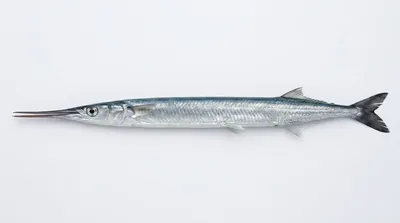
Some 97% of the common thresher's diet is composed of bony fishes, mostly small schooling forage fish such as sardine, anchovy, mackerel, hake, bluefish, herring, needlefish, and lanternfish. Before striking, the sharks compact schools of prey by swimming around them and splashing the water with their tails, often in pairs or small groups. Threshers are also known to take large, solitary fishes such as lancetfish, as well as squid and other pelagic invertebrates. Off California, common threshers feed mostly on the northern anchovy (Engraulis mordax), with Pacific hake (Merluccius productus), Pacific sardine (Sardinops sagax), Pacific mackerel (Scomber japonicus), market squid (Loligo opalescens), and pelagic red crab (Pleuroncodes planipes) also being important food items. The sharks concentrate on a few prey species during cold-water years, but become less discriminating during less productive, warmer El Niño periods.
Numerous accounts have been given of common threshers using the long upper lobes of their tail fins to stun prey, and they are often snagged on longlines by their tails after presumably striking at the bait. In July 1914, shark-watcher Russell J. Coles reported seeing a thresher shark use its tail to flip prey fish into its mouth, and that one fish that missed was thrown a "considerable distance". On April 14, 1923, noted oceanographer W.E. Allen observed a 2 m (6.6 ft) thresher shark pursuing a California smelt (Atherinopsis californiensis) off a pier at the Scripps Institution of Oceanography. The shark overtook the small fish and swung its tail above the water like a "coachwhip" with "confusing speed", severely injuring its target. In the winter of 1865, Irish ichthyologist Harry Blake-Knox claimed to have seen a thresher shark in Dublin Bay use its tail to strike a wounded loon (probably a great northern diver, Gavia immer), which it then swallowed. Blake-Knox's account was subsequently disputed by other authorities, who asserted that the thresher's tail is not rigid or muscular enough to effect such a blow.
Description from Wikipedia, available under CC BY-SA.
Where the common thresher lives
Distribution data from GBIF (DOI: 10.15468/dl.8rzs8d).
Also known as
- Fox shark
- Long-tailed shark
- Sea ape
- Sea fox
- Slasher
- Thintail thresher
- Atlantic thresher
- Thresher shark
- Requin-renard commun
- La faux
- Péi aspasu ratou
- Poisson épée
- Renard
- Renard de mer
- Renard marin
- Singe de mer
- Gemeiner Fuchshai
- Fuchshai
- Rävhaj
- Raefhajen
- Allopia coda lunga
- Allopia volpe marina
- Pavone
- Pavone di mare
- Pesce bandiera
- Pesce bannera
- Pesce pavone
- Pesce sorcio
- Morska lisica
- Peix espasa
- Pez zorro
- Rabosa
- Tiburón zorro común
- Zorra de mar
- Zorro
- Zorro blanco
- Kosogon
- Lis morski
- Arequim
- Peixe alecrim
- Peixe cavallo
- Peixe raposo
- Peixe rato
- Peixe zorra
- Romano
- Româo
- Revehai
- Fynstert-sambokhaai
- Louarn-mor
- Peix guilla
- Liškoun obecný
- Llwynog Môr
- Itsas azeri
- Kettuhai
- Raposo do mar
- Rókacápa
- Hiu rubah laut
- Voshaai
- Rechin-vulpe
- Saban balığı
- 흰배환도상어
- Обыкновенная морская лисица
- Акула-лисица обыкновенная
- Лисья акула
- Морская лисица обыкновенная
- マオナガ
- أتبير
- Лисича акула
- Κοινός αλωπίας
- دمدراز معمولی
- כרישועל זנבתן
- Кадимки тулкуакула
- നാടൻ നിലംതല്ലിസ്രാവ്
- Łóóʼ hashkéhé bitseeneezígíí
- تھریشر شارک
- ปลาฉลามหางยาวธรรมดา
- Акула-лисиця довгохвоста
- 狐鯊
- قرش دراس شائع
- Марская лісіца звычайная
Where to catch common thresher
- Dubrovnik Coast Croatia Coast · Dubrovnik-Neretva
- Istria Coast Croatia Coast · Istria
- Kornati Archipelago Croatia Archipelago · Šibenik-Knin
- Kvarner Gulf Croatia Gulf · Kvarner
- Neretva Delta Croatia Delta · live river data
- Pag Channel Croatia Channel · Zadar