Fishing Calendar App
Bowfin
Amia calva
- Freshwater
- Least Concern
- Max length
- 100 cm
- Class
- Holostei
- Order
- Amiiformes
- Family
- Amiidae
- Genus
- Amia
- North America - Inland waters
About the bowfin
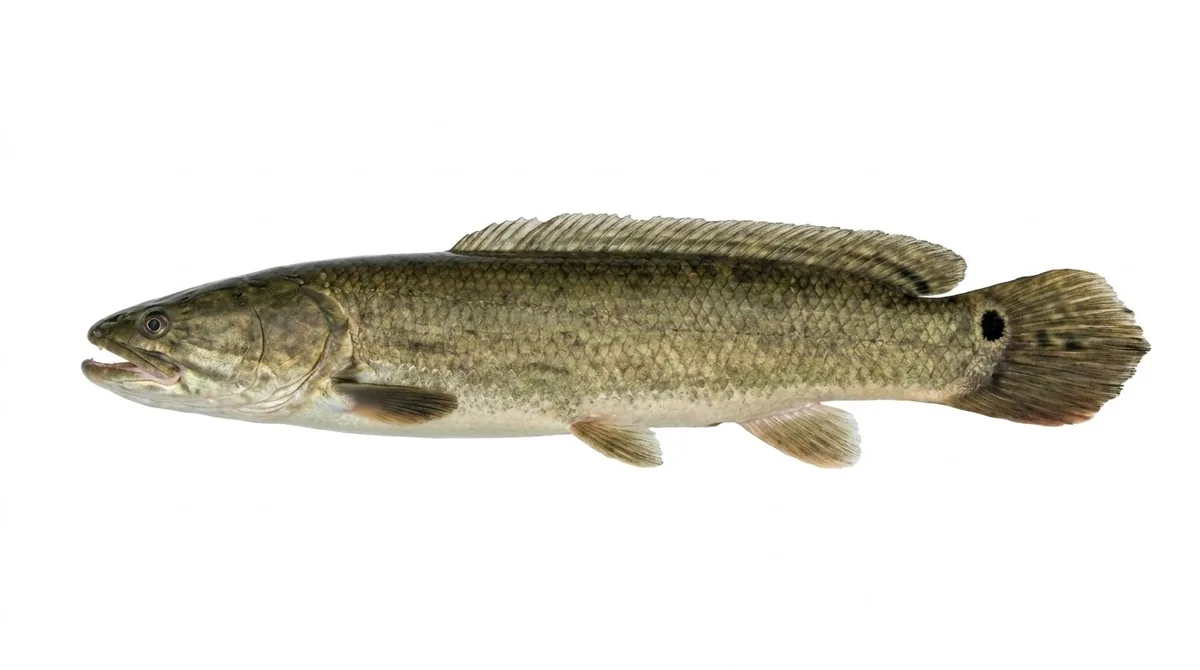
The ruddy bowfin (Amia calva) is a ray-finned fish native to North America. Common names include mudfish, mud pike, dogfish, grindle, grinnel, swamp trout, and choupique. It is regarded as a relict, being one of only two surviving species of the Halecomorphi, a group of fish that first appeared during the Early Triassic, around 250 million years ago. The bowfin is often considered a "living fossil" because they have retained some morphological characteristics of their early ancestors. It is one of two species in the genus Amia, along with Amia ocellicauda, the eyespot bowfin. The closest living relatives of bowfins are gars, with the two groups being united in the clade Holostei.
Bowfins are demersal freshwater piscivores, commonly found throughout much of the eastern United States, and in southern Ontario and Quebec. Fossil deposits indicate Amiiformes were once widespread in both freshwater and marine environments across North and South America, Europe, Asia, and Africa. Now, their range is limited to much of the eastern United States and adjacent southern Canada, including the drainage basins of the Mississippi River, Great Lakes, and various rivers exiting in the Eastern Seaboard or Gulf of Mexico. Their preferred habitat includes vegetated sloughs, lowland rivers and lakes, swamps, and backwater areas; they are also occasionally found in brackish water. They are stalking, ambush predators known to move into the shallows at night to prey on fish and aquatic invertebrates such as crawfish, mollusks, and aquatic insects.
Like gars, bowfin are bimodal breathers—they have the capacity to breathe both water and air. Their gills exchange gases in the water allowing them to breathe, but they also have a gas bladder that serves to maintain buoyancy, and also allows them to breathe air by means of a small pneumatic duct connected from the foregut to the gas bladder. They can break the surface to gulp air, which allows them to survive conditions of aquatic hypoxia that would be lethal to most other species. The bowfin is long-lived, with age up to 33 years reported.
Distribution
Fossil deposits indicate amiiforms included freshwater and marine species that were once widely distributed in North America, South America, Eurasia and Africa. Today, the two species of Amia are the only remaining species in the order Amiiformes; they are demersal freshwater piscivores, and their range is restricted to freshwater environments in North America, including much of the eastern United States and adjacent southern Canada from the St. Lawrence River and Lake Champlain drainage of southern Ontario and Quebec westward around the Great Lakes in southern Ontario into Minnesota.
Historically, their distribution in North America included the drainage basins of the Mississippi River from Quebec to northern Minnesota, the St. Lawrence-Great Lakes, including Georgian Bay, Lake Nipissing and Simcoe, Ontario, south to the Gulf of Mexico; Atlantic and Gulf Coastal Plain from the Susquehanna River drainage in southeastern Pennsylvania to the Colorado River in Texas.
Behaviour
Bowfin are stalking, ambush predators that customarily move into the shallows at night to prey on fish, amphibians, and aquatic invertebrates such as crawfish, other crustaceans, mollusks, and aquatic insects. Young bowfin feed mostly on small crustaceans, while adults are mostly piscivorous, but also known to be opportunistic. Some common examples of prey include frogs, bass, other bowfin, dragonflies, sunfish, crawfish, etc. Bowfin are remarkably agile, can move quickly through the water, and they have a voracious appetite. Their undulating dorsal fin propels them silently through the water while stalking their prey. The attack is straightforward and swift with a movement that lasts approximately 0.075 seconds. There were also some studies regarding the capacity of the bowfin to survive without food. In 1916, a female bowfin was starved for twenty months. It was the longest period that any vertebrate had been without food, as far the writer was aware during the observation. Some independent studies focus on the bowfin's ability to use organic material as a source of food and studied the structure of the gill raker. They concluded that it did not benefit from the organic material in the water because the gill rakers were short with blunt processes and a short space between them. Even bacteria could enter and exit through the gill easily. Its structure alone indicated that the Amia do not use microorganisms as a source of food.
Description from Wikipedia, available under CC BY-SA.
Where the bowfin lives
Distribution data from GBIF (DOI: 10.15468/dl.8rzs8d).
Also known as
- Poisson-castor
- Kahlhechte
- Miękławka
- Bågfena
- Dynnfisk
- Àmia
- Kaproun obecný
- Bogheiteach
- Gola muljarica
- Iszaphal
- Ikan sirip lengkung
- Eðjufiskur
- Dumblažuvės
- Moddersnoeken
- Halecomorfes
- Amiotvaré
- Kel balık
- Cá vây cung
- Ильная рыба
- 아미아고기
- アミア・カルヴァ
- آمية ملساء
- آميا ملساء
- Uzunbelüzgəc balıq
- اوزونبئلاۆزگج
- Амія
- Амия
- کمانباله
- קשות-סנפיר
- Տղմաձուկ
- ამია
- Балчыкчыл балык
- Ами
- ปลาโบว์ฟิน
- Амія мулова
- 弓鳍鱼
Where to catch bowfin
- Arkansas River at Salida United States River · live river data
- Cape Fear River United States River · North Carolina
- Green River (Flaming Gorge) United States River · live river data
- Kenai River United States River · Alaska
- Kentucky Lake United States Reservoir · Kentucky-Tennessee
- Lake Champlain United States Lake · live river data