Fishing Calendar App
American paddlefish
Polyodon spathula
- Freshwater
- Vulnerable
- Max length
- 220 cm
- Class
- Chondrostei
- Order
- Acipenseriformes
- Family
- Polyodontidae
- Genus
- Polyodon
- North America - Inland waters
About the american paddlefish
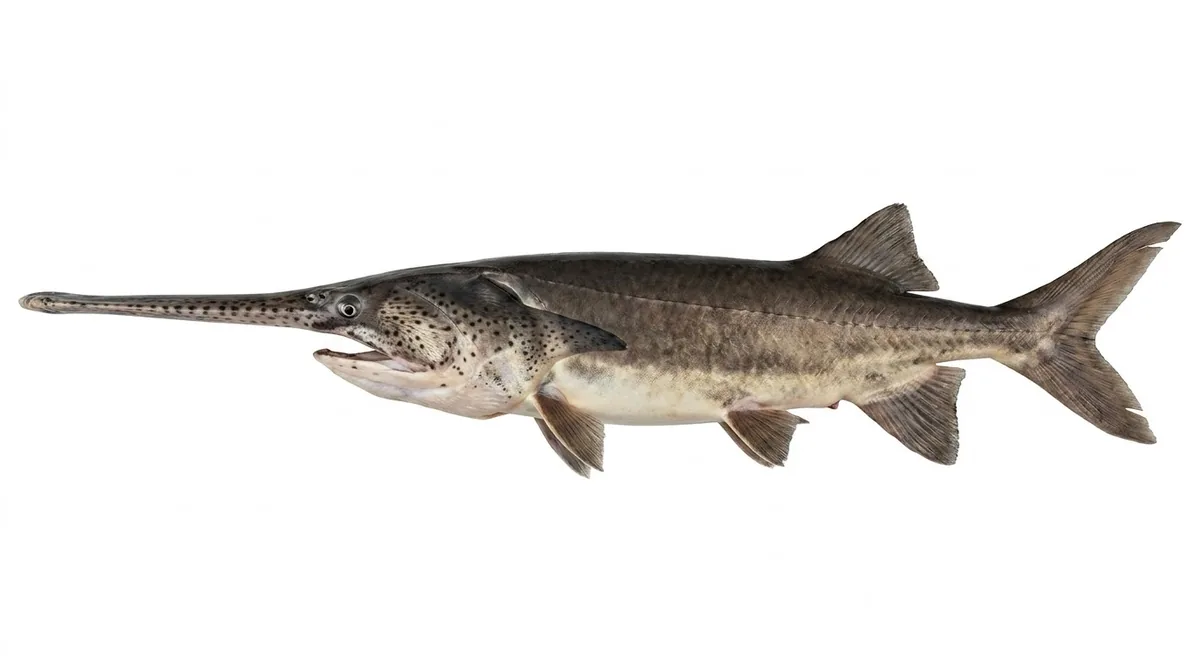
The American paddlefish (Polyodon spathula), also known as a Mississippi paddlefish, spoon-billed cat, or spoonbill, is a species of ray-finned fish. It is the last living species of paddlefish (Polyodontidae). This family is most closely related to the sturgeons; together they make up the order Acipenseriformes, which are one of the most basal living groups of ray-finned fish. Fossil records of other paddlefish species date back 125 million years to the Early Cretaceous, with records of Polyodon extending back 65 million years to the early Paleocene. The American paddlefish is a smooth-skinned freshwater fish with an almost entirely cartilaginous skeleton and a paddle-shaped rostrum (snout), which extends nearly one-third its body length. It has been referred to as a freshwater shark because of its heterocercal tail or caudal fin resembling that of sharks, though it is not closely related. The American paddlefish is a highly derived fish because it has evolved specialised adaptations, such as filter feeding. Its rostrum and cranium are covered with tens of thousands of sensory receptors for locating swarms of zooplankton, its primary food source. The only other species of paddlefish that survived to modern times was the Chinese paddlefish (Psephurus gladius), last sighted in 2003 in the Yangtze River in China and considered to have gone extinct no later than 2010.
The American paddlefish is native to the Mississippi River basin and once moved freely under the relatively unaltered conditions that existed prior to the early 1900s. It commonly inhabited large, free-flowing rivers, braided channels, backwaters, and oxbow lakes throughout the Mississippi River drainage basin, and adjacent Gulf Coast drainages. Its peripheral range extended into the Great Lakes, with occurrences in Lake Huron and Lake Helen in Canada until about 1917. American paddlefish populations have declined dramatically primarily because of overfishing, habitat destruction, and pollution. Poaching has also been a contributing factor to its decline and is liable to continue to be so as long as the demand for caviar remains strong. Naturally occurring American paddlefish populations have been extirpated from most of their peripheral range, as well as from New York, Maryland, Virginia, and Pennsylvania. They have been reintroduced in the Allegheny, Monongahela and Ohio river systems in western Pennsylvania. However, their current range has been reduced to the Mississippi and Missouri River tributaries and Mobile Bay drainage basin. American paddlefish are currently found in twenty-two states in the U.S., and are protected under state, federal and international laws.
Distribution
American paddlefish are highly mobile and well adapted to living in rivers. They inhabit many types of riverine habitats throughout much of the Mississippi Valley and adjacent Gulf slope drainages. They occur most frequently in deeper, low current areas such as side channels, oxbows, backwater lakes, bayous, and tailwaters below dams. They have been observed to move more than 2,000 mi (3,200 km) in a river system.
American paddlefish are endemic to the Mississippi River Basin, historically occurring from the Missouri and Yellowstone rivers in the northwest to the Ohio and Allegheny rivers of the northeast; the headwaters of the Mississippi River south to its mouth, from the San Jacinto River in the southwest to the Tombigbee and Alabama rivers of the southeast. They were extirpated from New York, Maryland and Pennsylvania, as well as from much of their peripheral range in the Great Lakes region, including Lake Huron and Lake Helen in Canada. In 1991, Pennsylvania implemented a reintroduction program utilizing hatchery-reared American paddlefish in an effort to establish self-sustaining populations in the upper Ohio and lower Allegheny rivers. In 1998, New York initiated a stocking program upstream in the Allegheny Reservoir above Kinzua Dam, and a second stocking in 2006 in Conewango Creek, a relatively unaltered section of their historic range. Reports of free ranging adults captured by gill nets have since been documented in Pennsylvania and New York, but there is no evidence of natural reproduction. They are currently found in 22 states in the US, and are protected under state and federal laws. There are 13 states that allow commercial or sport fishing for American paddlefish.
Behaviour
Scientists began to debate the function of the American paddlefish's rostrum when the species was described in the late 1700s. They had once believed it was used to excavate bottom substrate or functioned as a balancing mechanism and navigational aid. However, laboratory experiments in 1993 that utilized advanced technology in the field of electron microscopy have established conclusively that the rostrum of American paddlefish is covered with tens of thousands of sensory receptors. These receptors are morphologically similar to the ampullae of Lorenzini of sharks and rays, and are indeed passive ampullary-type electroreceptors used by American paddlefish to detect plankton. Clusters of electroreceptors also cover the head and operculum flaps. The diet of the American paddlefish consists primarily of zooplankton. Examples of animals in the P. spathula diet are copepods, cladocerans such as Daphnia pulex, and ephemeropteran nymphs. Their electroreceptors can detect weak electrical fields that signal not only the presence of zooplankton, but also the individual feeding and swimming movements of zooplankton appendages. When a swarm of zooplankton is detected, the paddlefish swims forward continuously with its mouth wide open, forcing water over the gill rakers to filter out prey. Such feeding behavior is considered ram suspension-feeding. Further research has indicated that the electroreceptor of the paddlefish may serve as a navigational aid for obstacle avoidance.
American paddlefish have small undeveloped eyes that are directed laterally. Unlike most fishes, American paddlefish hardly respond to overhead shadows or changes in illumination. Electroreception appears to have largely replaced vision as a primary sensory modality, which indicates a reliance on electroreceptors for detecting prey. However, the rostrum is not their only means of food detection. Some reports suggest a damaged rostrum would render American paddlefish less capable of foraging efficiently to maintain good health, but laboratory experiments and field research indicate otherwise. As well as electroreceptors on the rostrum, American paddlefish have sensory pores covering nearly half of the skin surface extending from the rostrum to the top of the head down to the tips of the operculum flaps. Studies have indicated that American paddlefish with damaged or abbreviated rostrums are still able to forage and maintain good health.
Description from Wikipedia, available under CC BY-SA.
Where the american paddlefish lives
Distribution data from GBIF (DOI: 10.15468/dl.8rzs8d).
Also known as
- Mississippi paddlefish
- Spoonbill
- Ameriški veslokljun
- Löffelstör
- Wiosłonos amerykański
- Skedstör
- Peixe-espátula-do-mississippi
- Spatulaire
- Ulam dayung Amérika
- Peix espàtula
- Veslonos americký
- Poliodono
- Lapasampi
- Američka veslokljunka
- Lapátorrú tok
- Ikan dayung amerika
- Amerikaanse lepelsteur
- Pește spatulă
- Kaşık ağızlı mersin balığı
- Веслонос
- 아메리카주걱철갑상어
- ヘラチョウザメ
- رماحة أمريكية
- السمكه ذات المجداف
- Весланос
- আমেরিকান প্যাডেলফিশ
- پوزهپارویی آمریکایی
- חדקן שיניים אמריקאי
- ამერიკული დინგნიჩაბა
- Ескектұмсық
- ปลาฉลามปากเป็ด
- Веслоніс американський
- Cá tầm thìa Mỹ
- 匙吻鱘
Where to catch american paddlefish
- Lake Erie at Cleveland United States Lake · live river data
- Lake Michigan at Chicago United States Lake · live river data
- Table Rock Lake United States Reservoir · live river data
- Arkansas River at Salida United States River · live river data
- Cape Fear River United States River · North Carolina
- Green River (Flaming Gorge) United States River · live river data