Fishing Calendar App
Alligator gar
Atractosteus spatula
- Freshwater
- Least Concern
- Max length
- 300 cm
- Class
- Holostei
- Order
- Lepisosteiformes
- Family
- Lepisosteidae
- Genus
- Atractosteus
- North America - Inland waters
About the alligator gar
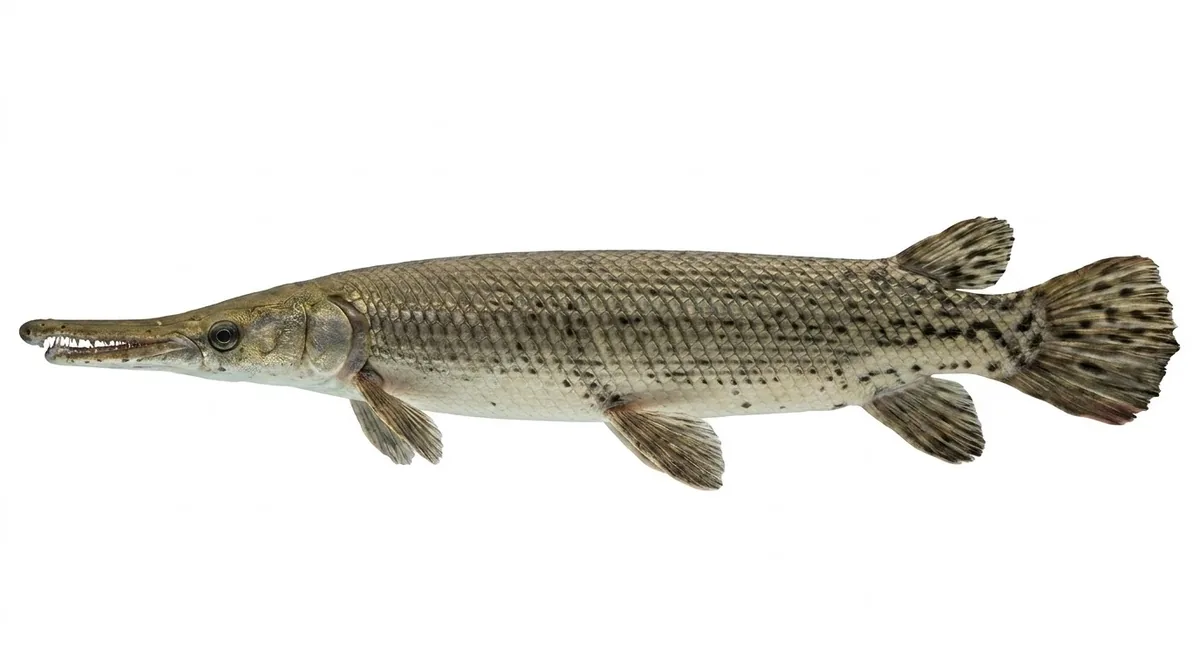
The alligator gar (Atractosteus spatula) is a euryhaline ray-finned fish in the clade Ginglymodi of the infraclass Holostei , being most closely related to the bowfins. It is the largest species in the gar family (Lepisosteidae), and is among the largest freshwater fishes in North America. The fossil record traces its group's existence back to the Early Cretaceous over 100 million years ago. Gars are often referred to as "primitive fishes" or "living fossils", because they have retained some morphological characteristics of their early ancestors, such as a spiral valve intestine, which is also common to the digestive system of sharks, and the ability to breathe in both air and water. Their common name was derived from their resemblance to the American alligator, particularly their broad snouts and long, sharp teeth. It is suggested that an alligator gar can grow up to 10 ft (3.0 m) in length.
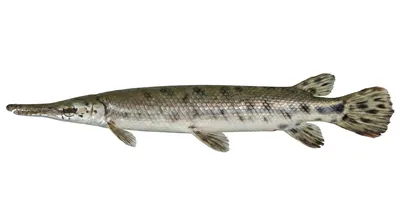
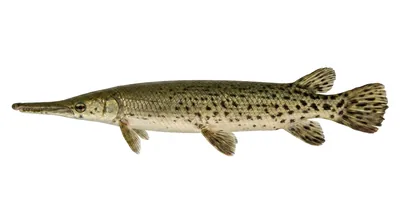
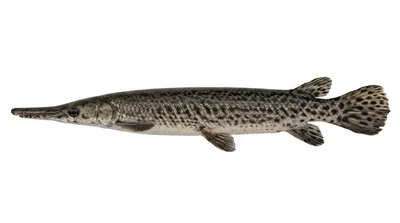
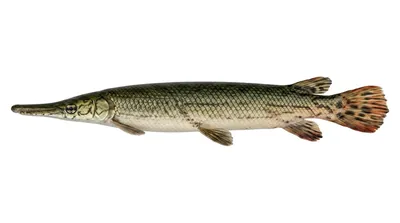
The body of an alligator gar is torpedo-shaped, usually brown or olive colored, fading to a lighter gray or yellow ventral surface. In very rare occurrences, they can also be black, seen in gars that have a high level of melanin. Their scales are not like the scales of other fishes; rather, they are ganoid scales, which are bone-like, rhomboidal-shaped scales, often with serrated edges, and covered by an enamel-like substance. Ganoid scales are nearly impenetrable, and are excellent protection against predation. Unlike other gar species, the upper jaw of an alligator gar has a dual row of large, sharp teeth that are used to impale and hold prey. Alligator gar are stalking, ambush predators, primarily piscivores, but they also ambush and eat waterfowl and small mammals they find floating on the water's surface.
Populations of alligator gar have been extirpated from much of their historic range as a result of habitat destruction, indiscriminate culling, and unrestricted harvests. Populations are now located primarily in the southern portions of the United States extending into Mexico. They are considered euryhaline because they can adapt to varying salinities, ranging from freshwater lakes and swamps to brackish marshes, estuaries, and bays along the Gulf of Mexico.
For nearly a half century, alligator gar were considered "trash fish", or a "nuisance species" detrimental to sport fisheries, and were targeted for elimination by state and federal authorities in the United States. The 1980s brought a better understanding of the ecological balance necessary to sustain an ecosystem, and an awareness that the alligator gar is an important element of the ecosystems they inhabit was eventually understood. Over time, alligator gar were afforded some protection by state and federal resource agencies. They are also protected under the Lacey Act, which makes transporting certain species of fish in interstate commerce illegal when in violation of state law or regulation. Several state and federal resource agencies are monitoring populations in the wild, and have initiated outreach programs to educate the public. Alligator gar are being cultured in ponds, pools, raceways, and tanks by federal hatcheries for mitigation stocking, by universities for research purposes, and in Mexico for consumption.
Distribution
Alligator gar inhabit a wide variety of aquatic habitats, but most are found in the Southern United States in reservoirs and lakes, in the backwaters of lowland rivers, and in the brackish waters of estuaries, bayous, and bays. Gars occur southward along the Gulf Coast of Texas, into Tamaulipas and northern Veracruz, Mexico; however, records from Nicaragua and Costa Rica are considered "suspect and refuted". They have occasionally been seen in the Gulf of Mexico. In Texas and Louisiana, large gars are commonly seen breaking the surface in reservoirs, bayous, and brackish marshes. They are found throughout the lower Mississippi River Valley and Gulf Coast states of the Southern United States and Mexico as far south as Veracruz, and encompassing the following states in the US: Texas, Oklahoma, Louisiana, Kentucky, Mississippi, Alabama, Tennessee, Arkansas, Missouri, Illinois, and Florida. Reports suggest alligator gar were once numerous throughout much of their northern range, but valid sightings today are rare, and may occur once every few years. Records of historical distribution indicate alligator gar once inhabited regions as far north as central Kansas, Nebraska, Ohio, Iowa, and west-central Illinois, where they are now listed as extirpated. The most northerly verified catch was in Meredosia, Illinois, in 1922. In 2016, there were efforts to reintroduce alligator gar between Tennessee and Illinois, as part of an effort to control invasive Asian carp.
Behaviour
Alligator gar are relatively passive, seemingly sluggish solitary fish, but voracious ambush predators. They are opportunistic night predators and are primarily piscivores, but gar will also ambush and eat water fowl, other birds, turtles, and small mammals that may be floating on the surface. Their method of ambush is to float a few feet below the surface, and wait for unsuspecting prey to swim within reach. The gar will then lunge forward, and with a sweeping motion, grab their prey, impaling it on their double rows of sharp teeth.
Diet studies have shown alligator gar to be opportunistic piscivores, and even scavengers depending on the availability of their preferred food source. They occasionally ingest sport fish, but the majority of stomach content studies suggest they feed predominately on forage fishes, such as gizzard shad, as well as invertebrates and water fowl. However, brackish water populations of alligator gar are known to feed heavily on blue crabs, in addition to fish such as the hardhead catfish (Ariopsis felis). Diet studies have also revealed fishing tackle and boat-engine parts in their stomachs.
Description from Wikipedia, available under CC BY-SA.
Where the alligator gar lives
Distribution data from GBIF (DOI: 10.15468/dl.8rzs8d).
Also known as
- Catán
- Alligatorhecht
- Kaimanfisch
- Niszczuka krokodyla
- Alligatorbengädda
- Peixe-jacaré
- Missisipi zirehlisi
- Kostlín obrovský
- Aligátorhal
- Pește aligator
- Timsah balığı
- Миссисипский панцирник
- 앨리게이터가아
- アリゲーターガー
- سمك رمحي تمساحي
- التمساح غار
- Мисисипски зарган
- ماسیی تیمساحی
- سرسوسماری الیگاتوری
- דג האליגטור
- مگرمچھ گاڈ
- അലിഗേറ്റർ ഗർ
- முதலை மீன்
- ปลาอัลลิเกเตอร์
- Панцирник міссісіпський
- 鳄雀鳝
Where to catch alligator gar
- Table Rock Lake United States Reservoir · live river data
- Arkansas River at Salida United States River · live river data
- Cape Fear River United States River · North Carolina
- Green River (Flaming Gorge) United States River · live river data
- Kenai River United States River · Alaska
- Kentucky Lake United States Reservoir · Kentucky-Tennessee