Fishing Calendar App
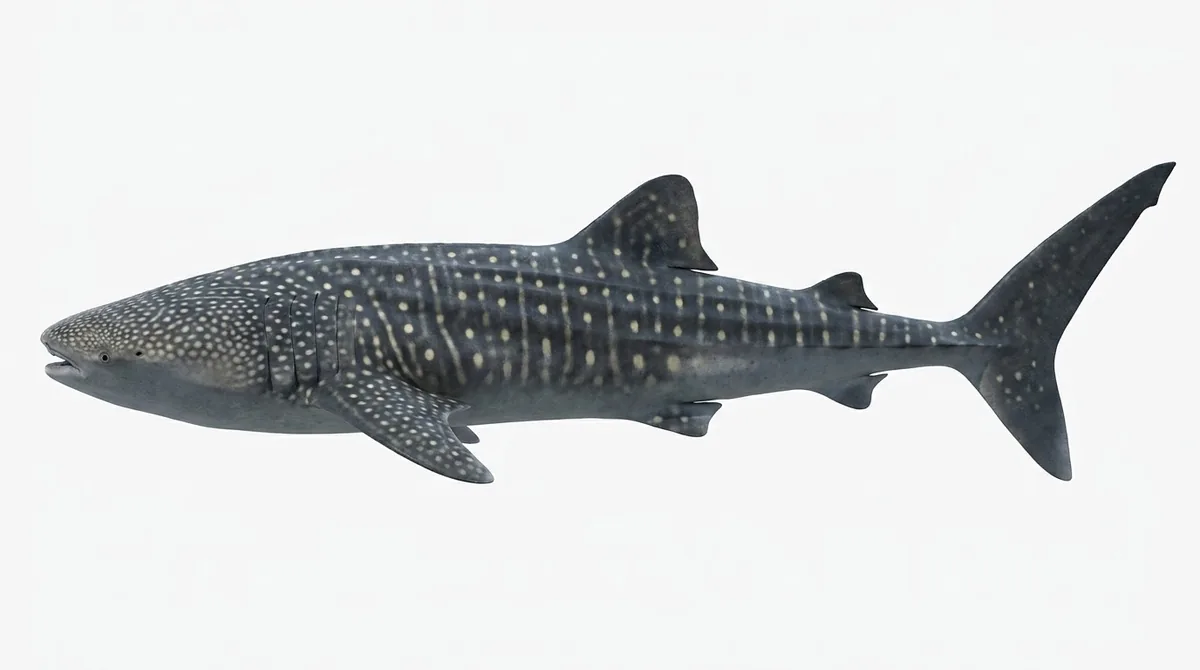
Whale shark
Rhincodon typus
- Saltwater
- Endangered
- Max length
- 1800 cm
- Class
- Elasmobranchii
- Order
- Orectolobiformes
- Family
- Rhincodontidae
- Genus
- Rhincodon
- Indian Ocean, Eastern
- Indian Ocean, Western
- Pacific, Eastern Central
- Pacific, Southeast
- Pacific, Western Central
About the whale shark
The whale shark (Rhincodon typus) is a slow-moving, filter-feeding carpet shark and the largest known extant fish species. An individual with a length of 18.8 m (61.7 ft) has been considered the largest reliably recorded. The whale shark holds many records for size in the animal kingdom, most notably being by far the most massive living non-cetacean animal. It is the only living species of the genus Rhincodon and the only extant member of the family Rhincodontidae, which belongs to the subclass Elasmobranchii in the class Chondrichthyes. Before 1984, it was classified as Rhiniodon into Rhinodontidae. An extinct species, Rhincodon ferriolensis, was described in Europe (probably in Spain), in the Late Burdigalian stage.
The whale shark is an active filter feeder, primarily consuming plankton, krill, fish eggs, and small schooling fish such as sardines and anchovies. The shark can process over 6,000 liters of water per hour through its specialized sieve-like gill pads. Highly migratory, the whale shark travels thousands of miles across tropical oceans to exploit seasonal food sources, with large, predictable feeding aggregations occurring at coastal sites such as Ningaloo Reef in Western Australia, the Yucatan Peninsula in Mexico, and off the coast of Gujarat and Kerala in India. Despite its immense size, the whale shark is docile and poses no significant threat to humans. It is currently listed as an Endangered species on the IUCN Red List owing to a population decline of more than 50% over the last 75 years, primarily as a result of targeted fishing, bycatch in other fisheries, and collisions with large ships.
Whale sharks inhabit the open waters of all tropical oceans. They are rarely found in water below 21 °C (70 °F). The lifespan of a whale shark is estimated to be between 80 and 130 years, based on studies of their vertebral growth bands and the growth rates of free-swimming sharks.
The species was distinguished in April 1828 after the harpooning of a 4.6 m (15 ft) specimen in Table Bay, South Africa. Andrew Smith, a military doctor associated with British troops stationed in Cape Town, described it the following year. The name "whale shark" refers to the animal's appearance and large size; it is a fish, not a mammal, and, like all sharks, is not closely related to whales.
Distribution
The whale shark inhabits all tropical and warm-temperate seas. The fish is primarily pelagic, and can be found in both coastal and oceanic habitats. Tracking devices have shown that the whale shark displays dynamic patterns of habitat utilization, likely in response to availability of prey. Whale sharks observed off the northeast Yucatan Peninsula tend to engage in inshore surface swimming between sunrise and mid-afternoon, followed by regular vertical oscillations in oceanic waters during the afternoon and overnight. About 95% of the oscillating period was spent in epipelagic depths (<200 metres (660 ft)), but whale sharks also took regular deep dives (>500 metres (1,600 ft)), often descending in brief "stutter steps", perhaps for foraging. The deepest recorded dive was 1,928 metres (6,325 ft). Whale sharks were observed to remain continuously at depths of greater than 50 metres (160 ft) for three days or more.
The whale shark is migratory and has two distinct subpopulations: an Atlantic subpopulation, from Maine and the Azores to Cape Agulhas, South Africa, and an Indo-Pacific subpopulation which holds 75% of the entire whale shark population. It usually roams between 30°N and 35°S where water temperatures are higher than 21 °C (70 °F) but have been spotted as far north as the Bay of Fundy, Canada and the Sea of Okhotsk north of Japan and as far south as Victoria, Australia.
Seasonal feeding aggregations occur at several coastal sites such as the Persian Gulf and Gulf of Oman, Ningaloo Reef in Western Australia, Darwin Island in the Galápagos, Quintana Roo in Mexico, Mafia Island of Pwani Region in Tanzania, Inhambane province in Mozambique, the Philippines, around Mahe in the Seychelles, the Gujarat and Kerala coasts of India, Taiwan, southern China and Qatar.
In 2009, more than 400 whale sharks gathered off the Yucatan Coast. It was one of the largest gatherings of whale sharks recorded. Aggregations in that area are among the most reliable seasonal gatherings known for whale sharks, with large numbers occurring in most years between May and September. Associated ecotourism has grown rapidly to unsustainable levels.
Behaviour
Despite their great size, whale sharks pose no danger to humans. Younger whale sharks are gentle and can play with divers. Underwater photographers such as Fiona Ayerst have photographed them swimming close to humans without any danger. Although whale sharks are docile fish, touching or riding the sharks is strictly forbidden and fineable in most countries, as it can cause them serious harm. Divers regularly encounter whale sharks in the Bay Islands in Honduras, Thailand, Indonesia (Bone Bolango, Cendrawasih Bay), the Philippines, the Maldives close to Maamigili (South Ari Atoll), the Red Sea, Western Australia (Ningaloo Reef, Christmas Island), Taiwan, Panama (Coiba Island), Belize, Tofo Beach in Mozambique, Sodwana Bay (Greater St. Lucia Wetland Park) in South Africa, the Galapagos Islands, Saint Helena, Isla Mujeres (Caribbean Sea), La Paz, Baja California Sur and Bahía de los Ángeles in Mexico, the Seychelles, West Malaysia, islands off eastern peninsular Malaysia, India, Sri Lanka, off the coast of Iran's Qeshm and Hengam islands in Persian gulf, Oman, Fujairah, Puerto Rico, and other parts of the Caribbean. Juveniles can be found near the shore in the Gulf of Tadjoura, near Djibouti, in the Horn of Africa.
Description from Wikipedia, available under CC BY-SA.
Where the whale shark lives
Distribution data from GBIF (DOI: 10.15468/dl.8rzs8d).
Also known as
- Basking shark
- East Indian basking shark
- Requin-baleine
- Chagrin
- Walhai
- Valhaj
- Squalo balena
- Kitovec
- Morski pes kitovec
- Dominó
- Tiburón ballena
- Tiburón dama
- Rekin wielorybi
- Tubarão-baleia
- Pintado
- Hvalhai
- Yèe bintang
- Kakia paus
- Rinkin-balum
- Tauró balena
- Žralok obrovský
- Morgi morfilaidd
- Hvalhaj
- Balenŝarko
- Vaalhai
- Marrazo balea
- Valashai
- Waalhei
- Míolsiorc
- Tiburón balea
- Munggiyango hulalo
- Cetcápa
- Hiu paus
- Hvalháfur
- Hiyu paus
- Bangininis ryklys
- Vaļhaizivs
- Antsantsa trozona
- Mango tohorā
- Yu paus
- Waalhai
- Làmia balena
- Qurxumboocuqaa
- Rechin-balenă
- Žralok veľrybí
- Peshkaqeni balenë
- Isdantuko
- Balina köpek balığı
- Cá nhám voi
- Gōng-á-soa
- Walvishaai
- Butanding
- Kitopsina
- 고래상어
- Китовая акула
- ジンベエザメ
- قرش حوتي
- قرش حوتى
- Balina köpəkbalığı
- Китова акула
- তিমি হাঙ্গর
- ཅིང་ཧྲ།
- ފެހުރިހި
- Φαλαινοκαρχαρίας
- کوسهنهنگ
- כריש לווייתני
- Կետաշնաձուկ
- ვეშაპისებრი ზვიგენი
- Кит тәрізді акула
- ह्वेल शार्क
- Кит-ајкула
- തിമിംഗല സ്രാവ്
- Халиман аварга загас
- Łóóʼntsxaaí łikizhígíí
- Гайахуыз акулæ
- ਵ੍ਹੇਲ ਸ਼ਾਰਕ
- ویل شارک
- نهنگی شارک
- Кит ајкула
- திமிங்கலச் சுறா
- ปลาฉลามวาฬ
- Китсыман акула
- Акула китова
- وہیل شارک
- 鲸鲨
- Кітовая акула
- 鯨鯊