Fishing Calendar App
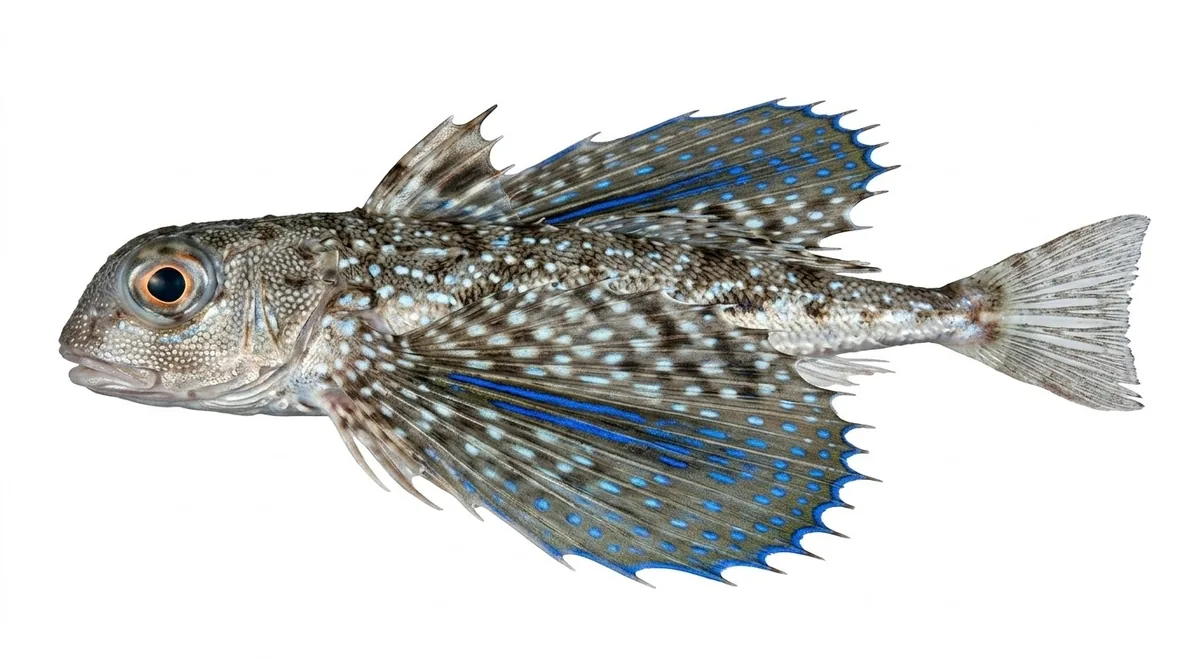
Flying gurnard
Dactylopterus volitans
- Saltwater
- Least Concern
- Max length
- 50 cm
- Class
- Teleostei
- Order
- Dactylopteriformes
- Family
- Dactylopteridae
- Genus
- Dactylopterus
- Atlantic, Eastern Central
- Atlantic, Northwest
- Atlantic, Southwest
- Atlantic, Western Central
- Mediterranean and Black Sea
About the flying gurnard
The flying gurnard (Dactylopterus volitans), also known as the helmet gurnard, is a species of Syngnathiformes fish belonging to the family Dactylopteridae. It is a bottom-dwelling fish that inhabits tropical to warm temperate waters on both sides of the Atlantic.
It is the only species in the genus Dactylopterus making it monotypic. Similar and related species from the genus Dactyloptena are found in the Indian and Pacific Oceans.
Habitat
It is native to the Atlantic Ocean being found on both sides. On the American side, it is found as far north as Massachusetts (exceptionally as far as Canada) and as far south as Argentina, including the Caribbean Sea and Gulf of Mexico. On the European and African side, it ranges from the English Channel to Angola, including the Mediterranean Sea.
Behaviour
The fish's main diet consists of small fish, bivalves, and crustaceans. They will use their pectoral fins to dig into the sediment to access prey items living within the sediments. Then they capture it by using oral suction feeding. When digging, they will typically use only one of their pectoral fins for digging. Each cycle of digging consist of 1-7 cycles of movement which occurs at a frequency of 1.15–3.74 cycles per second. To dig, it will move its fins forwards and then medially above the substrate. It will then twisted it medially and simultaneously depressed so that the anterior ray impacts and enters the substrate. It is then drawn backwards and laterally to disturb the substrate.
Description from Wikipedia, available under CC BY-SA.
Where the flying gurnard lives
Distribution data from GBIF (DOI: 10.15468/dl.8rzs8d).
Also known as
- Helmet gurnard
- Alón volador
- Dactyloptère
- Grondin volant
- Flughahn
- Strwolotka
- Flygknot
- Flygeknurr
- Verat volador
- Pesciu rondina
- Ikan belalang
- Vliegende poon
- Средиземноморский долгопёр
- Долгопер средиземноморский
- Aralıq dənizi uzunüzgəci
- Средиземноморски дългопер
- फ़्लाइंग गर्नार्ड
- خروسکماهی پرنده
- Морски петел
- Морски пјетлић
- Довгопер
- 翱翔真豹魴鮄
- ميج
Where to catch flying gurnard
- Dubrovnik Coast Croatia Coast · Dubrovnik-Neretva
- Istria Coast Croatia Coast · Istria
- Kornati Archipelago Croatia Archipelago · Šibenik-Knin
- Kvarner Gulf Croatia Gulf · Kvarner
- Neretva Delta Croatia Delta · live river data
- Pag Channel Croatia Channel · Zadar