Fishing Calendar App
Bat ray
Myliobatis californica
- Saltwater
- Least Concern
- Max length
- 400 cm
- Class
- Elasmobranchii
- Order
- Myliobatiformes
- Family
- Myliobatidae
- Genus
- Myliobatis
- Pacific, Eastern Central
About the bat ray
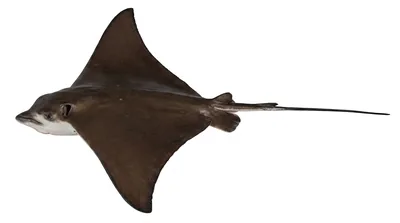
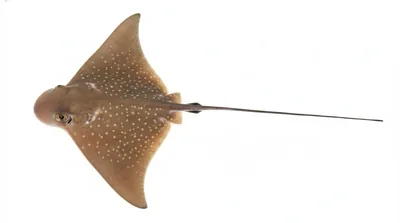
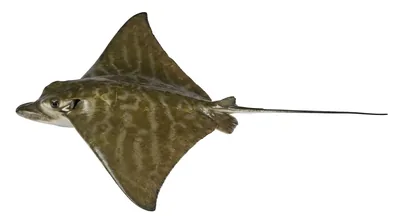
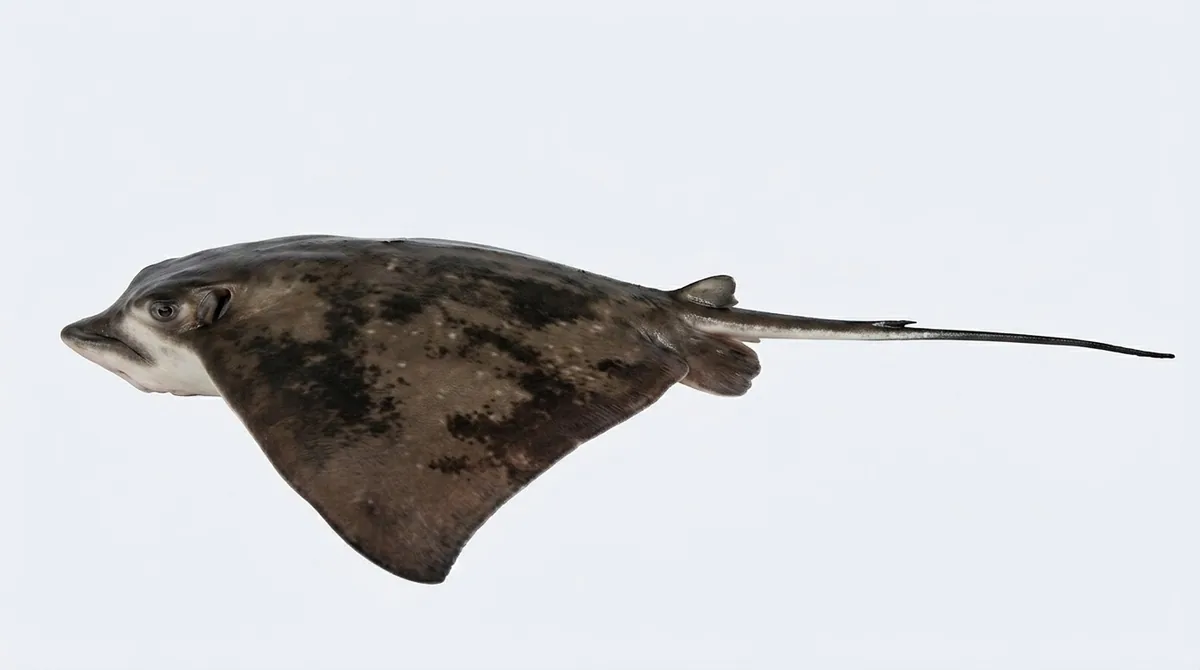
The bat ray (Myliobatis californica) is an eagle ray that has a diamond ray-like form that consists of pectoral fins that are wing-like and end in blunt points. The head is broad and raised higher than the pectoral fins. The eyes are laterally situated on the broad head. Below the front of the head projection is a horizontal depression. This means that instead of the head being flat, there is a slight indent in the top of the head in between the eyes. The tail is whip-like and is typically incomplete with at least one venomous spine at the base of the tail. The incomplete aspect means that the tail consists of cartilage instead of bone. The dorsal side is black or a dark brown while the ventral side is white with the exception of the areas close to the tips or disk. The largest specimens can grow to a wingspan of 1.8 m (5 ft 11 in) and a mass of 91 kg (201 lb). There is a record of this species reaching 240 pounds, however large specimens are typically closer to 200 pounds. They typically range from 9.07–13.61 kg (20.0–30.0 lb). The size of the bat ray is dependent on many factors, such as habitat alterations and different oceanographic and environmental conditions. Some bat rays are solitary, while others form schools numbering in the thousands. There has only been one record of albinism in this species during 1865 off the west coast of Baja California, Mexico.
There has been a record of an abnormal cephalic horn formation in a juvenile male on the coast of Baja California Sur, Mexico. This specimen had a total of three cephalic horns with one in the rostral middle area and two in the cephalic lobe zone. This could indicate morphogenetic plasticity in this species and could be an indication of how evolution of other species occurred. Morphogenetic plasticity is essentially the concept that organisms are able to change their physical structures due to genetic mutations or environmental factors and this can give us more information about the factors that may have caused these changes. Cephalic horns are a flexible projection from the front of the head and can be described as a modified aspect of their pectoral fins. These cephalic horns are used for pushing food into its mouth while feeding. Bat rays typically only have two cephalic horns and they are more reduced as compared to other ray species.
Distribution
The Bat Ray can be found in both tropical and temperate oceans from central Oregon in the USA to Mexico in the Gulf of California. The bat ray (Myliobatis californica) is found in muddy or sandy sloughs, estuaries and bays, kelp beds and rocky-bottomed shoreline. It is also found in the area around the Galápagos Islands. This species can typically be found in flat sections of water with a sand patch in between rocks or with a rocky bottom. They are commonly found in bays and sloughs within the shore area. They can be commonly found around offshore islands including San Clemente, Anacapa, and Santa Rosa. They have been observed during the summer and spring at San Clemente. During March and April they are common in the shallow waters of Santa Rosa. During the summer, they are common in the shallow water around Anacapa Island. Bat rays can live anywhere from the surface to up to 150 feet below the surface and are primarily concentrated within 8 to 100 feet below the surface.
Behaviour
Bat rays feed on mollusks, crustaceans and small fish on the seabed, using their winglike pectoral fins to move sand and expose prey animals. They may also use their snout to dig trenches up to 20 cm deep to expose buried prey, such as clams. Bat rays create pits by excavating the substrate in order to feed upon invertebrates and small fish. These pits can be up to 20 cm deep and 4 m long. By digging up invertebrates, small fish are often attracted to take the chance to opportunistically prey upon these organisms. Bat rays are considered opportunistic generalists which means that they consume the food that is most available to them. These rays are most likely using a type of suction mechanism in order to obtain their smaller prey from the substrate. Bat rays commonly feed upon shellfish, but also feed on clams, polychaetes, crabs, shrimp, Echiuran worms, sea cucumbers, gastropods, ophiuroids, and teleost fishes. Larger rays tend to feed on a wider variety of prey items and also consume a greater amount of large prey items. In Humboldt Bay, clams are the primary food source for bat rays. Echiuran worms are only consumed by adult rays. Clams and crabs are more important food sources for female sub adult rays while polychaetes and shrimp are more important for sub adult males.
Bat ray teeth are flat and pavementlike, forming tightly-packed rows that are used for crushing and grinding prey—the crushed shells are ejected and the flesh consumed. As with all elasmobranchs, these teeth fall out and are replaced continuously. Prey with shells are broken with teeth and then these hard shell parts are spit out while the softer pieces are swallowed. During squid spawning season, they also eat dead or dying squid.
Feeding habits can be altered due to climate shifts or anomalies. When the sea surface temperature increased, Bat Rays in Baja California Sur, Mexico were found to consume more pelagic crabs and peanut worms as compared to their typical crabs and stomatopods. This was due to the increased presence of pelagic crabs in the area which was caused by the increase in water temperature.
Description from Wikipedia, available under CC BY-SA.
Where the bat ray lives
Distribution data from GBIF (DOI: 10.15468/dl.8rzs8d).
Also known as
- Kalifornischer Adlerrochen
- Tecolote
- Garvleiz Kalifornia
- Milana de Califòrnia
- Калифорнийский орляк
- バットレイ
- Калифорнийски орлов скат
- سفرهماهی خفاشی
- טחן קליפורני