Fishing Calendar App
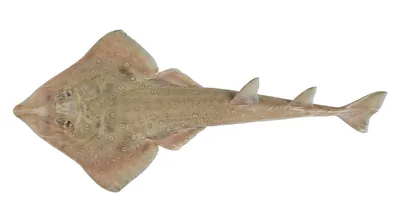
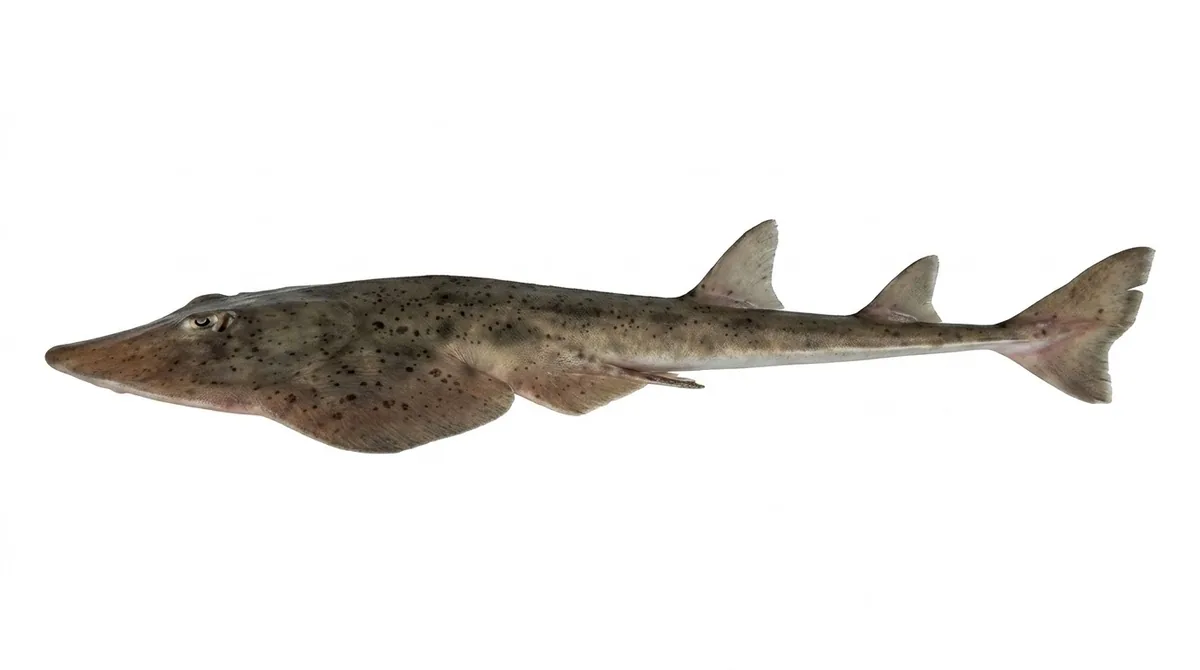
Shovelnose guitarfish
Pseudobatos productus
- Saltwater
- Near Threatened
- Max length
- 170 cm
- Class
- Elasmobranchii
- Order
- Rhinopristiformes
- Family
- Rhinobatidae
- Genus
- Pseudobatos
- Pacific, Eastern Central
About the shovelnose guitarfish
The shovelnose guitarfish (Pseudobatos productus) is a ray in the family Rhinobatidae. P. productus was first described by ichthyologist William Orville Ayre in 1854 as Rhinobatos productus, with the genus derived from the Greek word rhinos, meaning nose, and the Latin word batis, meaning ray. It was later placed in the genus Pseudobatos following reconsideration of many species placed in Rhinobatos. As its common name suggests, this species possesses a pointed shovel-shaped snout and a body similar to that of a guitar with a larger head and long, slender body. The shovelnose is considered to be a primitively developed ray, with many features of both sharks and rays. The shovelnose guitarfish was first considered to be a shark because of its dorsal fins' shape. Fossils of P. productus ancestors have been recovered, dating back over 100 million years.
Distribution
Pseudobatos productus inhabits shallow estuaries and bays of the Mexican Pacific ranging from San Francisco, California to Guerrero, Mexico. Additionally, they are widely distributed in the Gulf of California. Research suggests that La Jolla, California is the preferred residency of adult shovelnose guitarfish. Members of this species are not commonly found in open water and tend to remain in coastal ecosystems such as bays, estuaries as well as seagrass beds at depths of less than 40 feet. There have been sightings of shovelnose guitarfish reaching depths of up to 91 meters, but this is uncommon for the species.
Females migrate to southern California and Baja in spring to spawn and give birth in the early summer months. Males join them to mate soon thereafter, and they will leave the area together. Studies conducted on shovelnose guitarfish in the Gulf of California and the Pacific coast of Baja California have found morphometric variations in the rays. Morphological and genetic variations occur in the mitochondrial DNA in those found in the Gulf of California, evidencing their isolation from the rest. Rhinobatos productus has magnetic particles in its vestibular receptors, and the magnetic particles are believed to be exogenous in origin. The magnetic particles' spatial arrangement may aid in the sensitivity of the receptors to movements.
Behaviour
Shovelnose guitarfish feed on benthic invertebrates including worms, mollusks, crustaceans, cephalopods, and small fish. Much of their diet consists of decapods such as crabs and shrimps. As bottom-feeders, their mouth is on the underside of their body to easily capture food on the ocean floor. Smaller P. productus specimens tend to be more specialized predators, only feeding on crustaceans. Larger specimens have a more generalized diet but still maintain a diet dominated by crustaceans. The diets of males and females are not significantly different; however, the larger size of females allows them to capture larger prey such as fishes and cephalopods[17]. Females mainly consume shrimp-like prey while males prefer crustaceans.
When hunting, this species will use its pectoral fins to bury itself in the sand leaving only its eyes to watch the seafloor. When prey is visible, the fish will quickly ambush and trap its prey beneath its body, immobilizing it while creating a suction with the mouth to chew and ingest. Shovelnose guitarfish are not efficient at capturing fast-moving prey and therefore must maintain a diet of slow-moving organisms.
P. productus plays an important ecological role in their ecosystem by being both a prey and predatory species in coastal marine areas. They consume fish and mollusks, both second-order consumers, and are prey to coastal sharks, large predatory birds and California sea lions. Additionally, this species serves as a host for many tapeworms and parasitic flukes. Common parasitic and commensal species found on shovelnose guitarfish include Acanthobothrium olseni, Parachristianella monomegacantha, Rhinobatonchocotyle cyclovaginatus, Heterocotyle papillata, Spinuris lophosoma, and Norkus cladocephalus.
Description from Wikipedia, available under CC BY-SA.
Where the shovelnose guitarfish lives
Distribution data from GBIF (DOI: 10.15468/dl.8rzs8d).
Also known as
- Rhinobatos productus
- Pazifischer Geigenrochen
- Amerikankitararausku
- Pacifische vioolrog
- シャベルノーズギターフィッシュ
- سوسنمای پوزهبیلچهای
- גיטרן פרודוקטוס
- ปลาโรนันหัวเสียม
- 环吻犁头鳐