Fishing Calendar App
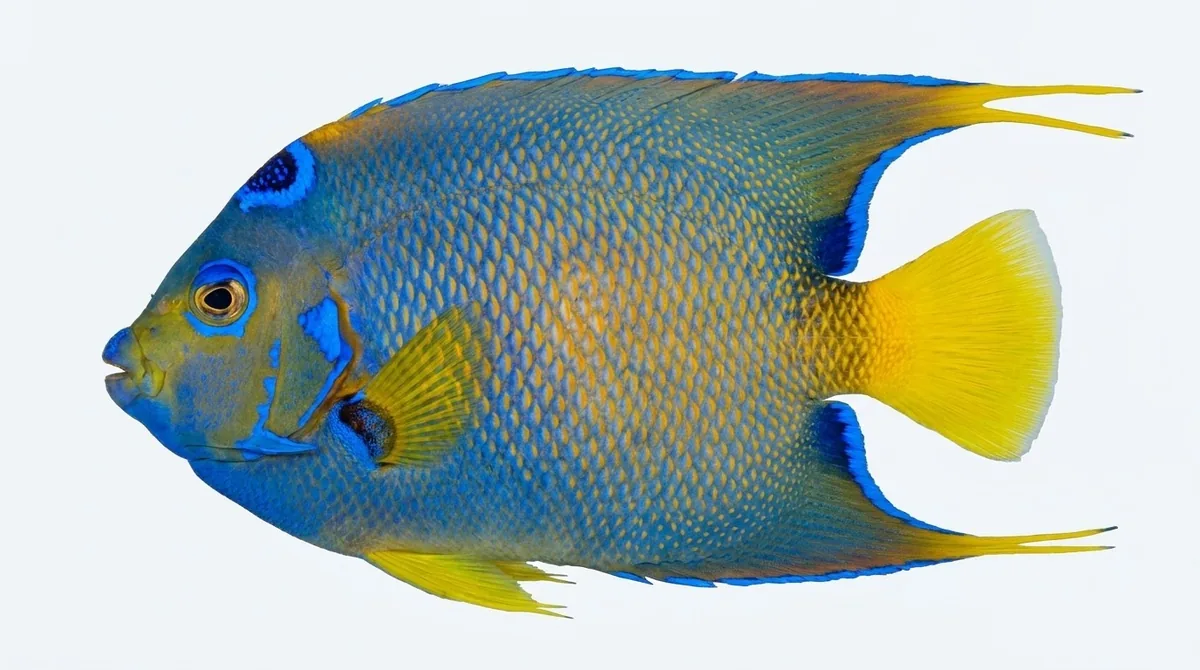
Queen angelfish
Holacanthus ciliaris
- Saltwater
- Least Concern
- Max length
- 45 cm
- Class
- Teleostei
- Order
- Acanthuriformes
- Family
- Pomacanthidae
- Genus
- Holacanthus
- Atlantic, Southwest
- Atlantic, Western Central
About the queen angelfish
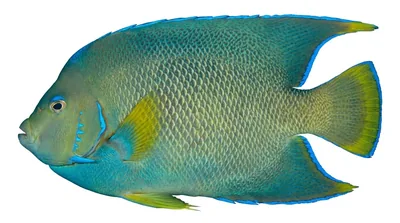
The queen angelfish (Holacanthus ciliaris), also known as the blue angelfish, golden angelfish, or yellow angelfish, is a species of marine angelfish found in the western Atlantic Ocean. It is a benthic (ocean floor) warm-water species that lives in coral reefs. It is recognized by its blue and yellow coloration and a distinctive spot or "crown" on its forehead. This crown distinguishes it from the closely related and similar-looking Bermuda blue angelfish (Holacanthus bermudensis), with which it overlaps in range and can interbreed.
Adult queen angelfish are selective feeders and primarily eat sponges. Their social structure consists of harems which include one male and up to four females. They live within a territory where the females forage separately and are tended to by the male. Breeding in the species occurs near a full moon. The transparent eggs float in the water until they hatch. Juveniles of the species have different coloration than adults and act as cleaner fish.
The queen angelfish is popular in the aquarium trade and has been a particularly common exported species from Brazil. In 2010, the queen angelfish was assessed as least concern by the International Union for Conservation of Nature as the wild population appeared to be stable.
Habitat
Queen angelfish are found in tropical and subtropical areas of the Western Atlantic Ocean around the coasts and islands of the Americas. They occur from Florida along the Gulf of Mexico and the Caribbean Sea down to Brazil. Their range extends as far east as Bermuda and the Saint Peter and Saint Paul Archipelago. Queen angelfish are benthic or bottom-dwelling and occur from shallow waters close to shore down to 70 m (230 ft). They live in coral reefs, preferring soft corals, and swim either alone or in pairs.
Queen angelfish eat sponges, tunicates, jellyfish, corals, plankton, and algae. Juveniles act as cleaner fish and establish and remove ectoparasites from bigger fish. Off St. Thomas Island and Salvador, Bahia, 90% of the diet of adults is sponges. Off the Saint Peter and Saint Paul Archipelago, more than 30 prey species may be consumed, 68% being sponges, 25% being algae, and 5% being bryozoans. Queen angelfish appear to be selective feeders as the proportion of prey in their diet does not correlate with their abundance. On the species level, the angelfish of the Saint Peter and Saint Paul Archipelago target the less common sponges Geodia neptuni, Erylus latens, Clathria calla, and Asteropus niger.
Description from Wikipedia, available under CC BY-SA.
Where the queen angelfish lives
Distribution data from GBIF (DOI: 10.15468/dl.8rzs8d).
Also known as
- Blue angelfish
- Golden angelfish
- Yellow angelfish
- Königin-Engelfisch
- Nefrytek królewski
- Ángel reina
- Anjo-rainha
- Peixe-anjo-rainha
- Enkelikala
- Ангел-королева
- ホクロヤッコ
- سمكة ملاك الملكة
- فرشتهماهی شهبانو
- رانی اشناک مچھی
- இராணி தேவதைமீன்
- 額斑刺蝶魚
Where to catch queen angelfish
- Cape Fear River United States River · North Carolina
- Florida Bay (Everglades) United States Bay · Florida
- Florida Keys United States Coast · Florida
- Galveston Bay United States Bay · Texas
- Lake Pontchartrain United States Lake · Louisiana
- Port Aransas United States Coast · Texas