Fishing Calendar App
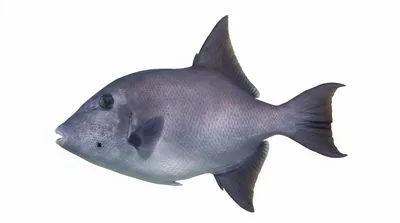
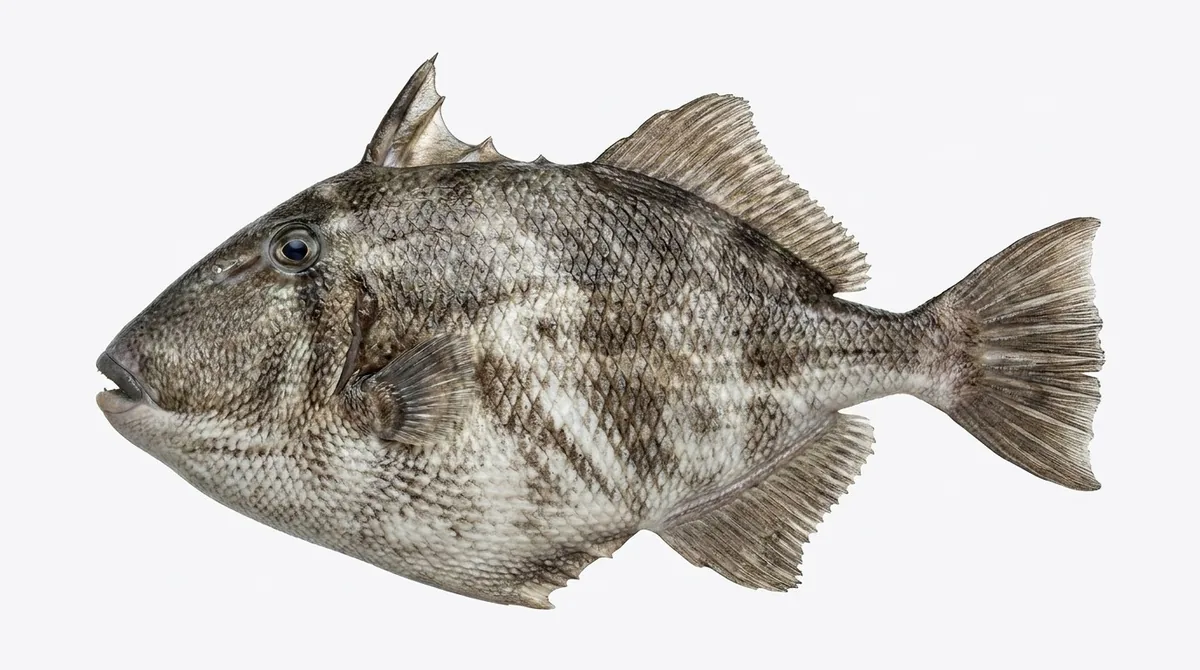
Grey triggerfish
Balistes capriscus
- Saltwater
- Vulnerable
- Max length
- 60 cm
- Class
- Teleostei
- Order
- Tetraodontiformes
- Family
- Balistidae
- Genus
- Balistes
- Atlantic, Eastern Central
- Atlantic, Northeast
- Atlantic, Northwest
- Atlantic, Southwest
- Atlantic, Western Central
- Mediterranean and Black Sea
About the grey triggerfish
The grey triggerfish (Balistes capriscus), or gray triggerfish, is a species of ray-finned fish in the triggerfish family Balistidae, the triggerfishes. The species is native to shallow parts of the western Atlantic from Nova Scotia to Argentina and also the eastern Atlantic, the Mediterranean Sea and off Angola on the west coast of Africa.
In its appearance and habits, the grey triggerfish is a typical member of the genus Balistes except for its drab, uniformly grey colouration. It is a relatively small fish, usually less than 2.3 kg (5.1 lb) in weight. It is fished recreationally and despite its tough skin, is an excellent food-fish. The species is classified as 'vulnerable' by the IUCN Red List.
Distribution
The grey triggerfish is principally a fish of shallow waters in the western Atlantic Ocean. Its native range extends from Nova Scotia to the Caribbean Sea, the Gulf of Mexico and Bermuda, and southwards to Argentina. It is typically found over hard bottoms on reefs and rocky areas, in lagoons and in bays, at depths down to about 55 m (180 ft). It is also found on the other side of the Atlantic, around the British Isles, in the Mediterranean Sea and off the coast of Angola. It may have crossed the Atlantic as a result of the movement of water in the Gulf Stream and breeds in the Mediterranean.
Once considered to be an uncommon visitor to northern European seas, an increase in records around the Cornish coast, may indicate it is now breeding there; in addition, it has been found in other areas along the coast of Great Britain in recent years, suggesting that its range is continuing to expand northwards, with one caught as far north as the island of Tiree in the Inner Hebrides, Scotland.
Behaviour
Locomotion in the grey triggerfish is by means of undulations of the dorsal fins. If threatened, the fish can work its way into a protective crevice and wedge itself in place by erecting its front dorsal spine. It is difficult to dislodge from this position. The second spine is connected to the first and when it is depressed, it triggers the unlocking of the first spine.
The grey triggerfish is a demersal species and feeds on bottom-dwelling invertebrates such as shrimps, crabs, molluscs, sea urchins, sand dollars, starfish and sea cucumbers. It has strong teeth specialised for making holes in hard-shelled prey. An interesting feeding behaviour has been observed, in which the fish positions itself vertically above a sandy seabed and puffs a stream of water out of its mouth. This disturbs the substrate and may reveal something edible. Further puffs expose more, and the prey item is gripped with the fish's sharp teeth and removed from the seabed. If it is a sand dollar, the fish drops it and picks it up again several times until the prey lands upside down. The fish then adopts its vertical stance once more and attacks the middle with closed jaws, crushing the soft central area. It then scoops out and devours the flesh.
Males develop a charcoal grey colouration and are highly territorial during the breeding season, which commences in summer when the water temperature reaches about 21 °C (70 °F). The males prepare up to a dozen nests in hollows blown out of sandy seabed and then patrol the area, driving unwanted fish away. The females roam around inspecting the nest sites. When a female is ready to spawn, both male and female enter a nest and tightly circle round each other while she lays large numbers of minute eggs and he fertilises them. The female stays in the nest, guarding the eggs and blowing and fanning them. The male defends his territory, which may contain other nests with females guarding their eggs. In this way, the male exhibits harem behaviour. Wrasses and red snappers sometimes feed on the eggs which, if they survive that long, hatch after about fifty hours. The fish larvae migrate up towards the surface of the water where they often become part of the community depending on floating sargassum weed. There they feed on algae, barnacles, hydroids and polychaete worms. In the autumn, when they reach about 15 cm (6 in), the juvenile fish leave the sargassum and sink down to the sea bed.
Description from Wikipedia, available under CC BY-SA.
Where the grey triggerfish lives
Distribution data from GBIF (DOI: 10.15468/dl.8rzs8d).
Also known as
- Gray triggerfish
- Leather-jacket
- Triggerfish
- Turbot
- Pejepuerco blanco
- Pez ballesta
- Baliste
- Baliste capri
- Baliste commun
- Grauer Drückerfisch
- Rogatnica
- Gråtryckarfisk
- Cangulo
- Avtrekkerfisk
- Balestra
- Surer
- Pysgodyn Clicied
- Baleztarrain
- Porsassäppikala
- Porquiño
- Papakulu
- Grijze trekkervis
- Çotira
- Kostorog
- Серый спинорог
- Рыба курок
- ネズミモンガラ
- قادوح رمادي
- سمك الخنزير
- Γουρουνόψαρο
- Спиноріг європейський
- 灰鱗魨
Where to catch grey triggerfish
- Dubrovnik Coast Croatia Coast · Dubrovnik-Neretva
- Istria Coast Croatia Coast · Istria
- Kornati Archipelago Croatia Archipelago · Šibenik-Knin
- Kvarner Gulf Croatia Gulf · Kvarner
- Neretva Delta Croatia Delta · live river data
- Pag Channel Croatia Channel · Zadar