Fishing Calendar App
Dorado
Salminus brasiliensis
- Freshwater
- Least Concern
- Max length
- 130 cm
- Class
- Teleostei
- Order
- Characiformes
- Family
- Bryconidae
- Genus
- Salminus
- South America - Inland waters
About the dorado
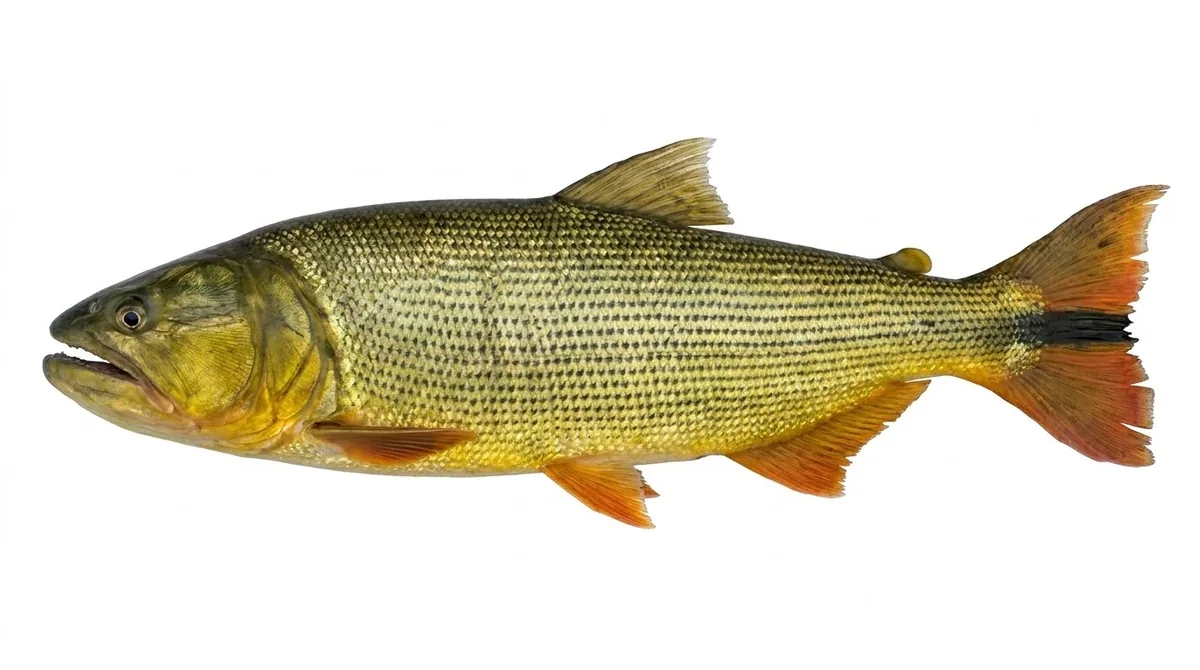
Salminus brasiliensis, also known as the golden dorado, dorado, river tiger, dourado, or jaw characin, is a large, predatory characiform freshwater fish found in central and east-central South America. Despite having Salminus in its name, the dorado is not related to any species of salmon, nor to the saltwater fish also called "dorado". It is very popular among recreational anglers and supports large commercial fisheries.
Distribution
The golden dorado is native to warm freshwater habitats in southern Brazil, Paraguay, Uruguay, Bolivia and northern Argentina. Here it inhabits the Paraguay (including the Pantanal), Paraná, Uruguay, Chapare, Mamoré and Guaporé River basins, and the drainage of the Lagoa dos Patos. Outside its native range, the golden dorado has been introduced to several southeast Brazilian river basins, notably Doce, Paraíba do Sul, Iguazu and Guaraguaçu.
Other South American river basins hold relatives of this species: S. franciscanus in the São Francisco Basin, S. hilarii in the upper Paraná, Amazon and Orinoco Basins, and S. affinis in the Santiago and Magdalena Basins in Ecuador and Colombia.
The golden dorado generally prefers water temperatures between 20 and 28 °C (68–82 °F). It is migratory in response to temperature, season, and food sources, and moves upstream, typically about 400 km (250 mi), to spawn in the spring and summer. It is generally a solitary species, but migrates in groups. The females reach maturity when 4–5 years old and can lay up to 2 million eggs, which are released near the water surface. Golden dorados can live more than 15 years.
Behaviour
Golden dorados are the apex predators in their freshwater habitat. They are primarily piscivores, eating a wide variety of fish, but have also been recorded feeding on large insects, crustaceans, and small vertebrates (for example, rodents, lizards, and birds). One of the adult dorado's favorite prey is the streaked prochilod (Prochilodus lineatus), a species of schooling fish that also is migratory.
In the larval stage, golden dorados feed on plankton. As they grow larger, they switch to insects and small fish. At up to 30 cm (12 in) long, juveniles are aggressive mimics of Brycon hilarii in both general shape and color, often staying near schools of this frugivorous species to be able to surprise smaller prey fish such as Astyanax and Moenkhausia tetras. In contrast, adult dorados have been known to eat Brycon hilarii.
Description from Wikipedia, available under CC BY-SA.
Where the dorado lives
Distribution data from GBIF (DOI: 10.15468/dl.8rzs8d).
Also known as
- Golden dorado
- Jaw characin
- River tiger
- Dourado
- Pirajuba
- Piraju
- ドラド
- דוראדו זהוב
- ปลาแซลมอนทองคำ
- 大顎小脂鯉