Fishing Calendar App
Bluefish
Pomatomus saltatrix
- Saltwater
- Vulnerable
- Max length
- 130 cm
- Class
- Teleostei
- Order
- Scombriformes
- Family
- Pomatomidae
- Genus
- Pomatomus
- Atlantic, Eastern Central
- Atlantic, Northeast
- Atlantic, Northwest
- Atlantic, Southeast
- Atlantic, Southwest
- Atlantic, Western Central
- Indian Ocean, Eastern
- Indian Ocean, Western
- Mediterranean and Black Sea
- Pacific, Southwest
- Pacific, Western Central
About the bluefish
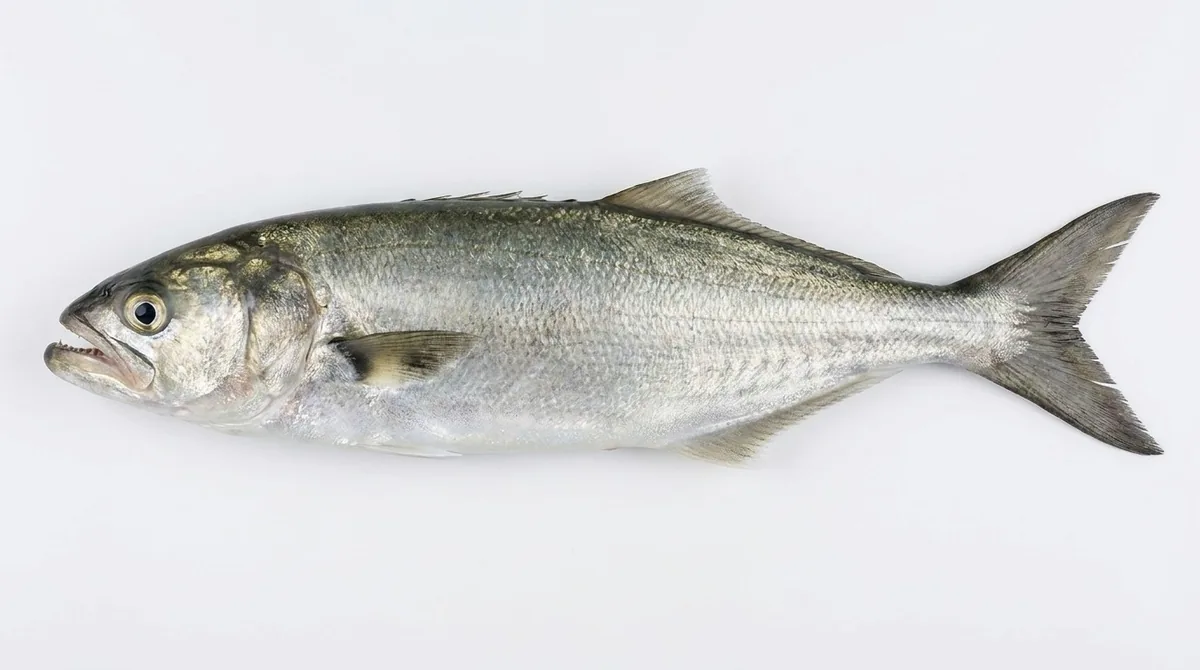
The bluefish (Pomatomus saltatrix) is the only extant species of the family Pomatomidae. It is a marine pelagic fish found around the world in temperate and subtropical waters, except for the northern Pacific Ocean. Bluefish are known as tailor in Australia and New Zealand, elf and shad in South Africa. It is a popular gamefish and food fish.
The bluefish is a moderately proportioned fish, with a broad, forked tail. The spiny first dorsal fin is normally folded back in a groove, as are its pectoral fins. Coloration is a grayish blue-green dorsally, fading to white on the lower sides and belly. Its single row of teeth in each jaw is uniform in size, knife-edged, and sharp. Bluefish commonly range in size from "snappers" of 7 in (18 cm) to much larger, sometimes weighing as much as 40 lb (18 kg), though fish heavier than 20 lb (9 kg) are exceptional.
Distribution
Bluefish are widely distributed around the world in tropical and subtropical waters. They are found in pelagic waters on much of the continental shelves along eastern America (though not between south Florida and northern South America), Africa, the Mediterranean and Black Seas (and during migration in between), Southeast Asia, and Australia. They are found in a variety of coastal habitats: above the continental shelf, in energetic waters near surf beaches, or by rock headlands. They also enter estuaries and inhabit brackish waters. Periodically, they leave the coasts and migrate in schools through open waters. Along the U.S. East Coast, bluefish are found off Florida in the winter. By April, they have disappeared, heading north. By June, they may be found off Massachusetts; in years of high abundance, stragglers may be found as far north as Nova Scotia. By October, they leave the waters north of Cape Cod, heading south down the East Coast of the United States from Rhode Island south to Georgia, to the waters off Florida. Some bluefish, perhaps less migratory, are present in the Gulf of Mexico throughout the year. In a similar pattern overall, the economically significant population that spawns in Europe's Black Sea migrates south through Istanbul (Bosphorus, Sea of Marmara, Dardanelles, Aegean Sea) and on toward Turkey's Mediterranean coast in the autumn for the cold season. A campaign was launched in Turkey by Fikir Sahibi Damaklar (Intelligent Palates) to protect the Bluefish. This was reported on in 2013. More recently, it was reported that bluefish near Istanbul were abundant and that there is a fishing ban every year between April 15 - Sept. 1 to preserve fish eggs and ensure sustainable fish farming. Along the South African coast and environs, movement patterns are roughly in parallel.
Behaviour
Adult bluefish are strong and aggressive, and live in loose groups. They are fast swimmers that prey on schools of forage fish, and continue attacking them in feeding frenzies even after they appear to have eaten their fill. Depending on area and season, they favor menhaden and other sardine-like fish (Clupeidae), jacks (Scombridae), weakfish (Sciaenidae), grunts (Haemulidae), striped anchovies (Engraulidae), shrimp, and squid. They are cannibalistic and can destroy their own young. Bluefish sometimes chase bait through the surf zone, attacking schools in very shallow water, churning the water like a washing machine. This behavior is sometimes referred to as a "bluefish blitz".
In turn, bluefish are preyed upon by larger predators at all stages of their lifecycle. As juveniles, they fall victim to a wide variety of oceanic predators, including striped bass, larger bluefish, fluke (summer flounder), weakfish, tuna, sharks, rays, and dolphins. As adults, bluefish are taken by tuna, sharks, billfish, seals, sea lions, dolphins, porpoises, and many other species.
Bluefish are aggressive and have been known to inflict severe bites on fishermen. Wading or swimming among feeding bluefish schools can be dangerous. In July 2006, a seven-year-old girl was attacked on a beach, near the Spanish town of Alicante, allegedly by a bluefish. In New Jersey, the large beachfeeder schools are very common and lifeguards report never having seen bluefish bite bathers in their entire careers.
Description from Wikipedia, available under CC BY-SA.
Where the bluefish lives
Distribution data from GBIF (DOI: 10.15468/dl.8rzs8d).
Also known as
- Snapper
- Serra
- Anchova de banco
- Anjova
- Anjova de banco
- Tassergal
- Blaufisch
- Lufar
- Blåfisk
- Anchova
- Dyphavsabbor
- Skakavka
- Elf
- Tallahams
- Lufara dravá
- Iasc gorm
- Vérengző makrahal
- Melsvieji ešeriai
- Trondrove
- Blauwbaars
- Isdang bughaw
- Lüfer
- Bleu pexhon
- Sinikala
- Луфарь
- Луфарь обыкновенный
- 파란농어
- オキスズキ
- سمكة زرقاء
- سمكه زرقاء
- Лефер
- Γοφάρι
- آبیماهی
- גומבר טורף
- ლუფარი
- பொமட்டோமைடீ
- Луфар
- 扁鰺
Where to catch bluefish
- Dubrovnik Coast Croatia Coast · Dubrovnik-Neretva
- Istria Coast Croatia Coast · Istria
- Kornati Archipelago Croatia Archipelago · Šibenik-Knin
- Kvarner Gulf Croatia Gulf · Kvarner
- Neretva Delta Croatia Delta · live river data
- Pag Channel Croatia Channel · Zadar