Fishing Calendar App
Swordfish
Xiphias gladius
- Saltwater
- Near Threatened
- Max length
- 450 cm
- Class
- Teleostei
- Order
- Carangiformes
- Family
- Xiphiidae
- Genus
- Xiphias
- Atlantic, Northeast
- Atlantic, Northwest
- Atlantic, Southeast
- Atlantic, Southwest
- Atlantic, Western Central
- Indian Ocean, Eastern
- Indian Ocean, Western
- Mediterranean and Black Sea
- Pacific, Southeast
- Pacific, Southwest
About the swordfish
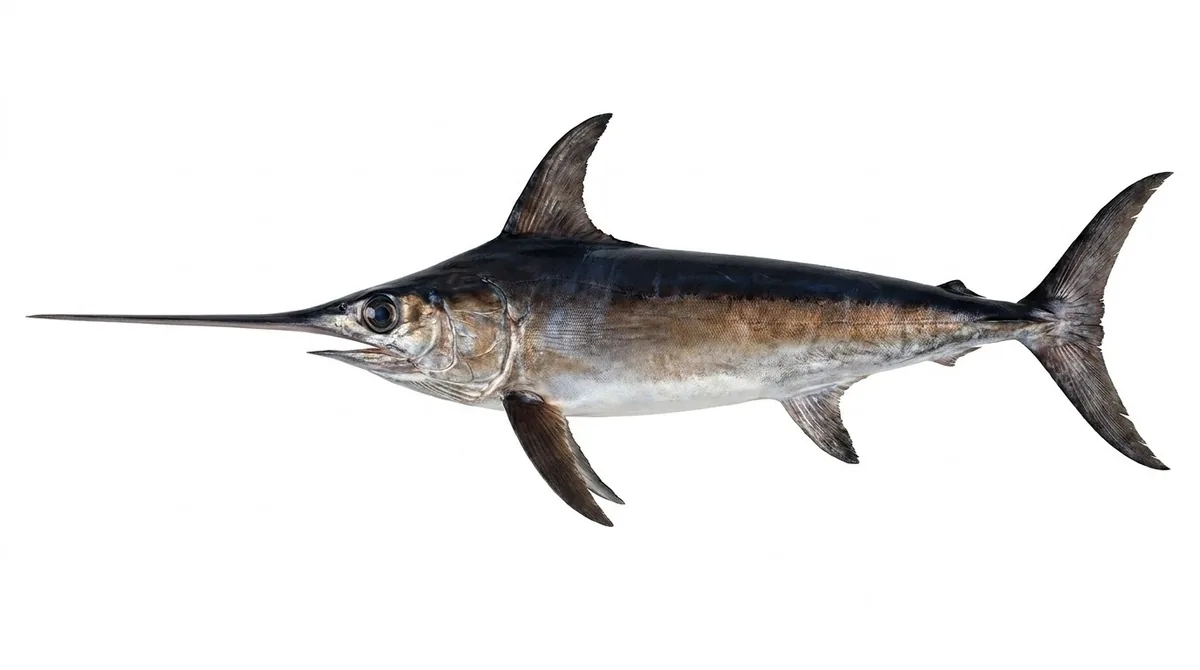
The swordfish (Xiphias gladius), also known as the broadbill in some countries, are large, highly migratory predatory fish characterized by a long, flat, pointed bill. They are the sole member of the family Xiphiidae. They are a popular sport fish of the billfish category. Swordfish are elongated, round-bodied, and lose all teeth and scales by adulthood. These fish are found widely in tropical and temperate parts of the Atlantic, Pacific, and Indian Oceans, and can typically be found from near the surface to a depth of 550 m (1,800 ft), and exceptionally up to depths of 2,878 m (9,442 ft). They commonly reach 3 m (10 ft) in length, and the maximum reported is 4.55 m (14 ft 11 in) in length and 650 kg (1,430 lb) in weight.
Behaviour
The popular image of the swordfish skewering its prey with its nose is based on little evidence. In a typical environment, swordfish most likely use their noses to slash at prey and inflict weakening injuries. The hypothesis that they may use their noses as spears in a defensive capacity against sharks and other predators is still under review.
Mainly, the swordfish relies on its great speed and agility in the water to catch its prey. It is no doubt among the fastest fish, but the basis for the frequently-quoted speed of 100 km/h (60 mph) is unreliable. Research on related marlin (Istiophorus platypterus) suggest a maximum value of 36 km/h (22 mph) is more likely.
Swordfish are not schooling fish. They swim alone or in very loose aggregations, separated by as much as 10 m (35 ft) from a neighboring swordfish. They are frequently found basking at the surface, airing their first dorsal fin. Boaters report this to be a beautiful sight, as well as the powerful jumping for which the species is known. This jumping, also called breaching, may be an effort to dislodge pests, such as remoras or lampreys. Swordfish prefer water temperatures between 18 and 22 °C (64 and 72 °F), but have the widest tolerance among billfish, and can be found from 5 to 27 °C (41 to 81 °F). This highly migratory species typically moves towards colder regions to feed during the summer. Swordfish feed daily, most often at night, when they rise to surface and near-surface waters in search of smaller fish. During the day, they commonly occur to depths of 550 m (1,800 ft; 300 fathoms) and have exceptionally been recorded as deep as 2,878 m (9,442 ft; 1,574 fathoms). Adults feed on a wide range of pelagic fish, such as mackerel, barracudinas, silver hake, rockfish, herring, and lanternfishes, but they also take demersal fish, squid, and crustaceans. In the northwestern Atlantic, a survey based on the stomach content of 168 individuals found 82% had eaten squid and 53% had eaten fish, including gadids, scombrids, butterfish, bluefish, and sand lance. Large prey are typically slashed with the sword, while small are swallowed whole.
Description from Wikipedia, available under CC BY-SA.
Where the swordfish lives
Distribution data from GBIF (DOI: 10.15468/dl.8rzs8d).
Also known as
- Swordfish sucker
- Broadbill
- Espadon
- Schwertfisch
- Svärdfisk
- Pesce spada
- Pisci spada
- Mečarica
- Pez espada
- Włócznik
- Miecznik
- Ryba miecz
- Espadarte
- Agulha
- Sverdfisk
- Thôk kojèk
- Swaardvis
- Ulam pedang
- Beg-sabrenn
- Emperador
- Malasugi
- Mečoun obecný
- Pysgodyn cleddyf
- Sværdfisk
- Spadfiŝo
- Mõõkkala
- Ezpata-arrain
- Miekkakala
- Colgán
- Peixe espada
- Kardhal
- Espad-fisho
- Sverðfiskur
- Iwak pedhang
- Durklažuvė
- Zobenzivs
- Trondro sabatra
- Pisce spata
- Zwaardvis
- Pește spadă
- Pisci spata
- Kılıç balığı
- Imbelu
- Iglun
- Todak
- 황새치
- Меч-рыба
- Сабленка
- Саблянка
- メカジキ
- أبو سيف
- ابو سيف
- قیلینج بالیغی
- Риба меч
- شمشێرماسی
- ތުންގަނޑު ހިބަރު
- Ξιφίας
- شمشیرماهی
- דג-חרב
- შიმშერი
- Семсер балық
- ಕತ್ತಿ ಮೀನು
- Селебебалык
- തള മീൻ
- Łóóʼ bíchį́į́h nineezí
- ସ୍ୱୋର୍ଡ ମାଛ
- Кардгæсаг
- تلوار مچھی
- வாள் மீன்
- ปลากระโทงดาบ
- Кылычбалык
- Риба-меч
- Cá kiếm
- 剑旗鱼科
- 剑旗鱼
- 劍魚
Where to catch swordfish
- Dubrovnik Coast Croatia Coast · Dubrovnik-Neretva
- Istria Coast Croatia Coast · Istria
- Kornati Archipelago Croatia Archipelago · Šibenik-Knin
- Kvarner Gulf Croatia Gulf · Kvarner
- Neretva Delta Croatia Delta · live river data
- Pag Channel Croatia Channel · Zadar