Fishing Calendar App
Cigar wrasse
Cheilio inermis
- Saltwater
- Least Concern
- Max length
- 50 cm
- Class
- Teleostei
- Order
- Eupercaria incertae sedis
- Family
- Labridae
- Genus
- Cheilio
- Indian Ocean, Eastern
- Indian Ocean, Western
- Pacific, Eastern Central
- Pacific, Northwest
- Pacific, Southwest
- Pacific, Western Central
About the cigar wrasse
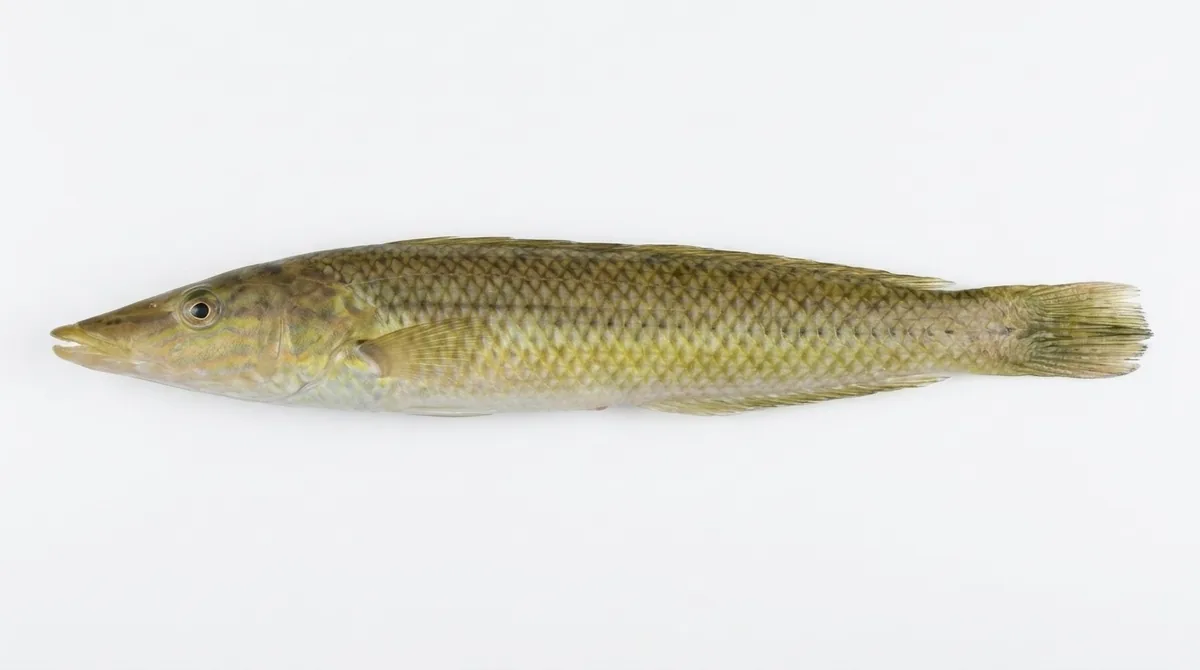
The cigar wrasse, Cheilio inermis, is a species of wrasse native to the Indo-Pacific Ocean. They are usually about 10cm in length, with some rare reports of cigar wrasses growing to be 50 cm. They have a long cylindrical, eel-like body shape referred to as anguilliform and have elongated dorsal and anal fins. They are often seen off the coast of Australia, the eastern seaboard of Africa, and India. They are primarily observed in, and occupy, reef habitats. Their coloration can vary widely to include yellow, brown, white, black, red, and stripes of all colors. Juvenile cigar wrasses have the same coloration as adults, but tend to have more pronounced stripes. It is unknown whether there is a difference in appearance between the female and the male.
This species is very understudied with only a few papers documenting their life history, distribution, and biology.
Distribution
The cigar wrasse is native to the Indian and Pacific Oceans. Cigar wrasse live primarily in seagrass within shallow reefs. They have been observed in abundance feeding in canopy macroalgae habitats as well. They primarily feed during the summer, but remain in the same algae meadows during the winter. Both adults and juveniles are found in abundance in seagrass beds during all seasons. They can be found in soft coral reefs that are close to sandy seagrass beds as well as other habitats in close proximity to the seagrass beds they frequent. Cigar wrasses have a special affinity for finding and remaining in habitats that surround seagrass. It serves as their primary habitat, providing them protection from predators as well as nutrition. They have also been observed in large abundance along the perimeter of their primary habitat, feeding and hiding.
Other species of wrasses have been observed at a depth of 10 meters and it is unknown whether, or not the cigar wrasse differs in this behavior. Since wrasse tend to occupy more shallow areas such as reefs and algae meadows, they are normally observed close to shore and in large groups. Wrasse are relatively stationary fish and remain within a home range for their entire lives. For many species, including the cigar wrasse, they do not stray far from the seagrass bed where they hatched.
Behaviour
Cigar wrasse diet depends heavily on their location. In Amitori Bay they have been observed feeding on gastropods and smaller fishes, while in Nagura Bay their diet consisted of mostly shrimp. While the body size of cigar wrasse can differ in populations across the Indo-Pacific, between 4.4cm to 14.8cm, all sizes are seen in each habitat; therefore, researchers do not attribute differences in diet to size.
Description from Wikipedia, available under CC BY-SA.
Where the cigar wrasse lives
Distribution data from GBIF (DOI: 10.15468/dl.8rzs8d).
Also known as
- Longue girelle
- Labre cigare
- Zigarren-Lippfisch
- Sigaar-lipvis
- Lubayan
- Lamboso
- Ilgoji lūpažuvė
- Tsenaby
- カマスベラ
- زمردماهی سیگار
- Хейлио
- 管唇鱼
- سمكة السيجار