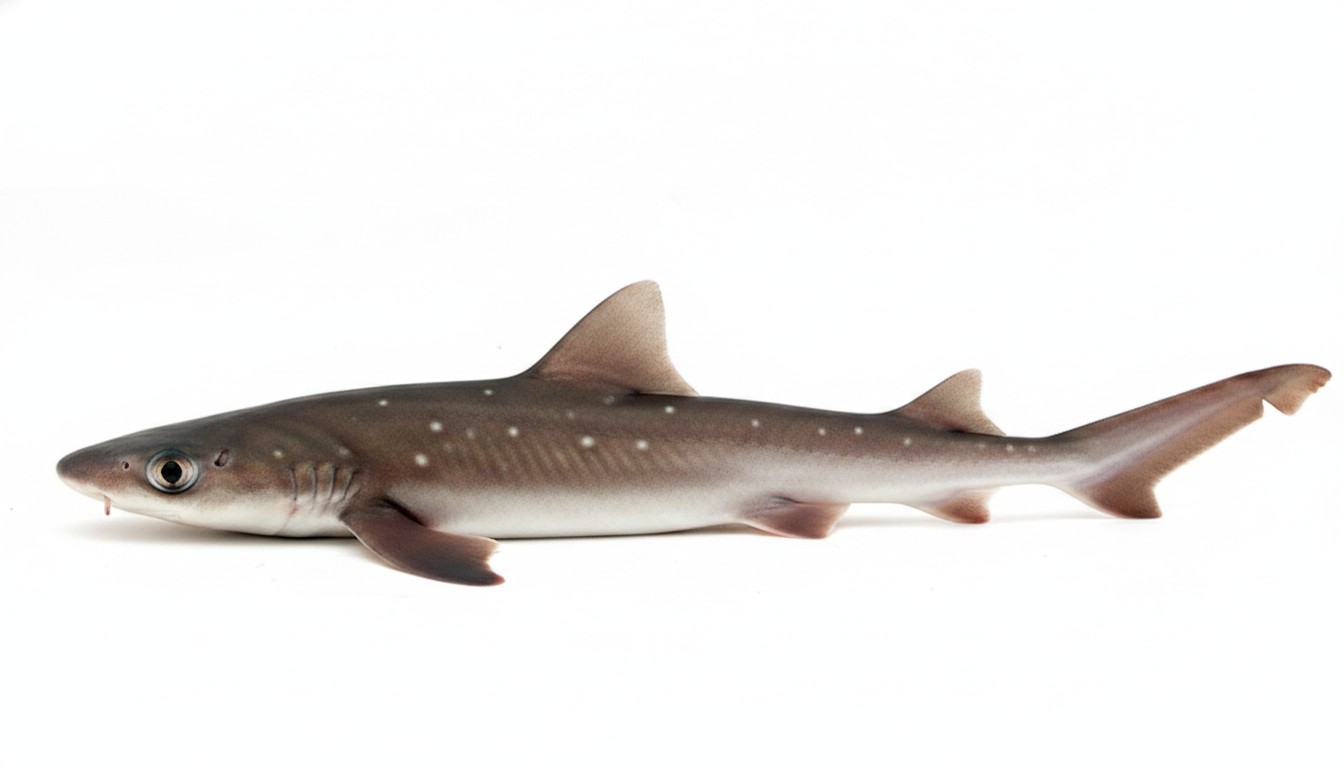
The spiny dogfish (Squalus acanthias), spurdog, mud shark, or piked dogfish is one of the best-known species in the Squalidae (dogfish) family of sharks, which is part of the order Squaliformes. While these common names may apply to several species, Squalus acanthias is distinguished by two spines (one located anterior to each dorsal fin) and no anal fin. It inhabits shallow and offshore waters in most parts of the world, especially in temperate waters. Those in the northern Pacific Ocean were reevaluated in 2010 and found to constitute a separate species, now called the Pacific spiny dogfish (Squalus suckleyi).
Distribution: Squalus acanthias fossils are known from the Miocene of Denmark and the Netherlands, dating from approximately 11 million years ago. As with other cartilaginous fish, the fossil record of Squalus acanthias consists predominantly of dental material, as cartilage does not fossilize well. The teeth of S. acanthias can be hard to differentiate from those of other squaliforme sharks, making identification difficult.
Behaviour: The spiny dogfish has dorsal fins, no anal fin, and white spots along its back. The caudal fin has asymmetrical lobes, forming a heterocercal tail. The species name acanthias refers to the shark's two spines. These are used defensively. If captured, the shark can arch its back to pierce its captor with spines near the dorsal fins that secrete a mild venom into its predator. This shark is known to hunt in packs that can range up into the thousands. They are aggressive hunters and have a sizable diet that can range from squid, fish, crab, jellyfish, sea cucumber, shrimp and other invertebrates. Dogfish sharks experience one of the longest gestation periods of any organism, which can last from around 18 to 24 months. During spawning season, which occurs during the colder months of winter, females can lay anywhere from 2 to 12 eggs, which develop ovoviviparously and the pups are birthed as live young, with about 5 to 6 in each litter of pups, mainly depending on the size of the female. Reproduction occurs in the winter in offshore waters, while pups are normally born in the warmer and deeper offshore waters where it is harder for humans and predators to reach them. The reproductive cycle begins when females produce several large eggs of yellow coloring, which become fertilized once they pass through the shell gland and are wrapped in what is called a "candle", or a kind of reproductive capsule. One can determine if an egg is fertilized when the blastoderm is visible. The candle passes through the rest of the reproductive tract until it reaches the uterus. Attached to the gill region of the pup is a yolk sac which provides nutrients for them as they develop, which they absorb as they grow. Even after fully absorbing the yolk sac, the pups may live in the uterus for a period of time afterwards during the gestation period. Both sexes are greyish brown in color and are countershaded. Males are identified by a pair of pelvic fins modified as sperm-transfer organs, or "claspers". The male inserts one clasper into the female cloaca during copulation. In females the size of ova and the state of uteri determines whether sexual maturity has been reached, while in males, clasper length and calcification is the determination factor. Many of the growth patterns show an isometric growth pattern, as the pups have very similar features to the adults. Sexual maturity does not match body size development, they mature quite earlier than one would expect. Most males reach sexual maturity at an earlier ages of around 10 years, growing to be about 60–65 cm (24-26 in) in length. Females take a longer period of time, around 16 years, to reach sexual maturity, and can grow to about 80-84 cm (31-33 in) at that time. Some dogfish have been seen to live nearly 70 years, but the average lifespan is around 30–40 years. Male Spiny dogfish use their claspers to impregnate females, which take time to develop properly, and before reaching sexual maturity, tend to be longer than their pelvic fins. During this time, the testes develop, but no sperm will exist inside until later stages are reached, and genital ducts are deformed compared to adult ducts. Once the adult stage is reached, claspers have elongated, and are now hardened with calcium and are still slightly longer than their pelvic fin. At this point testes are fully developed, and sperm exist within the seminal vesicles, and genital ducts conform to a twisted shape we commonly see in adults. Spiny dogfish are bottom-dwellers. They are commonly found at depths of around 50–149 m (160–490 ft), but have been found deeper than 700 m (2,300 ft). Life span estimates based on analysis of vertebral centra and annuli in the dorsal spines range from 35 to 54 years.
Description text from Wikipedia, available under CC BY-SA.
Log species, size, bait and conditions. Build your personal fishing diary.
Details are for general reference and may be incomplete or inaccurate. Images are illustrative and may not accurately represent the species. Never rely on this information to decide whether a fish is safe to eat or handle.
