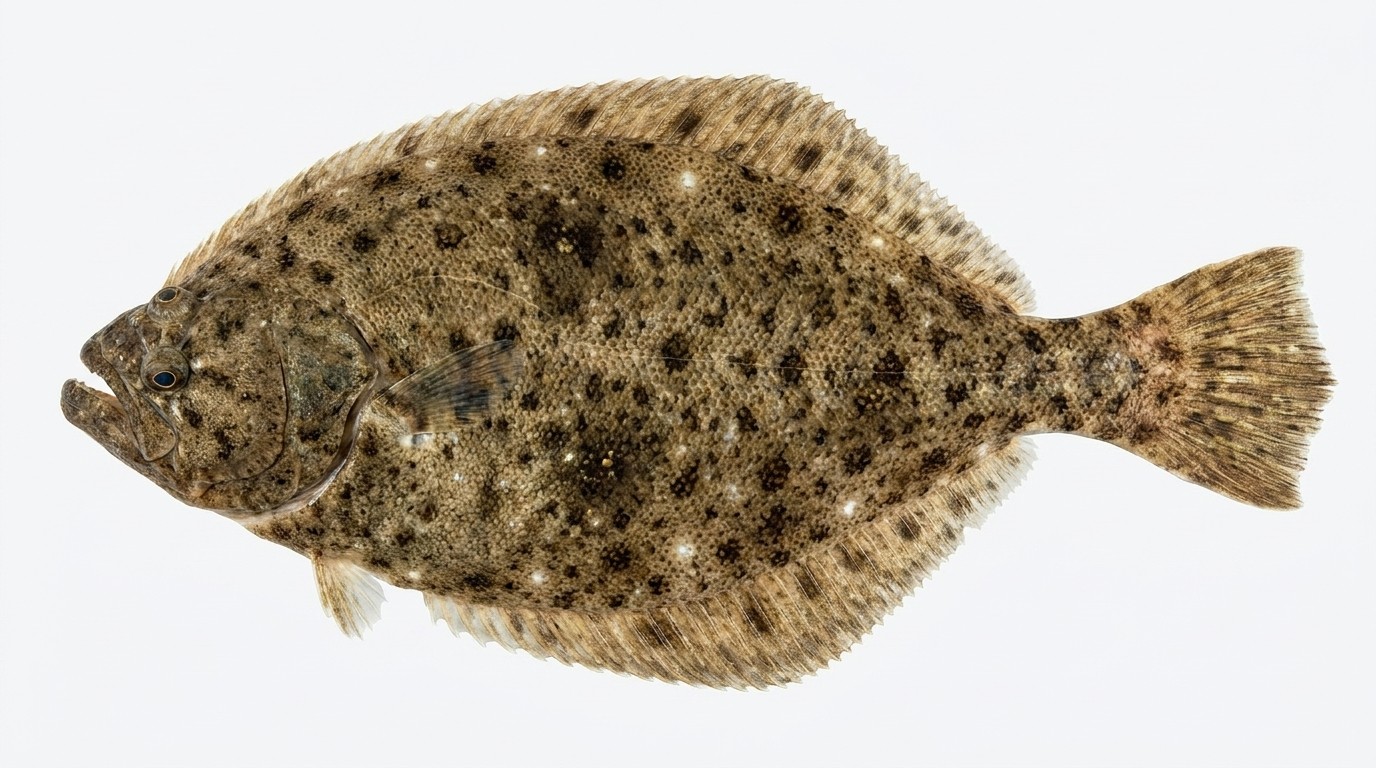
The California halibut or California flounder (Paralichthys californicus) is a large-tooth flounder native to the waters of the Pacific Coast of North America from the Quillayute River in Washington to Magdalena Bay in Baja California Sur. This is a demersal fish, living primarily in the lower water column as adults. They inhabit near shore regions and are free swimming. This is an unusual fish in that one eye migrates around from one side to the other as it grows from an upright fry or baby fish into an adult fish that lies on its side. This results in the adult fish having two eyes on the up-side as it lies on the ocean floor. Most flatfish are generally either right-eyed or left-eyed dominant, but the California halibut is unusual in having a roughly even number of each type. Like other flatfish, the halibut hides under sand or loose gravel, camouflaging into the sea floor. They are aggressive predators, using this camouflage to effectively ambush prey such as fishes and invertebrates.
Distribution: The geographic range for California halibut extends from the Quillayute River in northern Washington to Cabo Falsa (22°50'N) in southern Baja California, Mexico. Halibut have also been reported in the upper Gulf of California. They are most commonly encountered within Bodega Bay, northern California, to Bahía de San Quintín, northern Baja California. In association with warm water events, halibut are occasionally common in Humboldt Bay. Within these regions, adult California halibut reside on the seabed, in shallow water areas. However, they are known to go as deep as 317 m.
Behaviour: Halibut are carnivorous ambush predators that feed on fishes and invertebrates. They lie camouflaged in sediment and will swim up off the seabed to feed on schooling fish and invertebrates such as northern anchovy and market squid. While common prey items vary with geographic location and life stage, other prey generally include species of shrimps, crabs, croakers, flatfish, gobies, herring, mackerel, midshipman, sand lance, saury, sculpins, silversides, and surfperch. Larger adult halibut are considered a cryptic top predator in the benthic community since this aggressive and carnivorous predator is often elusive in nature and are at a low risk of predation due to their relatively large adult size. Other than humans, marine mammals and larger shark species have been documented to eat adult halibut. However, during juvenile stages, halibut have more predators and are likely eaten by a wide variety of species such as sharks and rays, osprey, cormorants, and terns, and marine mammals such as seals, sea lions, and dolphins.
Description text from Wikipedia, available under CC BY-SA.
Log species, size, bait and conditions. Build your personal fishing diary.
Details are for general reference and may be incomplete or inaccurate. Images are illustrative and may not accurately represent the species. Never rely on this information to decide whether a fish is safe to eat or handle.
