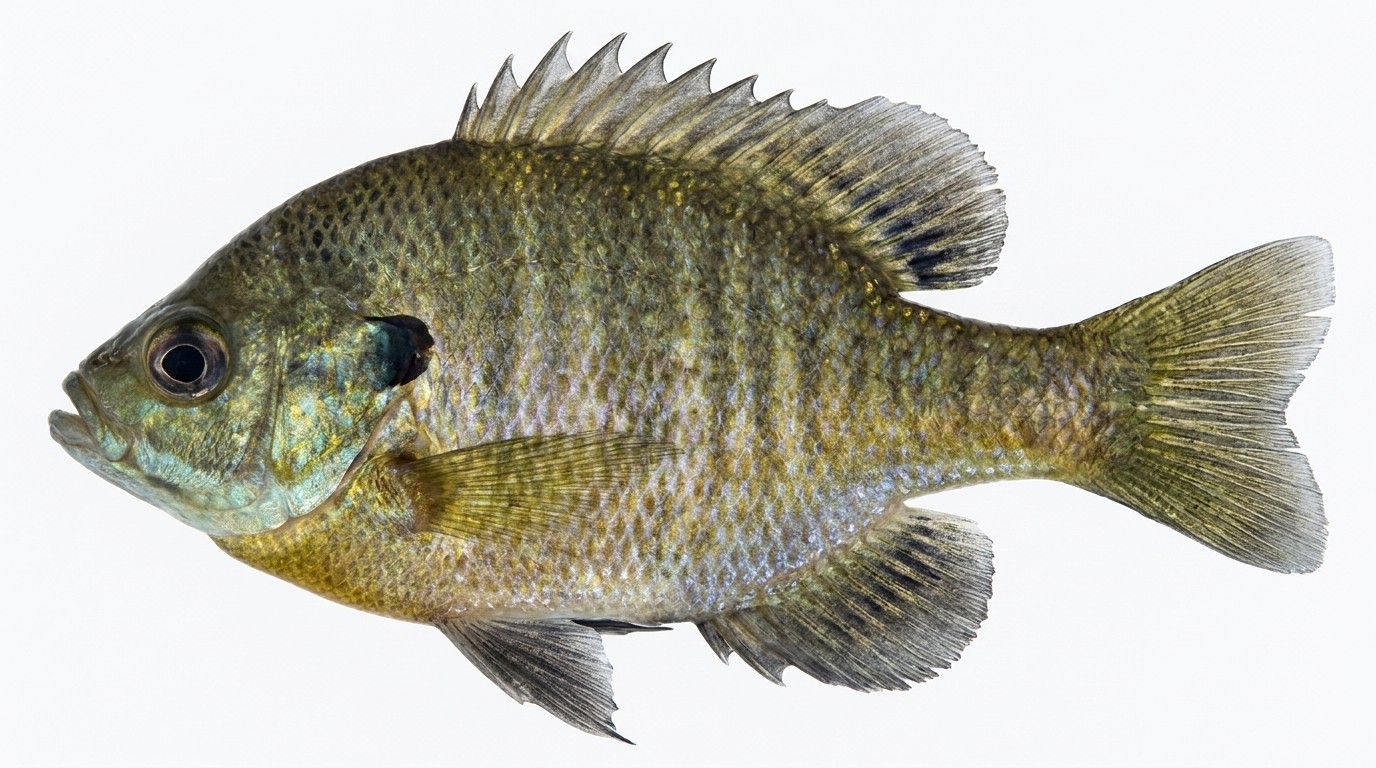
The bluegill (Lepomis macrochirus), sometimes referred to as "bream", "brim", "sunny", or, in Texas, "copper nose", is a species of North American freshwater fish, native to and commonly found in streams, rivers, lakes, ponds and wetlands east of the Rocky Mountains. It is the type species of the genus Lepomis (true sunfish), from the family Centrarchidae (sunfishes, crappies and black basses) in the order Centrarchiformes. Bluegills can grow up to 16 in (41 cm) long and about 4+1⁄2 lb (2.0 kg). While their color can vary from population to population, they typically have a very distinctive coloring, with deep blue and purple on the face and gill cover, dark olive-colored bands down the side, and a fiery orange to yellow belly. They are omnivorous and will consume anything they can fit in their mouth, but mostly feed on small aquatic insects and baitfishes. The fish are important prey for bass, other larger sunfish, northern pike and muskellunge, walleye, trout, herons, kingfishers, snapping turtles and otters, and play a key role within the food chain of its freshwater ecosystem. A popular panfish among anglers, bluegill usually hide around and inside old tree stumps in swamps and other underwater structures (e.g. snags), and can live in either deep or very shallow water. Bluegills also like to find shelter among aquatic plants and in the shade of trees along banks, and will often move from one cover to another depending on the time of day or season.
Distribution: The bluegill occurs naturally in the United States east of the Rocky Mountains from coastal Virginia to Florida, west to Texas and northern Mexico, and north to western Minnesota, New York and southeastern Ontario. They have been introduced widely in North America and Europe, South Africa, Zimbabwe, Asia, South America, and Oceania. Bluegills have also been found in the Chesapeake Bay, indicating they can tolerate up to 1.8% salinity. In some locations where they have been transplanted, they are considered pests: trade in the species is prohibited in Germany and Japan. In the case of Japan, bluegills were presented to the then-crown prince, Akihito, in 1960 as a gift by Richard J. Daley, mayor of Chicago. The prince, in turn, donated the fish to fishery research agencies in Japan, from which they escaped and became an invasive species that wreaked havoc with native species, especially in Lake Biwa. Akihito has since apologized. Bluegill live in the shallow waters of many lakes and ponds, along with streams, creeks, and rivers. They prefer water with many aquatic plants, and seclude themselves within or near fallen logs, water weeds or any other structure (natural or manmade) that is under water. They can often be found around weed beds, where they search for food or spawn. In the summer, adults move to deep, open water where they suspend just below the surface and feed on plankton and other aquatic creatures. Bluegill try to spend most of their time in water from 60 to 80 °F (16 to 27 °C), and tend to have a home range of about 320 square feet (30 m2) during nonreproductive months. They enjoy heat, but do not like direct sunlight – they typically live in deeper water, but will linger near the water surface in the morning to stay warm. Bluegill are usually found in schools of 10 to 20 fish, and these schools will often include other panfish, such as crappie, pumpkinseeds, and smallmouth bass.
Behaviour: Young bluegills' diet consists of rotifers, copepods, water fleas, and insects (mainly chironomids). The adult diet consists of aquatic insect larvae (mayflies, caddisflies, dragonflies), but can also include terrestrial insects, zooplankton, shrimp, crayfish, leeches, other worms, snails, and other small fish (such as minnows). If food is scarce, bluegill will also feed on aquatic vegetation and algae, and if scarce enough, will even feed on their own eggs or offspring. As bluegill spend a great deal of time near the surface of water, they can also feed on surface bugs. Most bluegills feed during daylight hours, with a feeding peak being observed in the morning and evening (with the major peak occurring in the evening). Feeding location tends to be a balance between food abundance and predator abundance. Bluegill use gill rakers and bands of small teeth to ingest their food. During summer months, bluegills generally consume 3.2 percent of their body weight each day. To capture prey, bluegills use a suction system in which they accelerate water into their mouth. Prey comes in with this water. Only a limited amount of water is able to be suctioned, so the fish must get within 1.75 centimeters of the prey.
Description text from Wikipedia, available under CC BY-SA.
Log species, size, bait and conditions. Build your personal fishing diary.
Details are for general reference and may be incomplete or inaccurate. Images are illustrative and may not accurately represent the species. Never rely on this information to decide whether a fish is safe to eat or handle.
